

[비즈한국] Cross Finance Korea, an online investment-linked finance (P2P) firm that was undergoing pre-rehabilitation M&A, now faces bankruptcy. The Seoul Bankruptcy Court recently decided to terminate Cross Finance's rehabilitation proceedings. The firm faced a 72.4 billion won unpaid settlement crisis in August 2024 due to the misappropriation of funds by its payment gateway (PG) firm, Lumen Payments. Since then, the company had been maintaining its corporate status with a minimum workforce to pursue debt collection and repayments, but with the suspension of the rehabilitation process, it is effectively on the brink of bankruptcy.
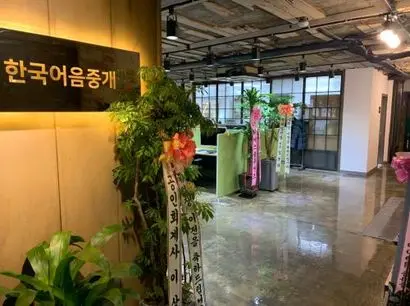
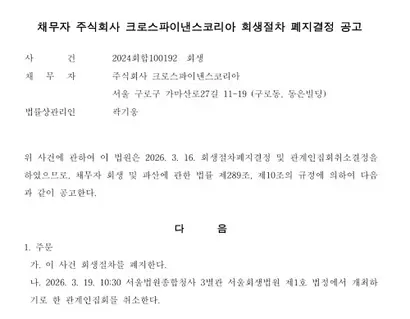
On March 16, the 16th Division of the Seoul Bankruptcy Court terminated Cross Finance Korea's rehabilitation proceedings. The court stated the reason for termination as, "The debtor's custodian withdrew the rehabilitation plan, and failed to submit a plan within the designated period." With this termination, Cross Finance ends its rehabilitation process before being able to pass the plan. The meeting of interested parties, originally scheduled for March 19, was also canceled. It has been confirmed that Cross Finance's legal representative submitted the application to terminate the rehabilitation proceedings on March 9.
Cross Finance withdrew its rehabilitation plan because it judged that obtaining creditor approval within the required timeframe would be difficult even if a meeting of interested parties were held. Kwak Ki-woong, CEO of Cross Finance Korea, who served as the rehabilitation custodian, explained, "To minimize damage to corporate value and protect investors, we pursued an M&A before the approval of the rehabilitation plan and finalized an acquirer on September 15, 2025. We submitted the rehabilitation plan to the court on December 12. However, as it became difficult to pass the meeting of interested parties, we withdrew the plan following the court's recommendation."
According to CEO Kwak, while major corporate creditors had given prior consent to the rehabilitation plan during the first meeting of interested parties on January 29, individual creditors did not attend. As individual creditors did not express their intentions even by mail, the review and resolution of the rehabilitation plan were postponed. Currently, there are 317 creditors for the Cross Finance rehabilitation case, most of whom are individual creditors. According to Cross Finance's legal representative, as many individual investors who failed to receive their investment settlements participated as creditors during the rehabilitation process, the number of interested parties required to pass the plan increased sharply.
Although the second meeting of interested parties was scheduled for March 19, the bankruptcy court recommended termination, viewing that Cross Finance would be unlikely to receive consent for the plan. In cases of corporate rehabilitation, a plan must be passed within a set period after the commencement of proceedings; it is reported that the court concluded Cross Finance would struggle to meet the required consent rate (approximately 66%).
Along with the withdrawal of the rehabilitation plan, the M&A also collapsed. The final intended acquirer was an e-commerce company, and they had envisioned resuming the P2P business after debt repayment upon acquisition, but this remained only a plan (Related article: '72 Billion Won Unpaid' Cross Finance Submits Rehabilitation Plan… M&A Conclusion Imminent).
However, CEO Kwak Ki-woong stated, "Due to the decision to terminate rehabilitation, the rights and obligations of the intended acquirer have been extinguished," but added, "The acquirer still has the willingness to purchase. Major corporate creditors are also willing to agree to the repayment rate of the existing acquisition plan. If we can secure the consent of individual creditors, there is still an opportunity to re-apply for rehabilitation."
The possibility of Cross Finance going through bankruptcy proceedings has increased. Usually, when corporate rehabilitation is terminated, it leads to a declaration of bankruptcy. In cases of termination before the approval of a rehabilitation plan, the custodian or debtor can file for bankruptcy, or the court can declare bankruptcy ex officio depending on the situation. Once the rehabilitation process is suspended, the status returns to pre-rehabilitation, allowing creditors to file for bankruptcy. Some corporate creditors even file for bankruptcy to write off their investments as losses.
When a company with debt goes bankrupt, the remaining assets are liquidated and distributed to creditors. The problem is that Cross Finance has been unable to conduct normal operations since the unpaid settlement crisis in August 2024, meaning even if the remaining assets are liquidated, it would not be enough to repay the debts. After restructuring, Cross Finance maintained its corporate form with CEO Kwak Ki-woong and minimal staff to handle debt collection and repayment, but currently, all employees have resigned, leaving only the CEO.
However, CEO Kwak stated that he is not considering bankruptcy. "Generally, when rehabilitation termination is finalized, it returns to the state before the start of the rehabilitation process, and if creditors begin legal action, normal activities become difficult, leading to bankruptcy," he said, adding, "For the time being, we are not considering filing for bankruptcy to protect investors. This is because bankruptcy could stop the investment repayment and distribution process. We intend to continue debt collection to ensure the settlement and distribution of investments without setbacks."
CEO Kwak added, "However, since creditors can also file for bankruptcy, we are striving to prepare sufficient investor protection measures just in case. We are working on supplementary measures so that even if a bankruptcy or business suspension occurs, debt collection and investment distribution can proceed without setbacks."
Cross Finance is a P2P firm with stakes held by Inji Group and Koscom, specializing in financial services for small business owners, specifically handling 'card sales pre-settlement products.' This product allowed small business owners to receive loans secured by their credit card sales, with the funding gathered from investors paid to the business owners through the pre-settlement company. However, in August 2024, Lumen Payments, the PG firm that was supposed to settle the loans, intercepted the payments, leaving Cross Finance unable to settle with the investors who participated in the funding. The outstanding unpaid loan balance for Cross Finance was 72.4 billion won, with over 9,000 investors involved.
Kim In-hwan, the CEO of Lumen Payments who caused the massive repayment delay, was indicted on charges including fraud under the Act on the Aggravated Punishment of Specific Economic Crimes and sentenced to 15 years in prison with a forfeiture of 40.8 billion won. It is reported that CEO Kim misappropriated the settlement funds that were not paid to P2P firms like Cross Finance for credit card bills and personal living expenses.