

[비즈한국] What would someone who has lived as a journalist in Korea for 60 years recall of that time? Especially if they joined a newspaper as a cub reporter, went on to serve as the CEO of that same newspaper, and then founded leading media outlets to grow them into a media group? While one might expect a life full of achievements and honors, the author unexpectedly confesses that his path was one of continuous failure and frustration.
However, he kept getting back up whenever he fell. "I ran, fell, and whenever I fell, I got back up and ran again. The emotional scars from those falls were not small, but my determination to overcome these trials was equally strong."
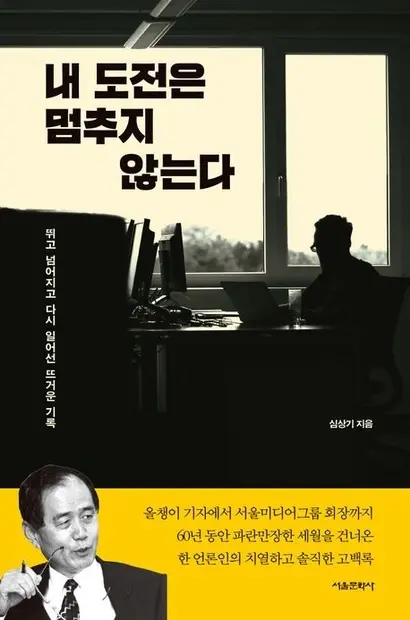
The protagonist of this story is Shim Sang-ki, Chairman of Seoul Media Group. Chairman Shim recently published an autobiographical record titled 'My Challenges Never Stop.' The book unfolds modern history as experienced firsthand by the author, who graduated from Korea University with a degree in law and began his career as a political reporter for the Kyunghyang Shinmun in 1961, shortly after the April 19 Revolution. The author observed the turbulent currents of South Korea's modern history from the field.
He vividly conveys intense moments such as the May 16 coup, the Yushin system, the 10·26 incident, and the June Struggle. He specifically details the on-site reporting in Tokyo during the ratification of the Korea-Japan Treaty, the untold stories behind the visit to North Korea by Lee Hu-rak, the Director of the Korean Central Intelligence Agency, who opened the door for inter-Korean dialogue, and the moments of frustration when facing media censorship under the new military regime. This is because the author, as a "witness who was closest to the scene of history," hopes his records will serve as pieces to complete the empty puzzles of our modern history. This is also why all the names of the individuals mentioned in the book are recorded in their real, uncensored form.
Reading the book makes one reflect on what constitutes a good journalist and what constitutes a good article. The articles the author wrote as a rookie, such as 'The Barefoot Volleyball Team,' 'The Honorary Graduation Diploma of Kyunggi High School,' and 'The Seonhye Academy in the Mountains of Gangwon-do,' serve as perfect examples. These articles demonstrate that good journalism does not only come from massive scoops, but is created by running on the ground while maintaining a keen interest in the small events around us—and that such articles continue to touch the hearts of readers long after time has passed.
Perhaps what catches the eye most in the book is the record of 'frustration.' It is rare in other autobiographies to find such honest accounts of failure, including being subject to disciplinary action for a major reporting miss as a political reporter, the regret of withdrawing too early after entering the cable broadcasting industry, and the bitter reflection following the suspension of the Sunday Newspaper after its acquisition. The author begins the book with an 'apology.' Any reporter would be able to fathom the depth of sincerity contained in these words.
Just as Sima Qian wrote the 'Records of the Grand Historian' to leave a record of the truth after being subjected to castration, I have always believed that journalists must take on the historical task of uncovering the unadulterated truth. Uncovering the truth is a historical task. It is easy to say, but executing it involves much pain. There may be those who were harmed or hurt by my writing. I sincerely apologize to these people. - From the preface
The author resigned while serving as the Editor-in-Chief of the JoongAng Ilbo and later as the CEO of the Kyunghyang Shinmun after standing against pressure from the regime. Afterwards, he founded Seoul Cultural Publishers and achieved great success by launching magazines like 'Woman Sense' and 'IQ Jump,' eventually completing the Seoul Media Group by acquiring the 'Sunday Newspaper' and 'Sisa Journal.' He successfully transformed into a media executive, perhaps because he upheld the journalist's mission of reporting with integrity.
It goes without saying that in media and publishing activities, the foundation must be placed on the pursuit of justice and truth. One must carry the belief that while enjoying freedom of the press, the corresponding responsibility is heavy. Reporting with integrity is the fundamental mission of a journalist. The role of serving as a yardstick to distinguish right from wrong must be particularly emphasized. In that sense, I believe that even from the position of leading a media company, one must strictly adhere to social norms and act with rectitude, without any deviation.
'My Challenges Never Stop' is both a memoir of a journalist and a chronicle of the intense life of a human being who, despite falling, rose up like a roly-poly toy.