

[비즈한국] Domestic digital healthcare companies are making unconventional moves to break through layers of regulations and the limitations of a narrow domestic market. Moving away from the 'Inside-Out' approach—where individual companies achieve success domestically before expanding abroad—a new 'Outside-In' model is being proposed, where multiple companies directly acquire overseas hospitals to enter the global market. Attention is now focused on its potential for success.
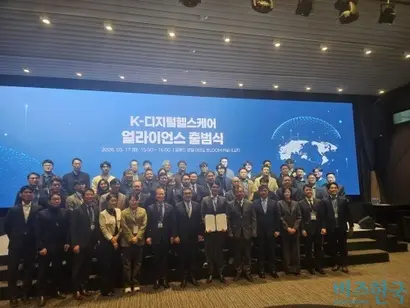
On the 17th, the 'K-Digital Healthcare Alliance (the Alliance)' was officially launched, bringing together 40 leading companies with competitive advantages across all sectors, including artificial intelligence (AI), genomic analysis, digital therapeutics, hospital IT, and healthcare platforms, with the Invite Ecosystem at its core.
These companies have set a goal to export Korean AI-based medical technologies and digital healthcare platforms as a packaged solution and to establish and scale local medical ecosystems directly.
Currently, 40 companies have joined the Alliance, including CG Invites037230, Macrogen038290, CJ OliveNetworks, Theragen Bio, HealthConnect, and HealthOnCloud. The Alliance plans to expand its reach further by adding global partners in the future.

The first step for the Alliance's overseas expansion is expected to be GRMC, a general hospital in Guam, a U.S. territory, which is currently in the final stages of acquisition by CG Invites. GRMC is the largest private general hospital in Guam, with 139 beds and over 1,100 local medical staff and employees, serving as a pillar of the medical infrastructure in Guam and the nearby Pacific island region. It recorded $225.3 million (335.3 billion KRW) in revenue in 2024.
The Alliance plans to move beyond Guam and extend its reach to the U.S. mainland. The strategy involves acquiring two or three additional hospitals in underserved U.S. medical areas or regions with lagging IT infrastructure and transforming them into top-tier digital hospitals. For individual startups lacking capital and networks, breaking into the U.S. market independently is a formidable challenge. However, the prevailing view is that if 40 companies unite to offer a vast ecosystem—ranging from hospital information systems to AI medical solutions—as a turn-key platform, they will possess the powerful leverage needed to overcome global regulatory hurdles. A representative from CG Invites expressed their ambition, stating, "The purpose is for the Alliance to stand together to cross the threshold of strict regulatory authorities," adding, "What we are pursuing is not just buying a single hospital, but buying the massive U.S. market itself."
However, the capabilities of a private alliance alone may not be enough to handle such a massive shift. Despite having world-class medical data, excellent IT infrastructure, AI technology, and globally competitive hospital systems, Korea's business expansion is currently held back by institutional constraints such as medical regulations and the national health insurance system. This means that government support is essential as they seek overseas expansion as a new breakthrough.
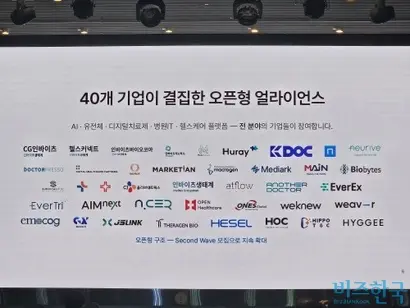
Attention is now focused on what kind of support cards the government will present in response to the Alliance's moves. According to the Alliance, the government's interest in the global expansion of K-Digital Healthcare is very high. K-Digital Healthcare was finalized as one of the 20 detailed tasks comprising the '15 Leading Super-Innovation Economy Projects' that the Lee Jae-myung administration is ambitiously pursuing. An Alliance official cited public-private partnering as the key success factor for this strategy, emphasizing, "If there are areas that private companies must pioneer as a group, they must be backed by solid foundational work from the government."
Kang Do-tae, former Chairman of the National Health Insurance Service who also served as Vice Minister of Health and Welfare, lent his support during his congratulatory speech on the day. Kang suggested, "The government and relevant organizations must spare no effort in providing financial support for local regulatory compliance, market pioneering based on international cooperation, and large-scale package exports so that the new challenges undertaken by private digital healthcare companies can succeed."