

[비즈한국] The full-group comeback and Gwanghwamun performance of BTS hold profound historical and cultural significance. It is a development that aligns with the group's global stature and serves as a prime opportunity to promote Korean culture to the world. Perhaps this is why articles and content covering the BTS comeback and Gwanghwamun performance are pouring out daily. However, it is also true that there are several points of contention.
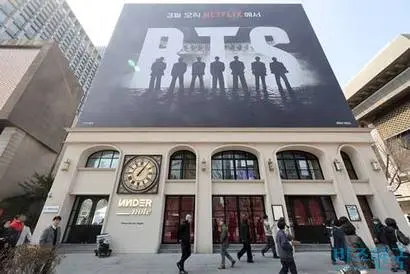
K-pop agencies that once tried to drop the 'K' to enter the pop song genre were caught off guard by the craze surrounding the animation 'K-Pop: Demon Hunters.' They realized that global interest in traditional Korean cultural heritage and the 'sense of place' associated with Korea can garner significant cultural resonance. Signs of this influence first appeared in BTS's comeback activities. The concept for their full-group comeback album is 'Arirang,' and the performance in front of Gwanghwamun was the first event planned in their comeback schedule. Arirang is, regardless of what anyone says, a song that encapsulates Korean identity and worldviews. Amid growing interest in traditional Korean culture, this appears to be an appropriate and excellent choice. The same applies to the performance at Gwanghwamun Square. It effectively reflects the current flow of the 'experience economy' through its sense of place as both a space of tradition and a space for democratic citizens.
However, there are a few points to consider. The 14 songs on their 5th studio album, which reflect the aspirations and expectations of K-pop fans, all have English titles, and none of the songs with English names contain the word 'Arirang.' The tracks' descriptions also lack traces of Arirang. Arirang embodies a will to overcome the pain and sorrow of life as Han (deep sorrow) and Heung (joy) intertwine. It is necessary for the album's tracks to reflect this well. The same can be said for the BTS performance where they will appear on the Gwanghwamun Square stage following the King's path. Arirang is a song of the people, so how will this sentiment be embodied in front of Gyeongbokgung Palace, the main royal palace of the Joseon Dynasty? It remains to be seen how Hamish Hamilton, who directed the Super Bowl halftime show, the Grammy Awards, and the London Olympics opening ceremony, will contemplate Arirang and capture that sentiment in the stage direction.
There is also much talk about the use of public resources for the BTS performance. For the sake of safety, public institutions such as the Ministry of Culture, Sports and Tourism, the Korea Heritage Service, the Seoul Metropolitan Government, the Seoul Bus Transport Association, the Seoul Metro, the Ministry of the Interior and Safety, the police, the fire department, the Ministry of Health and Welfare, and the Ministry of Food and Drug Safety are making full-scale efforts. Not only have police and fire personnel been fully mobilized, but subways and buses in the area are skipping stops or being detoured. Citizens working in the vicinity have been affected. Moreover, the process was one of notifying or announcing decisions that had already been made, without collecting public opinion.
There is also the issue of equity when compared to other K-pop idols. This is because it could be seen as granting special favors only to a specific idol group. What if a joint performance featuring multiple idol groups had been planned from the start? What if they had performed with Blackpink, who also made a recent comeback? This feels even more regrettable when considering the global popularity of Rosé's 'APT.'
In fact, the performance at Gwanghwamun Square was permitted partly due to its economic effects. Research results from government-affiliated institutes, which often cite that a single BTS concert generates approximately 1.2 trillion won in economic effects, are frequently mentioned. Although the Gwanghwamun Square performance is free, foreign fans who come to watch the show spend large amounts of money on transportation, food, lodging, sightseeing, and shopping, leading to it being called 'BTS-nomics.' We must ensure that businesses near the square can enjoy these benefits in a fair and equal manner.
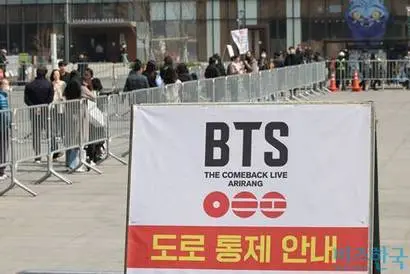
Conversely, with predictions that 260,000 people will flock to the area, those who usually visit Gwanghwamun for weekend outings or have appointments there are highly likely to avoid the area. Therefore, there will be small business owners who suffer losses due to the Gwanghwamun Square performance. Some buildings have already been advised to close. Compensation for them should also be considered.
In this regard, the case of Blackpink's Lisa is often mentioned. On May 3, 2024, from 2 a.m. to 5 a.m., Lisa filmed the music video for 'Rockstar' on Yaowarat Road in Bangkok, Thailand. Although it was a time when shops were closed, she provided compensation of 20,000 baht (about 750,000 won) per person to shop owners who were unable to do business. In Thailand, this amount is equivalent to a month's salary. She also paid 1,000 baht (about 37,000 won) to passersby as an apology for the inconvenience caused.
If this case were applied to Gwanghwamun Square, there should be compensation for works whose performances at the Sejong Center for the Performing Arts were canceled, as well as for the audience who booked to see those works. There are also citizens and foreigners who intended to visit Gyeongbokgung Palace or the National Palace Museum of Korea. Compensation for those commuting to the Gwanghwamun area also cannot be left out. Such compensation must be vast and have detailed criteria. This is the moment to establish an important precedent.
Regarding the live streaming of the performance on Netflix, the issue of domestic broadcasters and platforms being marginalized has been raised. The Gwanghwamun Square performance clearly confirms that the center of K-pop is Korea. If so, wouldn't it be desirable for Korean media and platforms to be at the center of the live stream that shares that content with the world? It would have been better to prioritize homegrown OTT services and then distribute them to Netflix, Disney, or Apple. The fact that the content broadcasting rights were handed over to Netflix is a very regrettable point.
The issue of net neutrality has also resurfaced. Live streaming increases traffic, leading to higher management costs. Although Netflix officially requested cooperation from domestic telecommunications companies on network quality management to ensure smooth global streaming, leading to preliminary measures such as increasing submarine cable capacity, Netflix does not compensate for these costs. It is a structure where Netflix reaps massive profits from the live stream, while domestic telecommunications companies bear the necessary quality management costs. It is as if the Republic of Korea, which dreams of being a content powerhouse, is handing over BTS's live content to overseas entities.
The dreams and hopes aimed for by K-pop prioritize individual rights and happiness. It is a principle of a democratic republic to minimize the damage and inconvenience someone might feel due to music performances that hold public value. Even considering the significance, value, and global attention of the BTS performance, the issues mentioned today should not be buried. Contemplation and discussion of these problems will serve as nutrients for the advancement of K-culture as well as our society.
The author Kim Heon-sik has wandered or navigated through the forest of popular culture phenomena since his 20s, with the expectation that there is a way to make the world a better place through culture. He continues on the same path in the 21st century, where artificial intelligence and quantum computers are active, with the same belief.