

[비즈한국] Conflict is erupting between Lotte Global Logistics, the operator of Lotte Parcel, and its delivery drivers as the company pushes to restructure its delivery zone system, which serves as the basis for calculating delivery fees. While Lotte Global Logistics maintains that this is a normalization of fees reflecting changes in the delivery environment, the labor union is strongly protesting, labeling it a de facto attempt to cut wages.
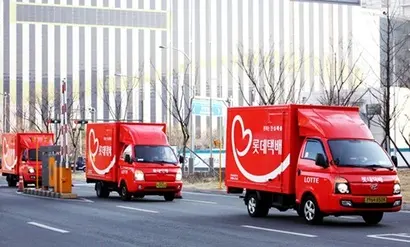
Controversy over fee reductions due to Lotte Parcel's zone system restructuring
According to the industry, Lotte Global Logistics recently informed the Lotte Parcel National Agency Association and others of its '2026 New Zone System' revision proposal. Typically, the parcel industry applies differential fees by zone based on delivery difficulty and regional characteristics. It is reported that Lotte Global Logistics is reviewing a plan to completely overhaul its existing zone-based fee system with new criteria starting in April.
However, the response from the field is cold. The Lotte Parcel Headquarters of the National Parcel Delivery Union claims that if this revision is implemented, delivery fees will decrease across all zones. A union official said, "It is estimated that when the new zone system is applied, fees will drop by a minimum of 5 won up to 55 won per package depending on the zone."
The official continued, "Delivery drivers operate on a structure where they sustain their income through delivery fees without a base salary. A reduction in fees leads directly to a decrease in income. With the burden of costs like fuel prices having increased, if delivery fees are also lowered, working conditions in the field will inevitably worsen."

The union is raising issues with the trend of declining delivery fees for drivers. The aforementioned official stated, "The head office has not adjusted fees by zone significantly since 2023. While they claim that some zones require adjustments due to high fees, there is a strong perception in the field that the overall fee level remains low."
They added, "Delivery fees only ever go down; they have never been raised. After the surge in volume following COVID-19, a logic was applied that fees could be lowered due to the increased volume of deliveries. Fees that were 1,000 won per package have fallen to the 900-won and 800-won ranges, and some companies have even set them in the 600-won and 500-won ranges."
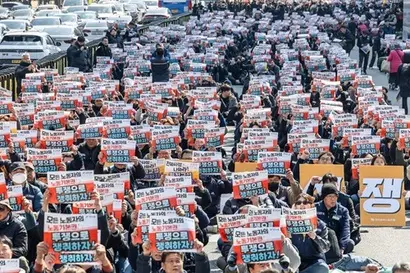
The union pointed out, "A structure is becoming entrenched where fees are lowered and offset by volume without reflecting inflation. Ultimately, this inevitably increases the labor intensity for drivers." The union is currently hanging banners opposing the new zone system and conducting a petition drive against it among field drivers.
Lotte Global Logistics maintains that the zone system restructuring plan has not been finalized. A company official stated, "While it is true that we are reviewing changes to the zone system criteria, nothing has been decided at this time." Regarding some accusations that it is a measure to cut fees, they explained, "The zone system criteria have not been changed for a long time, even though the delivery environment has changed due to new city developments and administrative district reorganizations. The purpose is to normalize them to fit current realities."
Demands for negotiation on the first day of the Yellow Envelope Act; will the fee issue become a point of contention?
Some in the industry interpret the restructuring of the fee system as being intertwined with changes in Lotte Global Logistics' business structure. With the recent expansion of low-priced volume such as convenience store parcels, the possibility of increased pressure on profitability is being discussed, along with the potential for fee adjustments.
Lotte Global Logistics is accelerating its pursuit of the convenience store parcel market. Starting this year, it won the exclusive contract for CU convenience store parcel volume and expanded its market share, and has also expanded its delivery coverage through the renewal of the 7-Eleven 'Kind Parcel' service. However, convenience store parcels have the limitation of being structurally low-priced. Since shipping rates are in the 1,800 to 2,700 won range—only about half of general parcels—it is a structure where the profit left for the company is not large, even if volume increases.
It is pointed out that the fees paid to drivers are also inevitably set low. In fact, during the process of expanding CU volume, Lotte Global Logistics set a fee of 150 won per package for CU convenience store parcels, and later adjusted it to 300 won after strong backlash.
One delivery driver criticized, "Even though the fees were adjusted slightly, it is still a low-price structure. The delivery method doesn't change just because it's a convenience store parcel, yet the fee returning to the drivers is too small. It's a problem that the burden is shifted to the drivers because the company set a low price for sales purposes."
Recent trends of slowing profitability are also pointed to as background for the fee system restructuring. Lotte Global Logistics' revenue in the parcel (last-mile) sector for the first three quarters of last year was 1.0403 trillion won, a slight decrease compared to the same period the previous year. However, operating profit was 11.691 billion won, a 51.1% decrease compared to the same period the previous year (23.908 billion won). While the scale was maintained, profitability has worsened significantly.
On March 10, the first day of the enforcement of the Yellow Envelope Act, the National Parcel Delivery Union demanded joint negotiations with major parcel companies. The Lotte Parcel union has also requested negotiations with Lotte Global Logistics. The union stated, "With the National Parcel Delivery Union having proposed negotiations, the issue of fee restructuring is likely to be treated as a major agenda item. We are also reviewing plans to separately request a meeting with the head office."
A Lotte Global Logistics official stated, "We will do our best to reach a consensus that can satisfy both labor and management in accordance with the system restructuring."