

[비즈한국] A few days ago, for the first time in a while, many people on Earth focused on the moon together. This was thanks to a total lunar eclipse, where the moon hid inside the shadow of the Earth that blocked the sun. The sight of the moon, dyed dark and reddish for an hour, was truly impressive. Seeing so many people looking up at the night sky together for the first time in a while made me feel proud, as it reminded me that we all originated from stars. I was also secretly grateful to the full moon for putting on a wonderful eclipse show to turn people's gazes toward the night sky. Sooner or later, a day will come when all people on Earth will look at the moon again. This is because the Artemis mission, which will send humans back to the moon for the first time in half a century, will be taking place soon.
In fact, it should have already happened. Unfortunately, however, it has not. It is truly regrettable that I have to tell you this. If everything had gone as planned, I would be happily sharing reviews of Artemis 2, which would have returned safely after circling the lunar orbit with a crew for the first time in ages. Sadly, Artemis 2 encountered technical problems just before launch and was postponed once again. Moreover, NASA has announced major changes to the Artemis mission. As disappointing news continues, some scientists express concerns that the next-generation Space Launch System (SLS) promoted by NASA might become a white elephant. Will humanity be able to succeed in its challenge to return to the moon safely?
Artemis 2 was originally preparing for a launch last February. However, a helium tank leak was discovered, and the launch was aborted. The launch was postponed to March, but it did not succeed then either. During the wet dress rehearsal, where the final preparations occur with all fuel loaded, they even reached the final 29 seconds of the countdown. Yet, a similar problem occurred again with the helium tank. Eventually, the launch was tentatively postponed. If they rush, they might attempt a launch within April, but as the lives of precious astronauts are at stake, being more cautious seems acceptable.
The problem that occurred in the most recent launch attempt is not simple. A 'rollback' was even carried out, where the rocket left the launch pad and moved back to the assembly building. Since the Apollo missions of the 1960s and 70s, NASA has spent a long time developing the Space Launch System (SLS), under the title of a next-generation rocket. However, this SLS is becoming a headache.
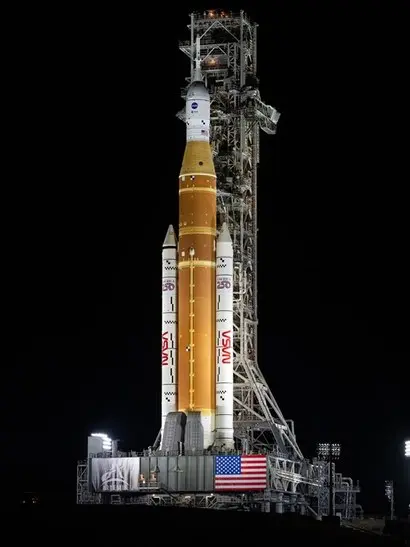
The biggest difference between the Apollo and Artemis missions lies in the reason for going to the moon. During Apollo, the moon was the final destination. And they did not stay on the moon for long. Of the three astronauts who left Earth, only two left footprints on the moon, and they stayed for only a few hours to a day or two before returning immediately.
The Artemis mission looks toward Mars, not the moon. The goal is to build an outpost on the moon where astronauts can live for several months. Therefore, the Artemis mission carries a larger Orion spacecraft, which accommodates one more astronaut than in the Apollo days.
However, unlike the payload, the launch vehicle, the SLS, shows little noticeable improvement compared to the Apollo era. Most of the perceptible advancements in the Artemis mission have come from the Orion spacecraft, not the launch vehicle. The Orion spacecraft is equipped with an emergency escape system that operates with millisecond precision, and four astronauts can live in it for up to 21 days. It is equipped with modern life support systems and radiation protection. In contrast, it is difficult to find clear improvements in the SLS compared to the Saturn V rocket used during Apollo.
The Saturn V rocket could carry up to 125 tons to low Earth orbit and up to 50 tons to lunar orbit. And now, 50 years later, the SLS Block 1B launch vehicle can carry between 38 and 46 tons to the moon. Therefore, even comparing only the maximum weight the launch vehicle can carry, the SLS cannot be considered to overwhelm the existing Saturn V.
An even bigger problem is that the cost is excessively high. The current four initial Artemis missions planned by NASA, including SLS launches and the operation of the Orion spacecraft, cost $4.2 billion per launch. This is just the cost of the launch itself; the development cost over the past decade is ten times that amount. Furthermore, the SLS rocket, unlike SpaceX's Falcon rocket, is not reusable, leaving no viable way to reduce costs.
The fact that it consumes more money without showing noticeable progress despite spending a lot of time and money reveals a structural limitation at NASA. This is because they failed to break away from existing technological legacies instead of taking risks and boldly attempting innovation. Initially, NASA judged that inheriting the technological legacy learned during the development of the previous Saturn V rocket and the Space Shuttle would save significantly more time and money than developing entirely new technology.
However, that assumption was completely wrong. Simply bringing in existing parts does not solve the problems. This is because they had to go through more complex procedures of redesigning, re-certifying, and integrating all parts for the new mission. Thus, the SLS did not become a safe rocket that combined proven past technologies; rather, it amplified complexity as old and new things were forcibly combined in a jumble.
Furthermore, in 2010, NASA forced the development process of the SLS rocket to utilize existing contracts, investments, and personnel as much as possible, and this constraint is criticized for hindering rocket innovation. NASA's rocket development is not just a challenge toward space; it is a source of livelihood that sustains the regional industrial base and the families of engineers. In reality, it is difficult for politicians to ignore the existing industrial base even at the cost of losing their own votes for the sake of innovation. Eventually, with various political and realistic reasons including jobs, the development of the SLS rocket was used for the purpose of maintaining and feeding NASA's existing industrial base, and there is a sense that it has remained in old technology without achieving meaningful innovation.
The difference in the era from the time of the Apollo missions cannot be ignored either. In fact, there were many regrettable and close-call incidents during the Apollo missions as well. Three astronauts were sadly lost in a sudden fire during the Apollo 1 test, and there were also instances where systems went dead due to lightning strikes during launch, or oxygen tanks exploded entirely. Ultimately, the first manned flight was attempted only with Apollo 8, and the actual moon landing was achieved by Apollo 11.
Nevertheless, the reason the Apollo mission seems more daring and aggressive is because it truly was. At that time, there was a political consensus that we could not fall behind in the systemic competition with the Soviet Union, and the public did not have major complaints about pouring massive tax money into NASA's space development. It was also an era where the sacrifice of astronauts was packaged as a noble sacrifice for the country.
But the times have changed. The reason of 'systemic competition' alone cannot justify pouring massive budgets into space development. People's interests have diversified, and there are even quite a few voices criticizing space development as a waste of budget. It has become an era that values human life more than before. People should not be rashly put on unverified rockets. It has become an era of checking more thoroughly and carefully until all risks disappear completely.
Artemis 2 has not yet left the launch pad. In particular, leaks, especially around the helium tank, are occurring frequently, causing chronic problems. Most recently, technical defects were found not only in the first-stage rocket but also in the upper stage, and measures are being taken to address them. Due to successive launch postponements and technical defects, NASA announced major changes to the Artemis mission.
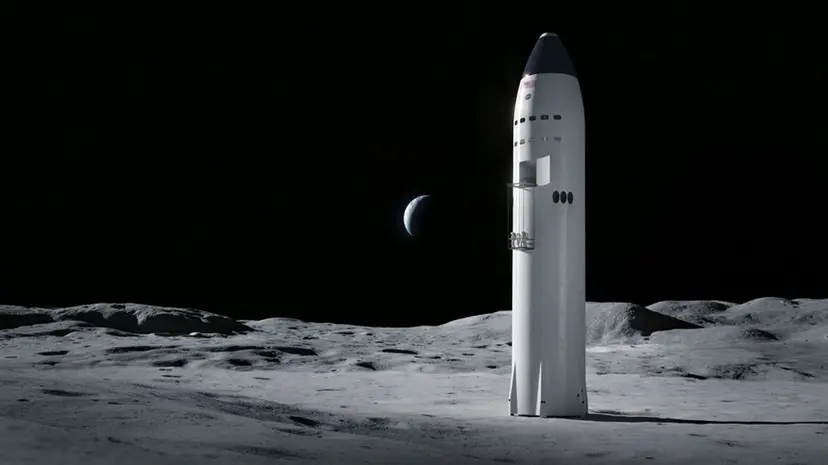
NASA judged that the problem with the SLS rocket was that the rocket development time was too long and it was not launched often enough. Under the current method, it is inevitable to launch only about once every 3 years. So, NASA established a new goal to build more SLS rockets and launch them at least once every 10 months to verify them technologically. It looks as if they are following the method of SpaceX, which has secured stability through successive launches. NASA also announced that it would standardize the SLS rocket to the current Block 1B and develop them all identically. The original plan was to improve and upgrade the performance little by little every time a launch was attempted, but to launch an identical, standardized rocket every time without changes in order to launch faster and more frequently. However, whether they can churn out the massive SLS rocket once every 10 months is uncertain.
NASA had a bold goal to attempt to land humans on the moon starting with Artemis 3. However, the lunar landing attempt for Artemis 3 was canceled. Instead, it will practice rendezvous and docking with the lunar spacecraft in low Earth orbit. The Artemis mission is actively collaborating with private companies such as SpaceX and Blue Origin. It has not been decided yet which company's lunar lander will be used for the next lunar landing. For the Artemis 3 mission, after lifting the spacecraft to low Earth orbit, they plan to hold a rehearsal for rendezvous and docking with the 'Blue Moon Mark' or 'Lunar Starship.' While it is a necessary process to verify the performance of the new rocket and spacecraft, serious deliberation is needed on whether it is a useful method, given that they are making a massive SLS rocket only to perform a rehearsal that goes up to low Earth orbit.
About the author, Ji Ung-bae? He loves cats and the universe. After watching 'Galaxy Express 999' as a child, he dreamed of spreading the beauty of the universe. Currently, he is an assistant professor at Sejong University's College of Liberal Arts, participating in various science communication activities including lectures and writing. He has written books such as 'Every Day a Piece of the Universe', 'Scientists of the Starry Universe', 'Can't Go But Can Know', and 'Strange Questions That Come to Mind When Looking at the Universe', and translated books such as 'The Hitchhiker's Guide to the Real Universe', 'How I Killed Pluto', 'Quantum Life', and 'Cosmigraphics'.