

[비즈한국] POSCO Future M003670 announced on the 16th that it had signed a 1.0149 trillion won supply contract for artificial graphite anode materials with a global automaker. This contract, which spans five years starting in 2027, suggests that the domestic battery material industry is moving toward self-reliance, breaking away from a supply chain structure overly dependent on specific countries. Especially given that South Korea's reliance on Chinese natural graphite imports reaches 97.7%, the localization and large-scale procurement of artificial graphite are viewed as a practical alternative for securing supply chain stability.
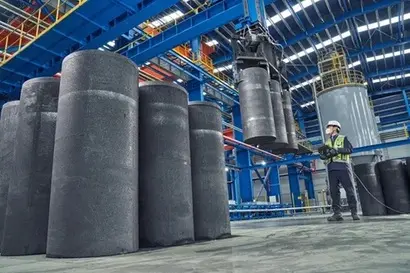
The biggest risk in the anode market is raw material concentration. Currently, South Korea imports all of the natural graphite needed for anode manufacturing from China. Natural graphite is a resource that requires mining. Because deposits and processing facilities are concentrated in specific countries like China, the domestic industry is structured to be hit immediately if resource weaponization or export control measures are implemented.
Artificial graphite is considered a key material to mitigate these geopolitical risks. Unlike natural graphite, it is artificially synthesized using coke, a byproduct of oil or coal, resulting in fewer supply chain concerns compared to graphite.
Artificial graphite has a uniform internal structure that allows for faster lithium-ion movement, which leads to longer battery life and improved fast-charging performance. Previously, China held over 90% of the artificial graphite market due to high power consumption and complex processes, but there is keen attention on whether POSCO Future M's large-scale contract can create a crack in this trend.
The core background behind this successful order is the internalization of the supply chain, extending from raw materials to the finished product. POSCO Future M has established a system to produce needle coke, the raw material for artificial graphite, by processing coal tar generated from POSCO's steelmaking processes. By procuring raw materials through its subsidiary, POSCO MC Materials, the company has secured an independent production line free from raw material export restrictions imposed by external nations like China.
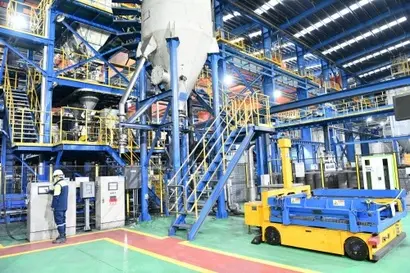
This vertical integration is evaluated as being able to respond to global trade regulations such as the U.S. Inflation Reduction Act (IRA). As global automakers must reduce the proportion of Chinese-made materials to meet subsidy requirements, POSCO Future M's artificial graphite has acted as an alternative to resolve regulatory risks. Beyond technological competitiveness, a 'secure supply chain' capable of responding to policy changes is becoming a key competitive edge for the product itself.
To respond to the large-scale order volume, POSCO Future M has decided to build a new artificial graphite anode plant in Vietnam. The company plans to invest approximately 357 billion won to establish a local mass-production base and proceed with phased expansions based on future additional orders. This is interpreted as a strategy to overcome domestic production limitations and strengthen a global, localized supply system.
Starting with this 1 trillion won-scale order, POSCO Future M is expected to continuously expand its anode production. Despite the temporary stagnation in demand in the electric vehicle market, this long-term contract suggests that companies with supply chain stability and technological reliability are highly likely to take the lead in the future battery market.