

[비즈한국] A person in their 60s surnamed A, who operates a restaurant in Gangseo-gu, Seoul, recently discovered a strange sticker on their shop door while opening for business. It was a sticker featuring the logo of the Chinese mobile payment service 'Alipay'. Having no memory of applying for it, they asked neighboring merchants, only to find that others had experienced the same thing. Worried that the strong adhesive might leave marks if removed, they have left it in place for now.
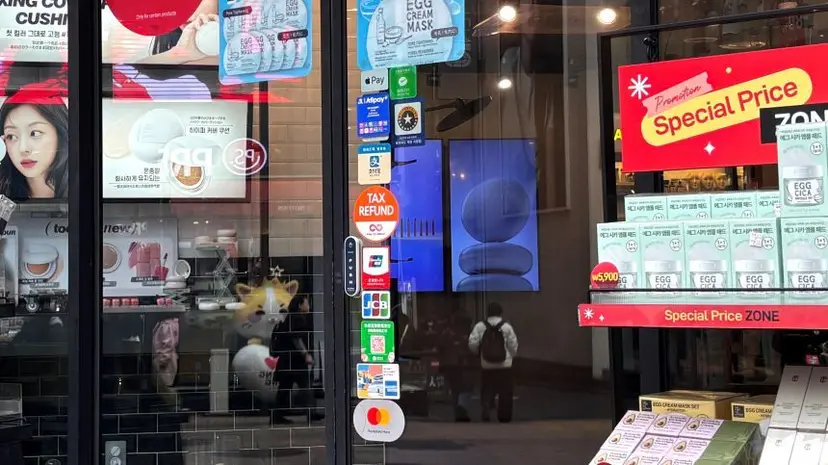
Recently, a controversy known as 'stick-and-run' has emerged, regarding Alipay information stickers being attached to storefronts in major commercial areas in Seoul without the owners' consent. Stories are circulating among some self-employed business owners about stickers appearing out of nowhere that they never requested.
The controversy spread rapidly, especially online. Anti-Chinese sentiment intensified after recruitment posts for part-time jobs specifically for placing Alipay stickers appeared on second-hand trading platforms and subsequently spread to various communities. Some even raised conspiracy theories suggesting that China was systematically placing these stickers in domestic commercial districts to expand their payment service. However, a Biz Hankook investigation revealed that these interpretations are somewhat far from the truth.
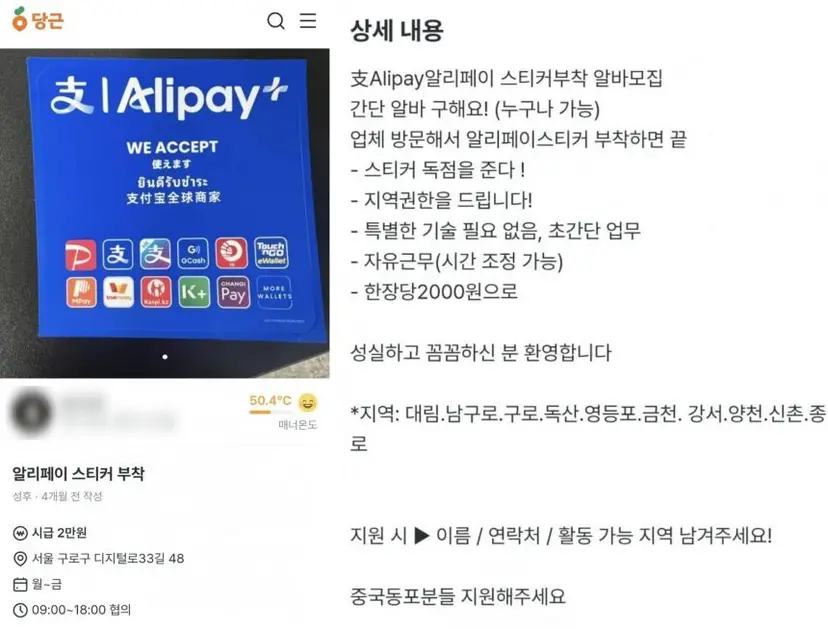
Alipay is a mobile payment platform operated by Ant International, an affiliate of China's Alibaba Group, which connects payment services from various countries through Alipay+. In most domestic stores, Alipay can be used through payment interoperability with Zero Pay, operated by the Korea Easy Payment Promotion Agency. In other words, if a store is a Zero Pay merchant, foreign tourists can pay via Alipay, and the industry explains that the controversial sticker is simply a sign to inform customers of this interoperability.
The problem is that the stickers were attached without sufficiently explaining this to the shop owners. In response, PPL Networks, an official partner of Alipay, clarified that the controversy stemmed from a misunderstanding.
PPL Networks stated, "We utilized external part-time staff while visiting major commercial areas in Seoul sequentially, and it seems that due to language barriers and other issues, the explanation was not sufficiently conveyed to the owners," adding, "The intention was to inform shop owners, who face card fee burdens, about the Zero Pay linked payment structure and to enhance payment convenience for tourists." They further added, "The allegations regarding the so-called 'part-time job' controversy spreading online are untrue," and, "Starting this year, we will have company employees visit in person to explain and attach the stickers instead of using external personnel."

While some owners point out the procedural issues, the general atmosphere is that they do not consider the attachment of the stickers themselves as a serious harm. B, who posted about the issue online, said, "I'm flustered because the post seems to be interpreted politically," adding, "I didn't have any ill feelings toward a specific country or an intent to raise a significant issue; I intend to just leave it there as it's not a major inconvenience."
The industry views this controversy more as a communication issue that arose during the process of informing merchants about payment network interoperability, rather than unauthorized expansion of a foreign payment platform. However, there are voices suggesting that the consent procedure for owners and the way information is provided need to be improved and made clearer.
Zero Pay explained, "Alipay payments are possible at Zero Pay merchants through interoperability with overseas payment apps," noting, "However, there is no separate procedure to announce the fact of Alipay interoperability, so it is a structure where owners can only know if they check for themselves." They added, "In the case of Zero Pay merchants, attaching an Alipay information sticker itself is not a problem."