

[비즈한국] Two experts who shine in fields outside their primary professions have released new books. The protagonists are Park Jong-ho, a psychiatrist famous as a classical music enthusiast, and Jeong Yeon-deok, a law professor who also works as an artist and novelist.
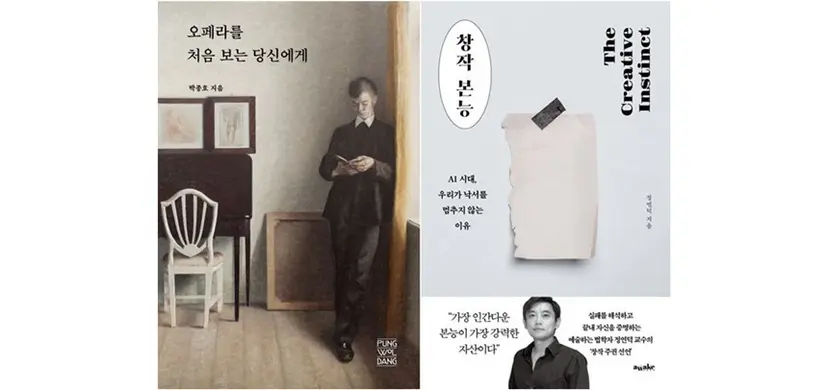
Park Jong-ho is known as the author of many classical music bestsellers, such as 'The Classics I Love' and 'Immortal Classics'. A psychiatrist, he founded the classical music brand 'Poongwoldang' over 20 years ago, introducing classical music through various channels, including a specialized record store, lectures, and publishing. Following his book for beginners, 'To You Who Are Listening to Classics for the First Time,' he recently released 'To You Who Are Watching Opera for the First Time' for opera novices.
The book begins with the story of a man who first heard the aria from the opera 'Pagliacci' at a construction site in the Saudi Arabian desert. The fate of the opera's protagonist, who must put on clown makeup and go on stage even while crying tears of blood, overlaps with the life of the man struggling in the sandstorms.

As such, 'To You Who Are Watching Opera for the First Time' focuses not on the vast history or grand theories of opera, but on the emotions and feelings that opera imparts to the listener. This is similar to the scene in the movie 'Pretty Woman' where Julia Roberts is thrilled after listening to an aria at the opera house for the first time, or the scene in the drama 'The Love Interpreter' where Go Yoon-jung is moved while feeling the meaning of the lyrics in the aria line by line.
The author travels to opera houses across Europe every year to hear operas in person. This is something he has done for decades, and he has captured those vivid stories he learned through direct experience in his book. He provides easy and clear answers to the most fundamental questions for opera beginners, such as the roles of those who create opera, the subject matter and scripts of works, vocal ranges of singers, practical appreciation methods, and season festivals.
The second book, 'Creative Instinct', was written by Jeong Yeon-deok, a professor at Konkuk University Law School and an expert in intellectual property. A 'legal scholar who does art,' balancing painting and novel writing, he asks and answers whether humans can still remain the subject of creation in the age of AI.
Since the use of AI, 'creation' can no longer be called an act of making something from nothing. The threshold for creation has been lowered, and productivity has increased dramatically. Human creation is being replaced by AI creation.
The author argues that creation in the AI era should be evaluated by 'what is left behind' rather than what was made. This is because it is humans who decide which sentences to keep and which to delete, which scenes to place first and which to push back, and which emotions to emphasize and which to restrain. Those judgments are infused with human experience, ethics, context, and emotion.

As such, in creative works using AI, the key to determining copyright is whether there are human-unique creative elements that society should protect. The author explains that it is important whether there are traces of human emotion and choice within the work, whether those traces reach the readers and audience, and who is responsible for the decisions that made that reach possible.
'Creative Instinct' covers various legal debates and conclusions related to copyright, such as the extent to which freedom of creation is recognized and the boundaries between creation and plagiarism (copying). Finally, it addresses the co-creation between humans and AI, specifically pointing out the structure of co-creation and the legal issues that must be addressed in that process. A Q&A on AI-related controversies, such as the theft of Ghibli's art style, is also included in the appendix.
The author concludes that AI is a 'new tool and language,' and what to say with that language depends on human imagination and experience. He expresses his hope that creation in an era where we have gained a new partner, rather than a competitor, will bring deeper meaning to more people.