

[비즈한국] The electric vehicle (EV) market, which once led the rapid growth of K-batteries, is wavering. Demand is growing more slowly than expected, and Chinese companies are encroaching on the market with low-cost offensives, placing the Korean battery industry at a structural crossroads. The breakthrough lies in diversification. With the need to reorganize by expanding into ESS, AI data centers, and robots, the most notable focus is on robots. As artificial intelligence evolves into 'Physical AI' and the commercialization of humanoid robots becomes a reality, batteries are emerging as the core of product competitiveness, going beyond simple components. We examined what possibilities and potential Korean battery companies hold in this new stage called robotics.
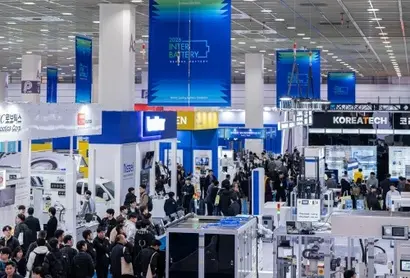
'InterBattery 2026,' held at COEX in Gangnam-gu, Seoul, from March 11 to 13, recorded its largest scale ever, with 667 companies from 14 countries participating. The most significant change in this exhibition is that the center of gravity for battery applications has shifted from EVs to the 'Physical AI' sphere, including robots, drones, and Urban Air Mobility (UAM). Battery technologies and safety solutions aimed at the commercialization of humanoid robots filled the front of major company booths, foreshadowing a shift in the industrial landscape.
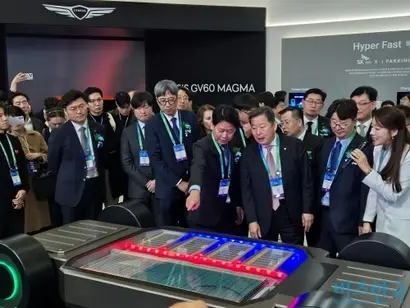
The domestic battery industry is currently facing a double whammy: slowing EV demand and Chinese overproduction. China is rapidly encroaching on the position of Korean companies in the global market, backed by the government's comprehensive R&D support and the weaponization of resources. In response, domestic companies are seeking breakthroughs by putting forward robots, ESS, and AI infrastructure as new pillars of growth.
Batteries for robots require higher energy density and output performance than those for EVs. Safety is the top priority, especially for humanoid robots operating in environments close to humans. This is why the Korean battery industry, which has led the global market in high-performance fields such as ternary batteries, is focusing on robots as a new battleground.
The Three Major Battery Companies Target the Robot Market
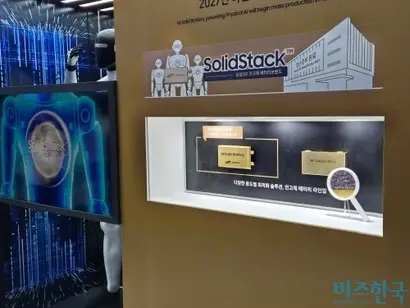
Samsung SDI unveiled its 'SolidStack' pouch-type all-solid-state battery sample for Physical AI to the public for the first time at this exhibition. Designed with the limited space of robots in mind, the product achieves both lightweight design and high density. The company also announced plans for mass production and the development of prismatic batteries in the second half of next year.
LG Energy Solution373220 showcased actual application cases by displaying the LG Electronics066570 home robot 'LG CLOiD' and Bear Robotics' autonomous robot 'Carti 100,' both equipped with its cylindrical batteries. By also introducing blood-transport drones and cube satellites, it revealed its ambition to expand beyond ground robots into the drone and aviation sectors.
SK On put safety and reliability at the forefront. It unveiled 'On-Vent' cells, which enhance heat dissipation through laser processing, and emphasized its safety-focused portfolio, including advanced BMS technology that detects and blocks fires in advance. The booth also displayed Hyundai WIA011210's autonomous mobile robots (AMR) equipped with its high-nickel ternary batteries. These robots are currently used for logistics automation in industrial sites such as the Hyundai Motor Group Metaplant America.
“Cylindrical or Pouch-type All-Solid-State?” The Prelude to the Next-Generation Standard Competition
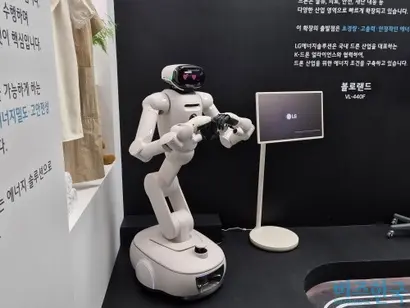
Currently, the robot market mainly uses cylindrical batteries, which have standardized specifications and high production efficiency. Another strength is the lower risk of fire and explosion due to less contact area between cells. However, they have a limitation in that there is significant space waste due to their structure.
What the industry is paying attention to as the next-generation standard is the pouch-type all-solid-state battery. The idea is to maintain the benefits of pouch cells, which have high design flexibility, while compensating for the structural safety weaknesses of existing pouches by using all-solid-state technology with lower fire risk. Joo Yong-rak, head of the Samsung SDI Research Institute, said in an interview with reporters, "Since they need to be lightweight, the pouch form will be in the spotlight. High-nickel batteries have high fire risk, and LFP batteries have low capacity. All-solid-state, which overcomes both disadvantages, is the answer."
However, the high price of all-solid-state batteries is a variable for initial market entry. As batteries account for only 4-10% of robot manufacturing costs, some analysts suggest that the perceived burden may not be significant from the supplier's perspective. Hwang Gyeong-in, head of the External Cooperation Office at the Korea Institute for Industrial Economics & Trade, predicted, "Just like the early EV market, an early-adopter market where high-performance battery demand is prioritized will form first. Depending on market maturity, we will see a composition where portfolios are segmented and coexist by type, such as cylindrical, pouch, and material-specific options."
Battery manufacturers are also adopting a strategy of maintaining multiple portfolios rather than betting on a single technology. Hyun Jang-seok, a team leader of Global TPM at Samsung SDI, said, "We need to carry both cylindrical and pouch-type all-solid-state batteries. It is still too early for all-solid-state to trigger a paradigm shift. The market structure will likely be that all-solid-state handles high-performance, low-volume production, while cylindrical batteries handle general-purpose robots."