

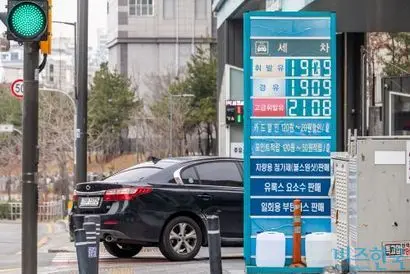
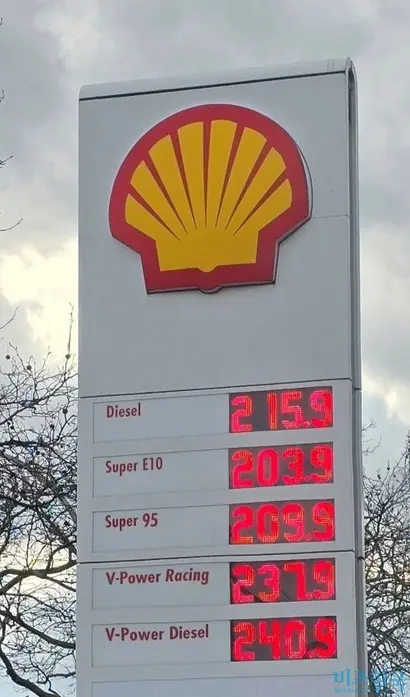
[비즈한국] As the geopolitical situation in the Middle East becomes unstable, international oil prices are fluctuating. Fuel prices at gas stations in South Korea are rising rapidly, and the situation in Europe is no different. According to the German Automobile Association (ADAC), just before the Iran war, the average price of gasoline (Super E10) in Germany was 1.69 euros (2,900 won) per liter, and diesel was 1.61 euros (2,760 won). However, prices began to climb vertically immediately after the outbreak of the war, and by March 10, both fuel types exceeded the 2-euro (3,400 won) mark per liter. This is the first time both fuels have surpassed the 2-euro threshold simultaneously since September 2022, when the aftermath of the Russia-Ukraine war was still ongoing.
Changes in Perception of Energy After the Russia-Ukraine War
Rising oil prices affect not only the burden of vehicle fuel costs but also the entire industry, from logistics and manufacturing to power generation.
While European countries like Germany are attempting a rapid transition to green energy, they have not yet completely replaced fossil fuels. In the past, they relied on the Middle East and Russia for oil and on Russian pipelines for natural gas. While this was cheap and stable, it was vulnerable to external shocks.
Europe felt this painfully due to the Russia-Ukraine war in 2022. As energy trade between Russia and Europe effectively collapsed, the Dutch TTF price, the benchmark for European gas prices, exceeded 300 euros (510,000 won) per MWh at one point in the summer of 2022, surging more than 10 times compared to pre-war levels. This dealt a direct blow to various industries. For instance, the German chemical company BASF reduced production at its domestic plants due to rising energy costs.
A Market Driven by Fear
Recently, a sense of crisis has been spreading through European society as Middle Eastern energy supplies have been cut off due to factors like Iran's blockade of the Strait of Hormuz. However, this differs in nature from the "energy fear" of 2022, which bordered on helplessness. Since then, Europe has consistently developed a social discourse on the need to break the chain of energy dependency.
In fact, immediately after the Russia-Ukraine war, the EU declared 'REPowerEU'. The core of this initiative is to significantly increase solar and wind power generation while simultaneously promoting energy-saving policies. A shift in perception has also emerged among the public and corporations. In German households, the installation of heat pumps has rapidly increased instead of gas boilers, and companies are also expanding solar power facilities and long-term renewable energy purchase agreements.
If the past transition to renewable energy in Europe was closer to an idealistic discourse originating from Northern Europe to "save the planet," it has now transformed into a more persuasive and practical agenda of "energy security" and "energy sovereignty."
This has also influenced the startup ecosystem. Field experts note that the investment climate has changed. Investors who previously questioned carbon credit trading or consumer-facing eco-friendly services based on the climate crisis have begun to open their wallets for green tech rebranded as "energy security."
In 2022, when the Russia-Ukraine war broke out, European green tech startups received the second-highest amount of funding in history, despite the war shock and rising interest rates. Although investment volume has since decreased due to the AI boom, the direction has not changed. According to the Green Startup Report 2025, the success rate for funding green tech startups as of 2025 is approximately 30%, maintaining a level nearly double that of non-green startups. This means it is not the total amount of money, but where the money is flowing that is changing. A paradoxical situation is unfolding where war is fueling the growth of the green tech market. It is highly likely that the Iran war will serve as another catalyst.
Technological Development and Investment for Energy Independence
Investment in green tech startups has continued even recently.
On the 3rd of this month, the Dutch startup RIFT attracted attention by securing approximately 113.8 million euros (195 billion won) in funding. The technology this company is developing is "iron fuel." Instead of coal or gas, it burns iron powder to produce industrial heat. When iron reacts with oxygen, it generates high-temperature heat, but no carbon dioxide is emitted during this process. A key feature is that it is a circular fuel; the iron oxide remaining after combustion can be reduced back into iron, allowing for repeated use. It is attracting particular attention as a technology to replace fossil fuels in processes requiring high-temperature heat, such as steel, cement, and chemical industries.

Investors' interest is also turning toward next-generation geothermal technology.
German deep-tech startup Hades Mining, which specializes in next-generation geothermal technology and mineral extraction, has attracted approximately 15 million euros (26 billion won) in seed funding this year alone. The company aims to access much deeper strata than existing geothermal power plants by using laser drilling to dig up to 100 times faster than conventional methods. Because geothermal energy is a stable power source unaffected by weather or time, it is noted as a technology to compensate for the intermittency of renewable energy.
Funds are also flocking to the nuclear fusion deep-tech sector, which was once overlooked due to long capital recovery periods.
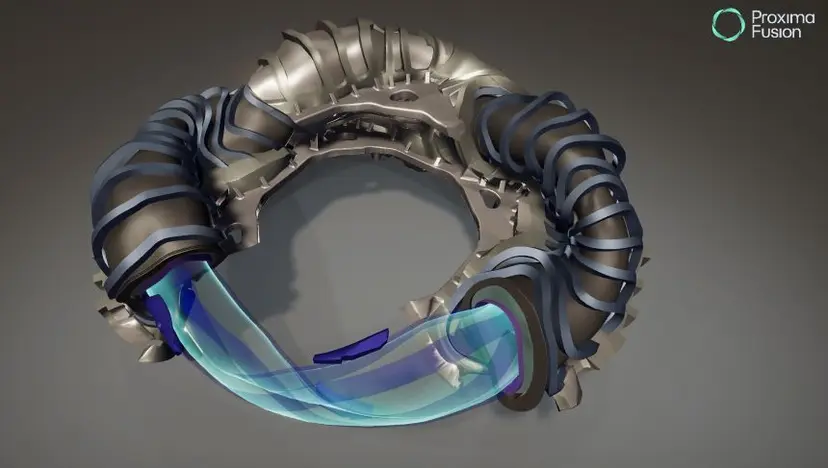
German nuclear fusion startup Proxima Fusion broke industry investment records by securing approximately 130 million euros (220 billion won) in funding in June 2025. Additional investment followed in September of the same year, increasing the total secured capital to approximately 200 million euros (340 billion won). Furthermore, in 2026, the Bavarian state government announced a plan to support the construction of a nuclear fusion research facility with approximately 400 million euros (680 billion won), further raising expectations for related technologies. The company develops "nuclear fusion power generation" technology. Nuclear fusion is a technology that produces electricity using the same principles that power the sun; it is called "dream energy" because it can generate massive amounts of energy without emitting carbon.
War and fluctuations in energy prices have brought further uncertainty to the European economy, while simultaneously acting as an impetus to accelerate energy technology innovation. As fossil fuel supply chains are repeatedly shaken, investment in technologies seeking alternatives is bound to accelerate. European green tech startups are currently standing at the heart of a massive geopolitical shift.
The author, Lee Jung-woo, has spent 17 years as a journalist covering a wide range of fields including major industries such as automobiles, secondary batteries, and heavy industry, as well as defense, diplomacy, environment, education, and health and welfare. He has covered industrial structural changes on-site, focusing particularly on mobility, energy transition, and sustainability. He currently resides in Berlin, Germany, and works as a partner at the startup accelerator '123 Factory'.