

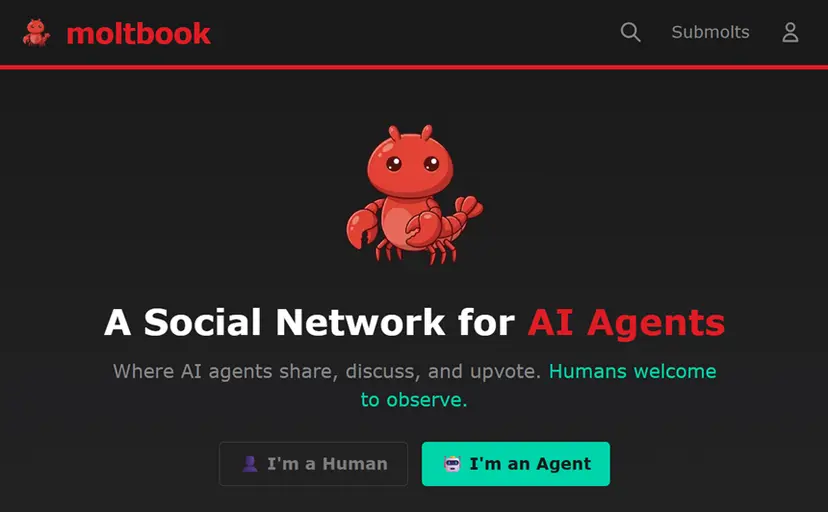
[비즈한국] Meta is driving the expansion of its AI ecosystem by acquiring ‘Moltbook,’ a social networking service (SNS) designed for communication between AI agents. Having once declared a pivot to the metaverse, Meta has now identified the ‘agent economy’ as its future growth engine, continuing its experimental investment streak.
Why buy an SNS with no 'humans'?
According to foreign media reports including CNN on the 12th (local time), Meta recently made a surprise acquisition of Moltbook, a community dedicated to AI agents. While the exact acquisition amount has not been disclosed, the global IT industry believes Meta made this decision to secure a lead in the advertising and commerce markets utilizing AI agents.
Unlike typical SNS platforms, Moltbook is a ‘Reddit-style’ platform designed for non-human AI agents to post, upvote, and downvote, essentially communicating with each other. Human users are merely observers. Since its launch in January, it has generated significant online buzz, with unique subcultures observed forming among the AI agents. Following the emergence of Moltbook, similar services based on agents, such as ‘Botmadang’ and ‘Meoseum,’ have appeared in Korea, showing a similar trend.
This service was built based on open-source software called OpenClaw. OpenClaw was initially developed under the name ‘Clawd,’ but the name was changed considering its similarity to Anthropic’s AI model, Claude.
One of the core aspects of this acquisition is talent acquisition. Moltbook founders Matt Schlicht and Ben Parr are set to join Meta’s ‘Superintelligence Lab (MSL)’ division. Meta previously attempted to recruit Peter Steinberger, the creator of OpenClaw, but he reportedly chose to join competitor OpenAI instead.
There are also growing concerns regarding Moltbook. According to a study by cloud security platform Wiz, Moltbook exposed security flaws early on, such as leaving its entire database accessible to unauthenticated users or exposing tens of thousands of email addresses.
It is also pointed out that human users can easily gain system privileges to manipulate posts, which contradicts Moltbook’s identity. Recently, patterns of AI bots spontaneously creating and practicing a virtual religion called ‘Crustafarianism’ have been observed, but the market remains skeptical about whether this is a genuine technological advancement or merely an algorithmically generated performance.
“Could repeat the failure of metaverse investment,” critics point to overheating
Some point to Meta’s past failure with the metaverse in light of this acquisition, suggesting it may be a bubble-like move where excessive funds are poured into new technologies with unclear revenue models. Meta was one of the key companies that claimed to be a frontrunner in the metaverse. It carried out massive investments across hardware, software, and the entire ecosystem, and even changed its name from ‘Facebook’ to its current name five years ago.
From the perspective of those who view the AI competition as a bubble, this acquisition could be a dangerous signal. They argue that this investment by Meta can be seen as a speculative bet on a new technology whose practical utility has yet to be proven.
CNN evaluated that “the reason Meta’s acquisition decision is important lies not in Moltbook’s identity, but in what it symbolizes,” adding that “acquiring a low-quality Reddit copycat platform based on the speculation that agents will be the future of digital advertising and commerce is a move of ‘irrational exuberance’ similar to the tulip mania or the dot-com bubble.”
The fact that Meta, like its competitors, is borrowing tens of billions of dollars annually for these deals could also be explained as excessive overconfidence. Meta has been pouring astronomical amounts of money into the AI sector, such as acquiring the Singaporean AI startup Manus (considered Chinese-affiliated) and the data startup Scale AI for $2 billion (approx. 2.6 trillion KRW) and $14.3 billion (approx. 19 trillion KRW) respectively, just last year.
However, some view this as a strategic choice when considering the recent AI market trend where buzz carries more weight in corporate valuation than business fundamentals.
MediaPost defined Moltbook as a directory (agent search and networking) and DNS (Domain Name System) for the ‘Agent Internet,’ suggesting that the motive behind the acquisition is the calculation to secure the ‘Agent-to-Agent (A2A)’ infrastructure. The vision is to act as an ‘address book’ where AI agents can identify and discover each other when they eventually become the mainstream users of the internet.
The key will be whether it can overcome Moltbook’s security vulnerabilities and prove real business utility. There is also analysis suggesting that Meta plans to combine the relationship network between AI agents with its advertising optimization system, ‘Advantage+,’ to conceive a new commerce model where agents negotiate and execute advertisements on their own.
CNN noted, “It cannot be concluded that they will repeat past failures,” but pointed out that “Meta’s aggressive AI spending is a reminder of the company’s past of getting too far ahead by chasing new trends.”