

[비즈한국] 26 years after the implementation of the separation of prescribing and dispensing in 2000, the deep-seated conflict between the medical and pharmaceutical sectors is escalating. As the National Assembly pushes for a bill to recommend or mandate generic prescriptions by doctors to stabilize the supply of essential medicines, the vested interests and justifications of both sides are clashing head-on. The medical community is raising its voice, suggesting that the very system of separation of prescribing and dispensing could be fundamentally re-examined, while the pharmaceutical sector dismisses this, arguing that doctors are making unreasonable demands to protect their vested interests in a distorted pharmaceutical sales ecosystem.
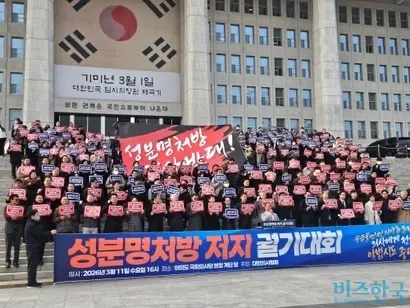
"Doctor takes the responsibility, pharmacist makes the choice?" Doctors outraged by forced imprisonment penalties
At 4 PM on the 11th, in front of the National Assembly building in Yeouido, about 200 medical professionals, including Kim Taek-woo, chairman of the Korean Medical Association, and Park Geun-tae, chairman of the Korean Association of Private Practitioners, held a 'Rally to Stop Generic Prescriptions' to condemn the Pharmaceutical Affairs Act amendment currently being discussed by the National Assembly Health and Welfare Committee.
The medical community opposes the generic prescription bill on the grounds that it cannot guarantee patient safety or consistency in treatment. Chairman Park Geun-tae raised the issue, stating, "We are here to protect the patient's right to safe treatment," and added, "Even with the same ingredients, manufacturing methods differ by pharmaceutical company, and there are significant differences in bioavailability and absorption rates."
Looking at the criteria for pharmaceutical equivalence tests under the Ministry of Food and Drug Safety's administrative rules, the bioequivalence of two preparations containing the same main ingredient is considered statistically equivalent if the 90% confidence interval of the geometric mean ratio of the comparative evaluation items between the reference drug (original) and the test drug (generic) is within 80–125%. The medical community fears that if a pharmacy arbitrarily replaces a drug prescribed by a doctor with another one simply because the ingredients are the same, it could lead to reduced efficacy or unexpected side effects. Kim Hyung-joong, representative of the patient group 'People Thinking of Medical Policy,' also expressed concern: "A 20% negative to 25% positive difference in drug efficacy is effectively a change in medication," adding, "We cannot rule out the possibility that elderly diabetic patients could die from hypoglycemia while sleeping, beyond simple failure to control blood sugar."
The medical community also expressed anger over the penalty provisions included in the bill. Park Jong-hwan, representative of the 25 district medical associations in Seoul, pointed out, "Doctors write the drug names because we take responsibility, but now they say pharmacists should choose the drugs," adding, "The pharmacist makes the choice, and the doctor takes the responsibility." He was furious, saying, "They even say that if this is violated, it will be punishable by up to one year in prison or a fine of up to 10 million won." Hwang Gyu-seok, head of public relations for the emergency committee, also denounced it, saying, "They say if we don't do generic prescriptions, we face up to a year in prison. It seems we doctors have to be ready to go to prison at any time to be doctors."
Regarding the pharmaceutical supply instability cited as the reason for the generic prescription bill, they pointed to failures in government policy and warned that if the situation worsens, they could abandon the principle of the separation of prescribing and dispensing. In a resolution issued that day, the medical community stated, "The pharmaceutical supply instability is a clear policy failure caused by excessive overseas dependence on raw materials and the government's misguided drug pricing policy. Yet, the National Assembly is ignoring fundamental improvements and shifting the burden onto doctors through an absurd bill claiming generic prescription is the solution." They added, "If this is forced through, we will consider it a breach of the medical-pharmaceutical-government agreement on the separation of prescribing and dispensing that began in 2000, and we will fundamentally re-examine the system itself."
Meanwhile, People Power Party leader Jang Dong-hyeok (Boryeong-Seocheon, South Chungcheong Province) attended the rally to show support for the medical community. Representative Jang said, "I am sorry that the Yoon Suk-yeol administration did not listen sufficiently to the medical community's voices, rushed to push for medical reform, and ultimately failed, causing inconvenience to the public and hurting many in the medical field," adding, "The People Power Party will listen more closely to the voices of the medical community and the field and make efforts to communicate fully. I promise that we will create policies that properly reflect the voices from the field," which received cheers from the medical community.
"Are the drugs you've been prescribing fakes?"… Pharmacists target the distorted sales structure
On the other hand, the pharmaceutical sector is cynical about this reaction from the medical community. They believe that behind the opposition, which doctors present as a moral crusade, lies an intention to protect the sales-based ties and vested interests created by pharmaceutical companies. On the same day, a National Assembly debate titled 'Securing Financial Sustainability through Reform of the Health Insurance-Centered Drug Pricing System' was held at the National Assembly Member's Office, co-hosted by Democratic Party lawmakers Nam In-soon, Lee Su-jin, Seo Young-seok, Jang Jong-tae, and Kim Yoon, along with the Free Medical Care Movement Headquarters and the Good Public Hospital Creation Movement Headquarters.
Noh Soo-jin, public relations director of the Korean Pharmaceutical Association, pointed out, "Currently, there are dozens of drugs with the same ingredients in Korea, and in the brand-name prescription system, the authority to choose a specific company's product is concentrated solely on the doctor who has the prescription power." She added, "In this structure, pharmaceutical companies focus on sales activities to get their own products into hospitals and clinics first rather than on the drug's quality or price competitiveness." She continued, "Unless we change the structure to generic prescriptions and price competition by ingredient, it is difficult to solve the problems of rebates, shortages, and multi-drug prescriptions. If we fully introduce generic prescriptions and substitute with the lowest-priced or median-priced drug among those with the same ingredients, it would result in financial savings of 7.9 trillion won every year."
The pharmaceutical sector also expressed doubt about doctors questioning the efficacy and safety of generics with the same ingredients. This is because the generics currently in distribution are the same drugs that doctors directly instruct and prescribe to patients at hospitals and clinics every day, and large general hospitals also procure and prescribe generics from specific pharmaceutical companies through competitive bidding. A pharmaceutical industry official criticized, "For doctors to now claim that generics cannot be trusted is a clear self-denial, implying that all prescriptions by other doctors are wrong."
From mandatory to recommended… Generic prescription bills waiting at the National Assembly gate
Currently, the generic prescription bill is tabled in the First Subcommittee of the National Assembly Health and Welfare Committee. Although a review was originally scheduled for the 11th, it is expected to be re-discussed at the subcommittee meeting next month because the discussion on other contentious bills dragged on that day.
Democratic Party lawmakers Jang Jong-tae (Seo-gu Gap, Daejeon) and Kim Yoon (proportional representation) each proposed bills. Representative Jang's bill mandates that doctors prescribe drugs by generic name instead of brand name. The bill includes the penalty provision that outrages the medical community—up to one year in prison or a fine of up to 10 million won for violations. The targeted drugs are limited to those officially designated as supply-unstable drugs after deliberation by a separate body called the Supply-Unstable Drug Supply Management Committee.
Unlike Representative Jang's bill, which makes it mandatory, Representative Kim's bill allows the Minister of Health and Welfare to recommend generic prescriptions to doctors. The scope of drugs is also broadened to include national essential medicines in addition to those with unstable supplies. Both of these bills can be seen as applying the generic prescription requirement in a limited scope rather than fully introducing it for all medicines.
In fact, current legal regulations do not prohibit generic prescriptions. Article 12 of the Enforcement Rules of the Medical Service Act specifies the items to be included when a doctor or dentist issues a prescription. Item 5 of Paragraph 1 specifies the 'name (generic name, brand name, or the name set by the Korean Pharmacopoeia under Article 51 of the Pharmaceutical Affairs Act), quantity, usage, and dosage of the prescribed drug,' so medical professionals can choose either the generic name or the brand name when writing a prescription.