

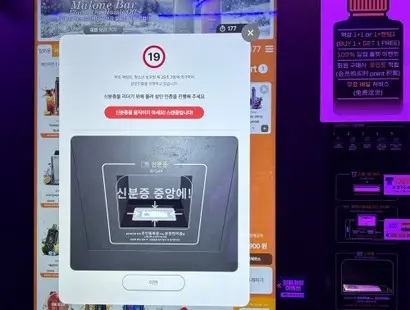
[비즈한국] On the 9th, in a bustling district in Seodaemun-gu, Seoul. An unmanned e-cigarette shop was located just 3 minutes away from an elementary school. Inside the store, there were vending machines selling e-cigarette devices, liquids, and disposable products, with no staff present. When I placed a fake paper ID printed with the name ‘Hong Gil-dong’ on the vending machine scanner, the screen displayed a message saying, “Scanning, please do not move.” There was no real-time face matching or additional verification process. Moments later, the screen moved on to the payment stage.

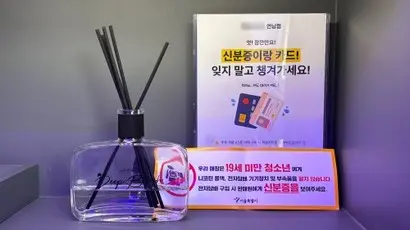
An unmanned e-cigarette shop visited the same day in Mapo-gu, Seoul, was no different. Although a sign saying ‘E-cigarettes are not sold to minors under 19’ was posted on the wall, the adult verification process was merely a formality. This store even operated a delivery service through a dedicated application.
Increased exposure of youth to e-cigarettes, regulations unable to keep up
Concerns are growing that e-cigarettes are becoming easily accessible to youth. According to a World Health Organization (WHO) survey of 57 countries, youth e-cigarette usage rates have already surpassed traditional cigarette smoking rates in 31 countries, including South Korea. It is estimated that at least 15 million youth worldwide use e-cigarettes.
The problem is that while e-cigarette sales methods are evolving rapidly, regulations are failing to keep pace. As the number of unmanned shops and online sales increases, critics point out that devices intended to block youth access are not working properly.
In the Mapo-gu area alone, where many universities are located and there is a large young population, there were a total of 9 unmanned 24-hour e-cigarette shops in operation. However, adult verification relies mostly on simple checks like ID scanning.
Actual users were also visiting unmanned shops for this very convenience. A man in his 20s, surnamed A, whom I met at a shop, said, “Unmanned vending machines are not much different from regular stores,” adding, “I come here because I can choose items comfortably without having to worry about staff watching me.”
Age verification with a ‘Health Insurance Card’… Lax adult authentication
The situation was not much different in stores where staff are present. When I visited a nearby e-cigarette shop and asked, “Can I only buy if I have an ID card?” the employee replied, “I check just in case, but you can show me a health insurance card instead of a resident registration card.” Health insurance cards cannot be legally used as a means of adult verification. Because they lack a photo, there is a possibility of using someone else’s. Because regulations are loose, age verification is poor, meaning even youth can easily buy e-cigarettes.
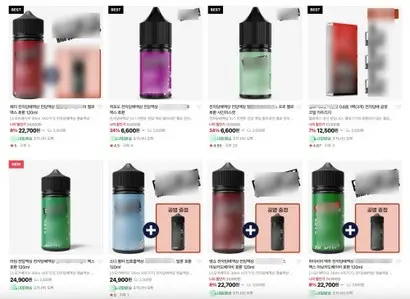
Online sales are also pointed out as a blind spot. Most e-commerce platforms have limited the distribution of synthetic nicotine e-cigarettes since 2023, allowing only nicotine-free liquids to be sold. However, there are many cases where this rule is not properly followed during actual distribution.
B (25), who purchased an e-cigarette through internet shopping, said, “I bought it believing the description that it was a nicotine-free product, but the product that arrived actually contained nicotine.” He added, “Looking at the review photos from other buyers, most were synthetic nicotine products,” and “When I inquired with the seller, they said they couldn’t exchange it and would only provide a refund.”
Expanding regulations is not a cure-all
Until now, unlike conventional cigarettes, e-cigarettes were not subject to the Tobacco Business Act and the National Health Promotion Act. To sell tobacco directly to consumers, one must be designated as a tobacco retailer by the competent mayor, county governor, or district head where the business is located. Since e-cigarettes did not require this designation, 24-hour vending machine operations were possible.
Accordingly, on the 26th of last month, an amendment to the Tobacco Business Act that includes liquid e-cigarettes in the category of tobacco passed the Legislation and Judiciary Committee of the National Assembly for the first time in 9 years. Starting April 24, as the definition of tobacco expands, synthetic nicotine e-cigarettes, which were previously in a regulatory blind spot, will be subject to the same regulations as regular cigarettes. Specifically, measures such as advertising restrictions, online sales bans, prohibitions on vending machines, and the imposition of various levies are scheduled to be implemented.
However, concerns are raised that it is difficult to solve the youth access issue solely through expanded regulation. Some argue that if retailer designation becomes possible, the number of sales outlets might actually increase, potentially raising accessibility.
Park Eun-hee, a senior specialist at the Korea Health Promotion Institute’s Tobacco Control Policy Planning Department, stated, “If the designation of synthetic nicotine e-cigarette sellers as retailers is permitted, purchase accessibility could expand along with the increase in sales outlets,” adding, “We must also prepare for the possibility that current regulations may not adequately respond to market changes.”
She emphasized, “The core factors determining the effectiveness of regulation are constant monitoring of age verification procedures and sales activities aimed at youth, and compliance with the obligation to disclose product ingredients,” noting that “these areas must be prioritized during the on-site enforcement process.”