

[비즈한국] As the government pushes forward with its policy to lower generic drug prices, the pharmaceutical and biotech industry has expressed concerns over a crisis of survival, presenting 48.2% of the original drug price as its final "red line" for price calculation. Just one day before the Health Insurance Policy Deliberation Committee (Health Insurance Committee) plenary session on the 11th, the industry has drawn a line in the sand, urging the government to seek a rational consensus through joint public-private research rather than forcing through a unilateral policy.
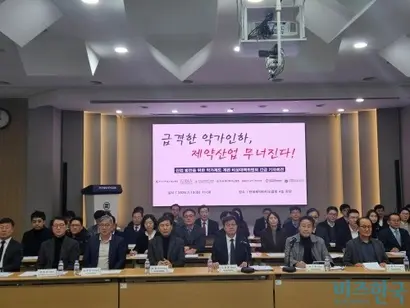
Roh Yeon-hong, Chairman of the Korea Pharmaceutical and Bio-Pharma Manufacturers Association (KPBMA) and co-chair of the Emergency Response Committee for Pharmaceutical Price System Reform, held a press conference on the 10th at the KPBMA building in Bangbae-dong, Seocho-gu, Seoul. He stated, "The industry cannot ignore the difficulties in health insurance finances and the burden on the public, so we have made a broad-minded decision that we can accept a generic price reduction to 48.2% of the original drug." Kwon Ki-bum, Vice Chairman of Dongkuk Pharmaceutical086450 and Chairman of the KPBMA, added, "We will make rigorous efforts to cut costs by sharing the burden with our business partners."
The press conference was held ahead of the Health Insurance Committee meeting scheduled for the 11th, which is solely dedicated to processing the drug price reform plan, and is interpreted as a desperate move by the pharmaceutical industry to block the government's forceful policy implementation. The drug price reform plan was initially expected to be processed at the February Health Insurance Committee meeting, but the agenda item itself had been postponed.
Currently, the government is pushing to lower generic drug prices—which are calculated at 53.55% of the original drug—to the 40% range, under the pretext of strengthening health insurance finances and encouraging R&D for new drugs.
Conversely, the pharmaceutical industry is concerned that if the maximum generic drug price under the government's proposal is lowered to 40% of the original drug, it could result in an annual loss of up to 3.6 trillion won. This could not only force small and medium-sized pharmaceutical companies to cut back on R&D investments but also threaten their very survival. Projections suggest that this could lead to the loss of approximately 14,800 jobs, which is more than 10% of the estimated 120,000 workers in the pharmaceutical industry.
Some pharmaceutical companies are reportedly already reducing or reconsidering their R&D and facility investment plans and have ceased new hiring. In the process, the number of companies voluntarily canceling product permits for essential or life-saving drugs with low profitability or considering production line cuts is increasing, raising concerns about aggravated instability in drug supply and demand.
Yoon Woong-sup, Chairman of Ildong Pharmaceutical249420 and co-chair of the Emergency Response Committee, said, "Our company has adjusted hiring and R&D budgets in line with emergency management for survival," adding, "Since price reduction is not just about shrinking profits but is directly tied to the sustainability of the business, if the government analyzes the industrial structure and corporate financial conditions precisely before designing the policy, it will allow (companies) to prepare for a predictable future."
Chairman Roh Yeon-hong lamented, "I believe we are in a golden time for industrial development, as 30% of the 41 domestically developed new drugs have emerged in the last 5 years," adding, "It is regrettable that a large-scale drug price reduction plan has been proposed just when we are not far from becoming a leader in the pharmaceutical and biotech industry."
Furthermore, the industry's anxiety is compounded by the fact that manufacturing costs are rising due to surging international oil prices and exchange rates following the recent war between Israel, Iran, and the global situation, especially given the high dependence on imported active pharmaceutical ingredients. The sentiment is that if generic drug prices are slashed amidst such increasing global uncertainty, the pharmaceutical industry will be pushed to a breaking point.
Chairman Kwon Ki-bum cited the case of Japan, the world's third-largest pharmaceutical market, to emphasize the significance of generic drug prices. Chairman Kwon explained, "Generics account for 80% of total prescriptions in Japan, exceeding the 53% level in Korea," adding, "By nationally promoting and encouraging the use of high-quality generics, it not only benefits health insurance finances and patients but also leads to the development of innovative new drugs and improved drugs." He then requested, "As drug prices are an important catalyst, please reconsider the excessive price reduction policy."
Before the government finalizes the drug price reform plan, the Emergency Response Committee has proposed three joint research projects. These include: △Analyzing the impact on public health and industrial structure if implemented according to the government's proposal, △Developing institutional improvements to establish sound distribution order, and △Creating sustainable advancement strategies to become one of the top 5 pharmaceutical and biotech powers, with a suggestion to produce results within one year.
Chairman Roh stated, "If we prepare implementation measures together, we expect to enhance the transparency and predictability of policy decisions and increase acceptance in the industrial field," adding, "If the government accepts this proposal, we are ready to start the research tomorrow."