

[비즈한국] The universe rotates. Planets spin, stars spin, and galaxies spin. But could an even larger structure, composed of many galaxies, also spin? Recently, astronomers discovered the largest rotating cosmic structure ever found. It appears that an entire cosmic filament stretching 50 million light-years across is rotating!
MeerKAT radio telescopes standing in the South African desert targeted a corner of the universe. The study was conducted as part of the MIGHTEE observation project, which maps galaxies in the distant universe by scanning the sky with 64 radio telescopes. Radio waves are particularly excellent for observing fresh hydrogen gas contained within galaxies. Hydrogen reveals how many more stars a galaxy will be able to create in the future. Astronomers discovered 14 galaxies rich in hydrogen gas at a distance of about 140 million light-years. Interestingly, these galaxies were not just scattered randomly in space; they were connected in a long line stretching about 5.5 million light-years.
That wasn't all. These 14 galaxies in a row were part of a much larger cosmic filament. This filament is clearly visible in galaxy maps previously confirmed through other optical observations. This massive filament, containing over 280 galaxies, stretches for 50 million light-years.
Cosmic filaments are also known as the "highways of galaxies." Shortly after the birth of the universe, there were fluctuations in density. From the beginning, matter rapidly gathered toward regions with even slightly stronger gravity, leading to the formation of filaments. Many gas materials and dark matter collect along these cosmic highways, and over time, galaxies form within them. Because these filaments are intertwined like a giant web, it is called the Cosmic Web. Today, many high-resolution cosmological simulations perfectly reproduce this process of how the Cosmic Web is formed.
The reason this newly discovered filament is more special is not just its size. It is because the thick, elongated filament is rotating as a whole! Observations of hydrogen gas using radio waves provide more certain information about the rotation speed and direction of each galaxy. As a galactic disk spins, half of it approaches us while the other half moves away, exhibiting the Doppler effect, where one half is blueshifted and the other is redshifted. Using this, astronomers found that the rotation axes of the 14 galaxies are surprisingly aligned with the direction of the giant gas filament to which they belong.
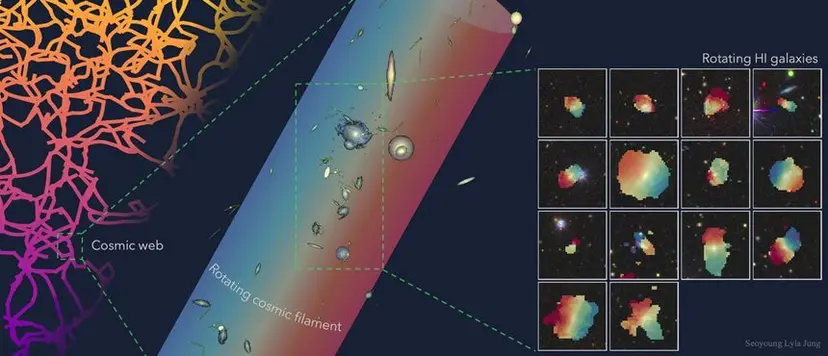
This result is difficult to expect from filaments typically reproduced in existing simulations. In standard simulations, if we assume that matter gathers and galaxies form within a filament solely due to gravity without additional external forces, there is no reason for the rotation directions of the galaxies to show any trend; they should be randomly distributed. However, the structure discovered this time has the rotation axes of the galaxies aligned almost perfectly along the direction of the filament.
This means that when galaxies are born, there is an additional effect significantly influenced by the orientation of the filament. If gas is flowing along the filament and galaxies are being forged within that gas flow, it would explain why the rotation axes of these galaxies are so consistently aligned.
Even more surprisingly, not only are the individual galaxies within the filament rotating, but the entire filament itself is spinning. The astronomers analyzed the relative motions of all the galaxies in the filament. The results showed a pattern where, along the long filament, half of the galaxies are moving away and the other half are moving toward us. The filament as a whole is rotating at a staggering speed of 110 km/s. This speed is comparable to the relative velocity of the Milky Way and the Andromeda Galaxy, which are currently hurtling toward each other. A giant, thick filament spanning 50 million light-years—a single strand of the cosmic structure—is rotating at a speed comparable to two galaxies colliding! It is the longest and largest rotating cosmic structure ever discovered.
In particular, the reason this filament shows a distinctly clear rotational pattern may be because it is a relatively young structure. This filament is rich in hydrogen gas—the raw material for new stars—and is inhabited by many galaxies with simple internal dynamics and consistent spin. In other words, it is still dynamically "cold." This means it is a "newly formed," young filament in the relatively early stages of the cosmic structure formation process. Therefore, the influence of the gas flow that was rushing along this freshly opened galactic highway is still strong, and the galaxies formed within it share clearly aligned spin directions.
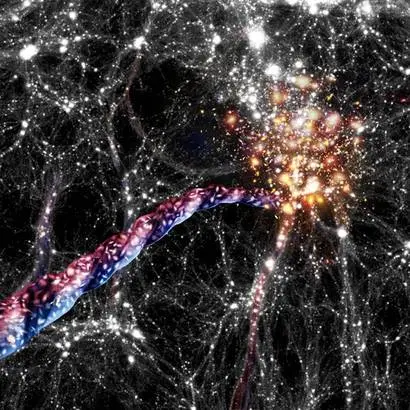
This discovery provides a clearer picture than ever before of exactly how cosmic structures are formed and how galaxies are born within them. Much like understanding star formation by observing young nebulae where new stars are actively being born, we are understanding the birth of cosmic structures by looking at this accidentally discovered, relatively young Cosmic Web. It is a site where the Cosmic Web—which could previously only be inferred through simulations—is just now connecting and taking on its new shape.
Furthermore, it is a reminder that our universe is not yet a world that has finished its formation process. If we examine the corners of our universe carefully, there are still many places where new structures are actively being created, even on the scale of a 50-million-light-year-long Cosmic Web. At a glance, the universe might seem like a boring world waiting to fade away, but it never stops forging its own new appearance and structures.
This discovery will be of great help in creating 3D maps of vast galaxies across the universe, such as those from the Vera Rubin Observatory and DESI, and in completing our understanding of the actual cosmic structure. Our universe is intricately intertwined like a giant net, with all galaxies following long, connected filaments. And now, we even know that each individual filament strand is twisting and rotating.
Before long, we will be able to move beyond static maps of cosmic structure that simply show how galaxies are connected, and complete more comprehensive maps that even express individual movements, such as how fast each filament is rotating and twisting. Just as we see matter gather and the skeleton of cosmic structure sharpen in a simulated virtual universe, we will soon be able to apply that incredible sight to the actual universe, visualizing and imagining it as it is.
Reference
https://academic.oup.com/mnras/article/544/4/4306/8363602?login=false
Who is the author, Woong-Bae Ji? He loves cats and the universe. After watching 'Galaxy Express 999' as a child, he dreamed of sharing the beauty of the universe. He is currently an assistant professor in the Faculty of Liberal Arts at Sejong University, participating in various science communication activities such as lectures and writing. He has authored books like 'A Piece of the Universe Every Day', 'Scientists of the Starry Universe', 'Cannot Go But Can Know', and 'Strange Questions That Come to Mind When Looking at the Universe', and translated books including 'The Hitchhiker's Guide to the Real Universe', 'How I Killed Pluto', 'Quantum Life', and 'Cosmigraphics'.