

[비즈한국] With the global TV market entering a mature phase, home appliance companies are increasingly prioritizing sound as a key differentiator. It is in this context that LG Electronics066570 has unveiled a premium home audio system that eliminates installation constraints by combining artificial intelligence (AI) with wireless technology. As picture quality competition reaches its peak and distinctiveness wanes, the company aims to secure a breakthrough in a stagnant market and grow its audio business by elevating high-quality sound to a core pillar of the home entertainment experience.
Breaking the Rules of Spatial Audio: “The Speaker Follows the User”
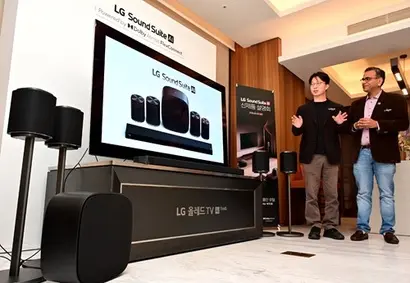
LG Electronics held a new product launch event at the Ambassador Seoul Pullman Hotel in Jung-gu, Seoul, on the 5th, where it introduced the ‘LG Sound Suite,’ the first in Korea to support Dolby’s advanced audio technologies. A defining feature of the premium home audio system is its ability to recognize the position of its speakers regardless of where they are placed, creating immersive surround sound tailored to the space.
Conventional home theater systems historically imposed significant installation constraints, requiring speakers to be placed in fixed positions with complex wiring. Even a slight change in speaker placement could disrupt the audio balance. The LG Sound Suite overcomes this limitation by using AI to detect the location of each speaker and implement spatial audio optimized for the room.
The core technology revealed during the live demonstration, ‘Sound Follow,’ utilizes Ultra-Wideband (UWB) wireless transmission technology to track the listener's location in real-time. Even if a user moves from the sofa to the dining table, operating the smartphone app shifts the audio focus to follow the user. Park Chan-hoo, Head of LG Electronics Audio Development, explained, “This is the first soundbar to collaborate with Dolby to ensure users can enjoy optimized sound no matter where they place the speakers.”
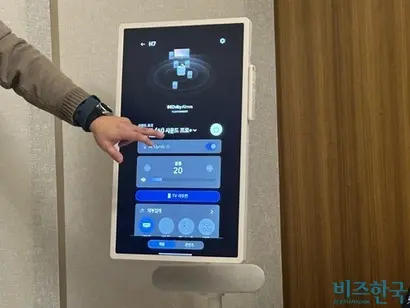
The soundbar is equipped with the 3rd Generation Alpha 11 AI processor, the same chip found in 2026 LG OLED TVs, serving as the ‘brain’ of the audio system. The AI identifies and distinguishes between sound effects, music, and vocals in real-time to clarify voices and enhance spatial presence through an ‘AI Upmix’ feature that expands low-channel audio into multi-channel. The system can be used even without a TV connection, allowing for music streaming via Wi-Fi and Bluetooth.
LG emphasizes that this product represents a new technological milestone. According to the company, this is the first time Dolby’s ‘Atmos FlexConnect’ has been applied to a soundbar-based system equipped with wireless surround speakers and subwoofers for a global commercial release.
Kim Hyo-chul, Director at Dolby Korea, emphasized, “Previously, experiencing cinema-like immersive sound at home required expensive home theater equipment, complex wiring, and professional installation. FlexConnect is a ‘Copernican shift’ in technology where the audio adapts to the environment rather than requiring the environment to be changed for the audio.” He added, “Consumers simply place the speakers where they want, and the system analyzes the room characteristics and speaker performance to create the optimal sound.”
‘Competition After Picture Quality’ in the 240 Trillion Won Audio Market
The growth potential of the global audio market and shifts in the TV industry landscape underpin LG Electronics’ focus on its audio business. Last year, the global audio industry was valued at approximately 163 billion USD (about 240 trillion won), a 7% increase from the previous year. In particular, the Korean home audio market is projected to grow at an annual average of 5.9%, from approximately 630 million USD in 2024 to approximately 1.13 billion USD by 2034.
As video consumption increases due to the proliferation of OTT and streaming content, sound quality is emerging as the ‘next frontier of competition’ after picture quality. As TV picture quality has reached a level of parity, consumers have begun to consider sound quality as a critical purchase factor.
LG Electronics has been actively expanding its audio business territory. Last year, it revamped its audio brand ‘XBOOM’ and introduced new products in collaboration with world-renowned musicians to strengthen its brand image. The company’s goal is to grow its current audio revenue of approximately 700 to 800 billion won into a ‘trillion-won’ business by expanding its B2C expertise into B2B sectors, such as automotive electronics.
Competitors are also making moves. Harman, a wholly-owned subsidiary of Samsung Electronics005930, expanded its business last year by acquiring the audio division of the U.S.-based Masimo. Harman, which owns over 20 audio brands including Harman Kardon, JBL, and AKG, recorded 15.8 trillion won in revenue last year, an 11% increase compared to the previous year. The audio segment, along with automotive electronics, is credited with driving this growth.
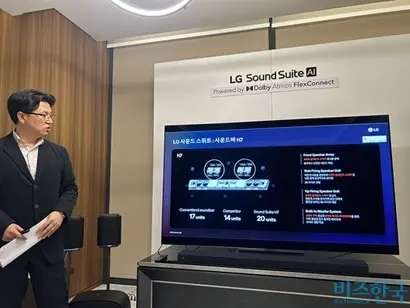
Starting with this product, LG Electronics plans to expand its audio lineup in stages. The company intends to strengthen its ‘TV + Audio’ integration strategy in the home entertainment market. The LG Sound Suite allows for up to 50 different configurations through various combinations of soundbars (H7), surround speakers (M5, M7), and subwoofers (W7). The LG Sound Suite will be released in North America and Europe first, followed by a domestic launch next month.
Lee Jung-seok, Executive Vice President of LG Electronics’ Audio Business, stated, “This is a product that allows customers to easily customize their own sound according to their lifestyle. We will strengthen our global brand competitiveness by expanding the premium audio experience.”