

[비즈한국] "If you believe in the word, you will receive spiritual blessings."
On the 3rd, in front of Seoul Station, the sounds of proselytizing from religious groups filled the plaza. Organizers raised their voices through microphones toward passersby. Just 20 meters away, hymns blared from another area, creating a chaotic mix of noise. Tourists pulling luggage looked on with curiosity as if witnessing an unfamiliar sight, before quickly hurrying past.
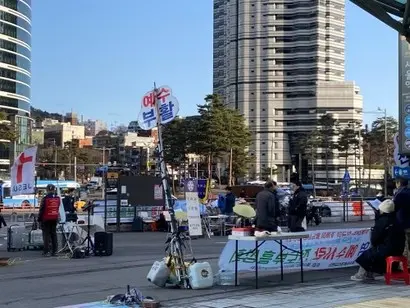
In Front of Exit 1 of Seoul Station: Recurring Noise and Conflict
The area in front of Exit 1 of Seoul Station, often called a "prime spot," is in complete disarray. Recently, a major disturbance broke out between members of the Tenrikyo sect and the Yesua World Mission Center, who even threw chairs at each other over territory. Although police were dispatched to resolve the situation, many citizens remain anxious.
According to the Namdaemun Police Station, about 15 religious groups hold protests or demonstrations at Seoul Station every week. On this day, the Sunshine Church, Jesus Evangelism Society, Yesua World Mission Center, and Tenrikyo each staked out their spots to hold rallies. The cycle repeats as one group speaks for 10 minutes, followed by the next.
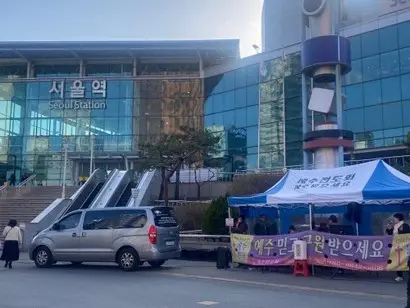
Proselytizing activities by religious groups in front of Seoul Station have continued for over 20 years. Missionary Ye Bong-han, who participated in the rally, said, "I understand that Tenrikyo was the first to begin missionary work in the center of Seoul Station Plaza over 20 years ago. Seeing this, passionate pastors began holding their own rallies right in front of them." He explained that other denominations began gathering at Seoul Station Plaza as a way to counter Tenrikyo.
As the number of religious groups increased, they began competing by turning up their volume to drown out the sounds of other groups. An employee at a nearby shop complained, "Even with the door closed, I can't even have a conversation with customers." A security guard stationed in front of the escalator mentioned, "It's so noisy that 501 employees and office workers once filed a petition."
The gathering of religious groups in front of Seoul Station also serves as a draw for the homeless. One homeless person said they visited the plaza because "if you finish the service on Wednesday, Friday, or Sunday, you can get a snack."
Ordinances and Assembly Laws Exist, But Enforcement on the Ground is Not Easy
As the noise from protests and issues regarding the homeless at Seoul Station Plaza emerged, the Seoul Metropolitan Government initiated the 'Ordinance on Support for Creating a Sound Usage Environment for Seoul Station Plaza' in March the year before last. The goal was to "contribute to enhancing the image of Seoul, creating a pleasant and safe environment, and improving the quality of life for citizens." However, as there have been no changes tangible to citizens, critics argue the ordinance is toothless. In fact, even relevant agencies were unaware of the existence of this ordinance.
Seoul Station Plaza is a site owned by the Korea National Railway, KORAIL, and the Cultural Heritage Administration. However, the actual management authority lies with the police. Since the proposal of the ordinance, the Seoul Metropolitan Government has worked with related agencies like the police and KORAIL to establish management measures for the plaza, but discussions have been held only six times in nearly two years. It has been noted that no meetings have been held yet this year.
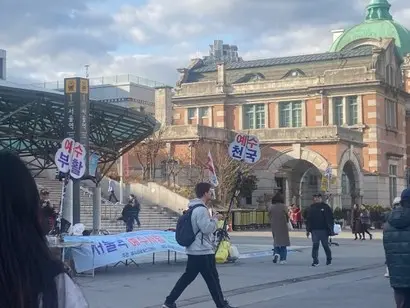
It is not that there are no methods of regulation. According to the 'Assembly and Demonstration Act,' noise from protests can be regulated based on 'equivalent noise levels' (average) and 'maximum noise levels' (measured peaks). Administrative orders can be issued if the equivalent noise exceeds 70dB over 10 minutes, or if the maximum noise exceeds 90dB more than three times within an hour.
However, the police state that it is difficult to measure the noise of religious groups on site. The groups reportedly lower their volume momentarily while police are on the scene, keeping the equivalent noise level below 70dB. The situation is similar when measuring for peak noise. Furthermore, when multiple groups use loudspeakers simultaneously, the resulting noise is classified as 'overlapping noise.' In this case, the police explain that it is difficult to regulate because the specific group responsible for the noise cannot be identified. Amidst such deficient administrative management systems, legal enforcement also fails to be effective due to limitations on the ground.
Filling Legal and Administrative Gaps is Necessary for a 'Space to Stay'
Ultimately, to regulate the noise from religious protests, the 'Assembly and Demonstration Act' noise standards must be amended to close institutional loopholes. Current regulations apply an 'average noise' standard, making it difficult to prevent the practice of temporarily lowering volume only to raise it again. Additionally, the criteria that prevent enforcement due to the classification of 'overlapping noise' when volume levels increase also appear to require improvement.
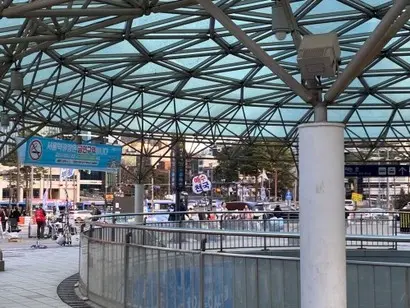
Along with this, suggestions are being made that the Seoul Metropolitan Government ordinance also needs to be supplemented to increase its effectiveness. This means establishing a system that exercises practical management authority to regulate groups that repeatedly cause noise.
A Seoul city official stated regarding this, "We plan to prepare alternatives in connection with related agencies for tasks that require improvement, and we will continue to review the matter if necessary." The Secretariat of the Citizens' Coalition for a Better City added, "Seoul Station Plaza currently exists only as a transit facility; there is no clear definition of what kind of space it should become. We must continue to contemplate what direction the plaza should take so that citizens can use it comfortably in the future."