

[비즈한국] Barcelona, early March. The Fira Gran Via exhibition center in Barcelona, Spain, where the global telecommunications industry gathers, is a space where the 'new order' announced by the industry feels much larger than the latest phones. MWC 2026, marking its 20th anniversary, was highly anticipated worldwide to see what major agenda would define this new order.
However, the sudden outbreak of the Iran-Israel war last weekend cast a shadow of tension over the event from the start. King Felipe VI of Spain also addressed the war, rather than new technologies, at the event. He kicked off the exhibition by stating, "At this very moment, the Middle East is once again in a critical phase, and there is a clear risk of regional conflict expanding," adding, "I hope that technology can be used as a tool for connection rather than division, for development rather than exclusion, and for peace rather than confrontation." This remark symbolized the mood of this year's MWC.
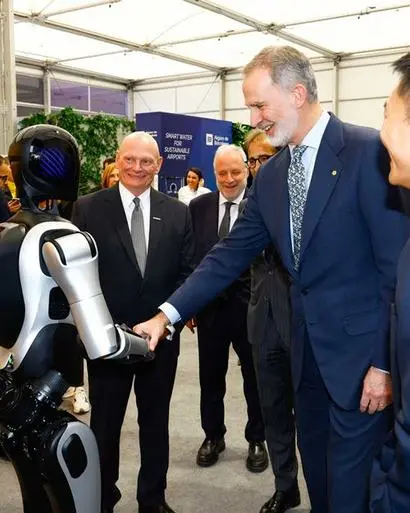
The impact of the war, which began with U.S. and Israeli airstrikes on Iran on the 28th of last month, reached the scene in Barcelona directly. As Middle Eastern airspace closed, major flights from airlines like Qatar Airways, Emirates, and Etihad were canceled one after another, leaving many booths of companies from Iran, the UAE, Qatar, and other Middle Eastern nations empty. Spots that were filled every year with large booths from Middle Eastern telecom and tech companies remained vacant this year, displaying only banners. GSMA Director General Mats Granryd expressed his condolences during a panel discussion on the opening day, saying, "Our hearts go out to all those affected by the conflict." It was a case where war took the lead in the agenda at an event dedicated to discussing technological innovation.
Nevertheless, or perhaps because of it, the core message of this year's MWC was even more pronounced: If the smartphone was a 'vessel for AI,' the trend is now shifting toward the communication network itself becoming the AI. The announcement symbolizing this inflection point was none other than the 'AI Call Assistant' from Germany's leading telecom operator, Deutsche Telekom.
"Hey Magenta": The Moment AI Joins a Phone Call
The structure of the Magenta AI Call Assistant unveiled by Deutsche Telekom is intriguing. Usually, AI features are attached to apps (messengers, meeting tools) or specific high-end devices (earbuds, latest phones), but Deutsche Telekom declared it would embed the functionality at the 'network level' instead. The claim that "No apps or the latest smartphones are needed; it even works on old feature phones" demonstrates the market expansion approach desired by European telecom operators—that is, the direction toward reaching mass-market devices.
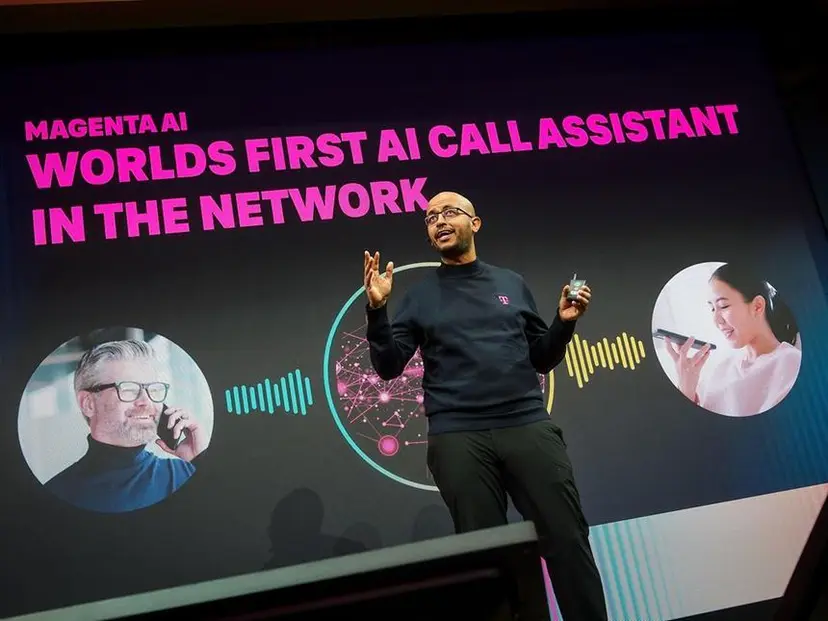
The features are intuitive. Users can get real-time translation during calls (aiming for 50 languages within 12 months), text summaries after calls end, and information searches for flights, hotels, sports, etc., during calls when needed. The activation method is also symbolic. During a call, if you say "Hey Magenta," the AI joins as a 'third participant' and responds via voice. Deutsche Telekom is known to have implemented this service in collaboration with the voice AI company ElevenLabs. ElevenLabs is a British AI startup that reached a valuation of $11 billion (approx. 16.25 trillion KRW) after securing $500 million (approx. 738.8 billion KRW) in Series D funding last February.
What is important here is the shift in power rather than the UX. Previously, the 'gatekeepers' of AI features were OS companies (Apple, Google) and handset manufacturers. Now, however, telecom operators have declared that they can "embed AI into the network and distribute it to everyone." This is a signal that areas where Europe holds strengths—'regulatory compliance, communication infrastructure, and data sovereignty'—can become weapons in the AI era as well.
Personal Information, Consent, and EU Processing: Conditions for 'European-style AI'
Deutsche Telekom defended against concerns regarding wiretapping, surveillance, and data leaks with a framework stating, "It only works when the user calls for it, and it adheres to law and ethics." For cases involving recording for call summaries, they emphasized protocols such as deletion after processing, data handling within the EU, and launching in Germany first.
This point is both an opportunity and a challenge for startups trying to enter the European market. In terms of opportunity, 'EU regulation, consent design, and data governance' can be turned into product competitiveness. Conversely, in terms of challenges and burdens, it means that if a product does not properly design for consent, transparency, and storage/deletion policies, it cannot enter the market at all. In other words, in Europe, AI will be defined not only by 'performance' but also by the compliance framework and the capability to build it. This is ultimately why telecom operators are taking the lead in such innovation.
Other 'Hints' from MWC: AI, Satellite, and 6G
The landscape of this year's MWC was even more macroscopic. With over 100,000 attendees and more than 2,700 exhibitors, the key focus was less on new hardware and more on AI, satellite internet, 6G, and supply chains. Three scenes in particular stood out.
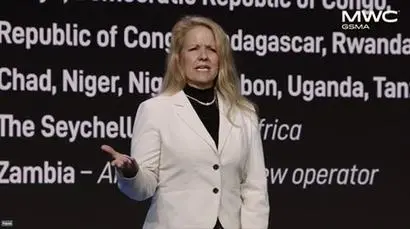
First, satellite internet has moved from the periphery of the telecom industry to center stage. Gwynne Shotwell, President of SpaceX, announced at MWC that they plan to launch about 1,200 second-generation satellites into space by 2027 to provide mobile Starlink internet services globally at DSL-level speeds.
Second, the 6G vision presented by Nvidia. This has been redefined not as a simple speed race, but as an 'AI-native network.' Leading up to MWC, Nvidia revealed massive AI-RAN collaborations with major telecom operators across Europe, Asia, and North America, alongside Nokia, directly jumping into the leadership race for the 6G era. AI-RAN is a structure where base station functions are implemented as software, and Nvidia's GPUs handle both AI computation and network traffic. Simply put, it is a way for communication networks to become 'smarter.'
T-Mobile in the U.S. completed field tests running video streaming, generative AI, and AI subtitle generation simultaneously with 5G on the Nvidia AI-RAN platform, while Japan's SoftBank set a technical milestone by implementing the industry's first 16-layer Massive MIMO in a fully software-defined manner. IOH, Indonesia's largest telecom operator, successfully demonstrated the first AI-based 5G call in Southeast Asia, showcasing real-time cross-border connectivity and remote control of robots over 5G networks.
At this MWC, the number of AI-RAN-related demos tripled from last year to 26. These included technology where AI learns signal formats to achieve transmission speeds about twice as fast as before, demos of autonomous vehicles distributing AI computations across devices, edges, and clouds in real-time, and orchestration blueprints where GPUs share AI and communication workloads while maintaining service quality. Dr. Choi Jin-sung, chair of the AI-RAN Alliance, stated, "By consolidating telecom operators, equipment manufacturers, and research institutions centered on software-defined and GPU-accelerated architectures, we are building the foundation for AI-native 6G right now."
The connection to Europe is also concrete. In the EU-funded Project ULTIMO, Capgemini is conducting demonstrations to support large-scale autonomous shuttle operations in European cities by combining Nvidia AI-RAN servers with 5G. Ultimately, 6G is becoming not just 'faster internet,' but an infrastructure for physical AI that allows robots, autonomous driving, and industrial sites to think and move in real-time. Who designs that foundation—whether it's OS companies, telecom operators, or players like Nvidia who hold both chips and software—has become the core question of the next platform war.
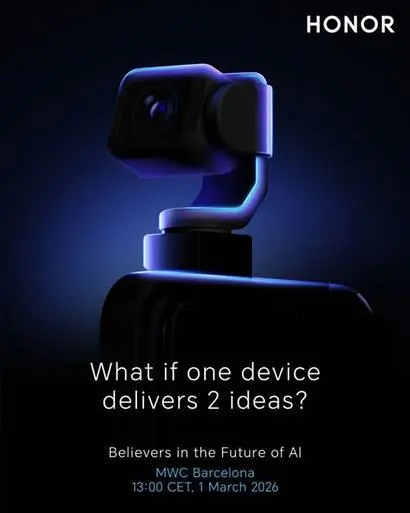
Showmanship was not missing from MWC either. The concept phone shown by Chinese smartphone maker Honor, which features a "camera that moves and nods its head," showed that people are now more drawn to experiences where AI responds like a human than to device specs. This so-called 'robot phone' operates with a camera attached to a three-axis gimbal arm that recognizes human speech, tracks movement, and interacts accordingly. It can respond to emotional gestures, such as nodding or shaking its head like a person, and even dance to music. It was a scene that made one realize the center of gravity of MWC has completely shifted from hardware to interaction.
Startup Opportunities Discovered at MWC 2026
MWC 2026: where Middle Eastern booths were empty due to war, satellite internet took center stage, and telecom operators positioned themselves as the new gatekeepers of AI. To summarize the landscape: AI is moving from apps to networks, satellites and 6G are redrawing the map of connectivity, and supply chain issues like chip shortages are realistically limiting the speed of innovation. And geopolitical instability acts as a catalyst, reshaping all of this even faster. The conclusion from a startup perspective that can be drawn from this MWC is quite clear.
First, 'Network AI' becomes a new platform. The moment a telecom operator embeds call AI into the network, startups must change their questions. They should ask, "How can we become a plug-in for communication networks and call UX?" Second, the demand for satellites, 6G, and AI expands the market for 'connectivity startups.' As the discourse on satellite internet and 6G grows, startups are shifting from mobile apps to service design in environments where connectivity is unstable. Opportunities can be found in specific vertical areas such as logistics, maritime, disaster relief, border regions, and defense/public safety. As the recent Iran war shows, as geopolitical instability increases, stable connectivity based on satellite communication will actually see even higher demand.
The author, Lee Eun-seo, majored in law in South Korea and studied theater in Berlin. She is based in Berlin, a city of art and a European startup hub, and leads 123factory, which connects the startup ecosystems of Korea and Germany while growing alongside the city.