

[비즈한국] Unmanned stores that keep their lights on 24/7 in every downtown alley have now become a familiar part of daily life. Since the end of 2022, the government has included unmanned cafes, ice cream shops, and photo studios in the category of 'multi-use facilities,' steadily tightening safety nets through mandates like fire risk assessments and interlocking automatic door fire systems. However, small ground-floor shops that citizens visit daily remain outside the regulatory scope, hindered by exemptions based on floor area and story count. I visited several unmanned stores in alleys where the lack of an on-site manager makes initial fire response realistically difficult, to witness how these spaces are effectively left neglected under the guise of legality.
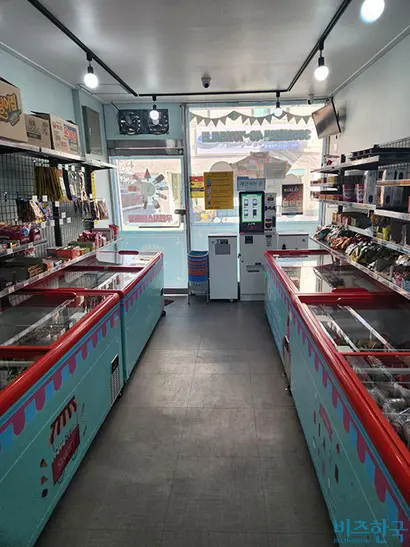
After checking 5 unmanned cafes in the Dongjak-gu area, 3 of them were found to have no fire extinguishers. The situation was no different for the unmanned ice cream shops nestled between these cafes. I also checked 2 unmanned ice cream shops in Dongjak-gu, and in both cases, I could not find a fire extinguisher.
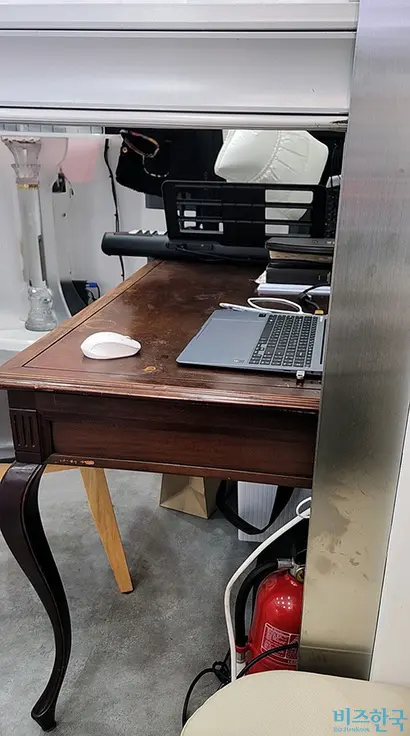
This precarious landscape continued in Seocho-gu. Of the 3 unmanned cafes investigated, one lacked a fire extinguisher, and another had a structure that made it difficult to access the fire extinguisher even if it were present. About half of the store's interior space was firmly blocked off by a shutter. Only when an individual, presumably the owner, appeared and operated the shutter did the laptop, desk, seating, and a fire extinguisher hidden in the inner space become visible. If the shutter is down when there is no manager present, customers wouldn't even be able to reach the fire extinguisher in the event of a fire. The legal assumption that ground-floor locations are easy to evacuate from is being misinterpreted in the field as a signal that 'even the most basic safety tools are unnecessary.'
The root cause of this breakdown in on-site principles is the legal exemption for 'small ground-floor stores.' Stores with a total floor area of less than 33 square meters located on the ground floor, where evacuation is considered easy, are largely exempt from requirements to install such fire-fighting equipment. Because evacuation is supposedly easier in the event of a fire, they are exempted from duties such as posting fire safety guides or playing evacuation instruction videos. However, nowhere in the statutes does it state that the placement of fire extinguishers is exempt.
There was no guidance from local governments or franchise headquarters regarding fire safety. The unmanned cafe owners I met said they had never received any fire-related training or instructions on their obligations. An owner of a franchise unmanned cafe who requested anonymity shared, "I have never received any fire-related training from the local government or the headquarters. Even the fire extinguisher I have was bought by a friend as a housewarming gift, saying, 'Isn't it better to have at least one?'" Another owner explained their reason for having an extinguisher: "I have fire insurance, but I kept one just in case. In case a fire breaks out later, there are issues of liability. Most things are covered by insurance, but one never knows." Minimal safety was left to the conscience of individual owners rather than a systemic requirement, leaving them to fend for themselves.
The gap between customer perception and actual safety was profound. Interviews with 6 customers ranging from their 30s to 70s revealed that none of them were aware that fire regulations for unmanned stores had been steadily strengthened. Four customers in their 70s who frequently visit unmanned cafes could not hide their embarrassment when I pointed out that there were no fire extinguishers in the store. They said, "Of course I thought it would be safe. You usually find fire extinguishers everywhere you go, so I naturally assumed there would be one."
An investigation of a district office in Seoul revealed that the reporting and management bodies for unmanned stores vary depending on the items sold. Ice cream shops selling finished goods can open business with just a tax office registration, while unmanned cafes that manufacture beverages must register with the district office as an 'automatic food vending business' or 'rest-type restaurant.' While district offices hold licensing data, they do not share it with fire authorities. A district office official stated, "Even if a new business report is accepted, there is no procedure or basis for sharing this with the local fire station or for the district office to conduct separate fire inspections on unmanned stores."
According to the Fair Trade Commission's franchise business information, as of December 31, 2025, there are 675 unmanned cafe franchise stores in Seoul. If private stores, which are hard to track through national data due to the fragmentation of business types, are included, the number is significantly higher. If we add other various unmanned services such as ice cream shops, study cafes, photo studios, and laundromats, it would not be an exaggeration to say that there are more than 10,000 unmanaged spaces in Seoul alone.