

[비즈한국] A massive power grid construction plan for the Yongin Semiconductor Cluster is facing intense social resistance. On the 4th, civic groups and local residents from across the country gathered in Gwanghwamun, Seoul, declaring, "The regions are not an energy colony for the capital area," and demanded a full review of the Yongin semiconductor industrial complex and transmission line plans. They warned that forcing rural and regional areas to sacrifice for massive power demand would trigger a "second Miryang incident," and strongly demanded a transition toward decentralized energy policies and the formation of a social dialogue body.
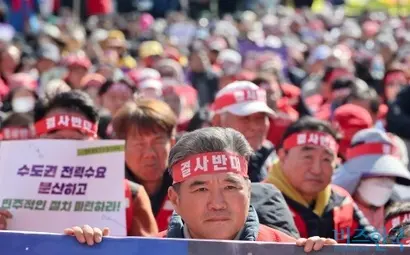
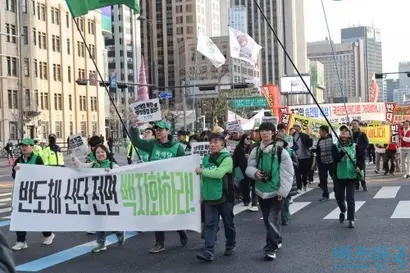
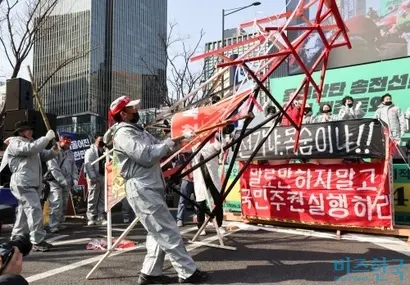
The 'National Action for Re-examining the Yongin Semiconductor National Industrial Complex and Opposing High-Voltage Transmission Tower Construction (National Action)' held the 'March 4th National Rally to Demand a Full Review of the Yongin Industrial Complex and Transmission Lines and the Formation of a Social Dialogue Body' in front of the Dongwha Duty Free shop in Gwanghwamun, Seoul, on March 4. According to organizers, approximately 5,000 people attended the rally. The event included speeches from the National Action executive committee, local residents, and politicians; a joint declaration by civic society; a performance involving a funeral bier and the demolition of a transmission tower; a head-shaving ceremony; and a march toward the Presidential Office.
National Action is a civic coalition formed to address the damages caused by national projects such as the construction of the Yongin semiconductor complex and transmission lines. It involves over 100 regional and climate-environment organizations from Gyeonggi, South Chungcheong, Daejeon, South Jeolla, Gwangju, and North Jeolla provinces.
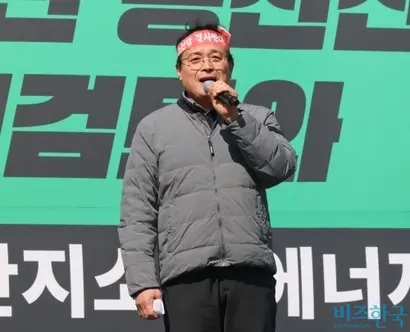
During the rally, National Action demanded a full re-examination of the Yongin semiconductor national industrial complex and its transmission lines, the formation of a social dialogue body for such reviews, the establishment of decentralized energy policies to minimize transmission lines, and the reorganization of governance and systems to address power grid inequality. Kim Hee-sang, co-chair of National Action and secretary-general of the Korean Peasants League, stated, "Is there no peasant sovereignty in a government of the people? Stop the method of achieving economic growth by sacrificing rural areas and withdraw the transmission tower plan."
The Yongin Semiconductor Cluster, with Samsung Electronics005930 and SK Hynix000660 as its two main pillars, is expected to become the world's largest semiconductor production base at a single location. However, this strategy of concentration has led to unprecedented power supply issues commensurate with its scale.
The Yongin Semiconductor Cluster is largely divided into the 'Yongin National Industrial Complex' led by Samsung Electronics and the 'Yongin General Industrial Complex' led by SK Hynix. It is estimated that by around 2050, when these complexes are fully operational, they will require a total of over 10GW of power. This is a massive scale, accounting for about 20% of the current maximum power demand of the entire capital region. Building the power grid is a major challenge, as the amount is equivalent to the power produced by about 10 nuclear power plants.
In particular, the power supply plan for phase 2 of the national industrial complex, scheduled to begin in 2030, requires drawing massive power from the Honam region (renewable energy) and the East Coast (nuclear and thermal power) via 345kV high-voltage transmission lines and High Voltage Direct Current (HVDC) lines. In this process, transmission grid construction faces a dual hardship: technical limitations and social resistance.
Voltage stability in the capital region is already unstable, and the increased reliance on long-distance transmission lines raises the risk of large-scale blackouts in the event of system failures. Due to concerns over voltage stability, the Korea Power Exchange operates only a portion of the actual transmission facility capacity, meaning that even with facility expansion, the efficiency gains remain low.
Civic society and local residents argue that the construction of large-scale transmission lines violates the principle of energy self-sufficiency. They point out that while rural regions must bear the burden of hazardous facilities like coal-fired power plants, nuclear power plants, and high-voltage transmission towers to generate power, the economic benefits and jobs are monopolized by the capital region and large corporations. There is a loud outcry that this structure turns regions into "energy colonies" for the capital, accelerating regional extinction and hindering balanced national development.
Cho Kyung-hee, representative of the North Jeolla Committee to Scrap Transmission Tower Construction, emphasized at the rally, "President Lee Jae-myung said at a town hall meeting in North Jeolla Province that sending electricity produced in the regions to the outside is a primitive method. Now, we need action, not just words from the President. We must stop KEPCO."
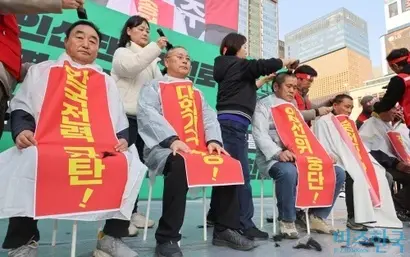
Local residents fear that the one-sided push for transmission line construction will lead to a second Miryang transmission tower incident. Residents of Gongju, South Chungcheong Province, have formed the 'Gongju Transmission Line Scraping Countermeasure Committee' and are resisting KEPCO's unilateral site selection method. They criticized the site selection committee for being a mere formality that determines the route of an already decided project rather than reviewing the necessity of the transmission lines themselves.
Lim Gyeong-ryeong, a resident of Gongju who participated in the rally, said, "I attended today's rally with a desperate and anxious heart. I am worried that the Miryang case, where electricity was said to flow with tears, will be repeated."