

[비즈한국] As a result of a Biz Hankook investigation, it has been confirmed that 49 reconstruction and redevelopment sites in Seoul have failed to begin construction even 10 years after the establishment of their associations (or designation of project operators). This figure accounts for 16% of all total urban renewal sites in Seoul where the date of association establishment is known. Among these long-term delayed projects, 16 sites have yet to receive the project implementation plan authorization, a step considered to be the formal entry into the main phase of urban renewal projects.
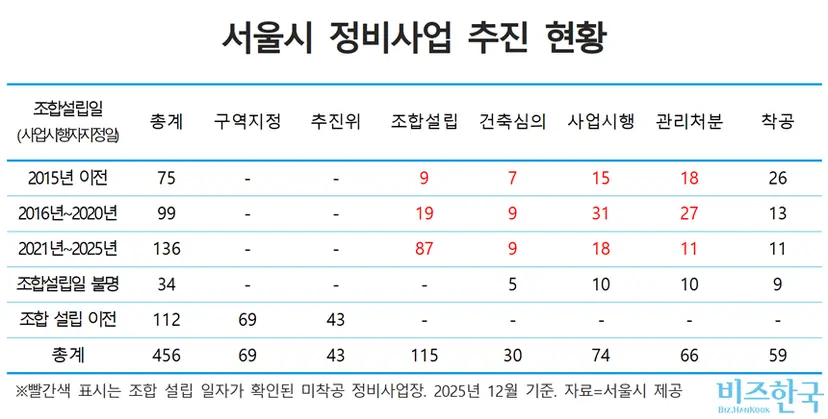
According to a full analysis by Biz Hankook of Seoul City’s urban renewal project progress data as of the end of last year, there are 75 renewal sites in Seoul where the association was established or the project operator was designated before 2015. This accounts for 24% of the 310 total urban renewal sites in Seoul where the establishment date is verified. Among these sites that have been in existence for 10 years or more, 49 sites (16% of the total) have not yet started construction, while 26 sites (8% of the total) have begun construction as of last year.
Reconstruction and redevelopment projects typically follow this sequence: designation of renewal zone → establishment of promotion committee → establishment of association → authorization of project implementation plan → authorization of management and disposal plan → start of construction. According to data released by the Seoul Metropolitan Government last July, it takes an average of 8.5 years from the establishment of an association to the start of construction. However, the actual pace of projects varies significantly depending on resident consent rates, conflicts between stakeholders, licensing procedures, and changes in the real estate market.
Among Seoul’s unstarted renewal projects that have been active for over 10 years since association establishment, 18 are in the management and disposal plan authorization stage, and 15 are in the project implementation plan authorization stage. There are also 16 sites that have failed to cross the threshold of project implementation plan authorization and remain in the association establishment stage. Of these, 9 have not even passed architectural review. These include Gangbyeon Gangseo and Wanggung in Yongsan-gu, Mangwu 1 in Jungnang-gu, Dongsomun 2 and Anam 1 in Seongbuk-gu, Susaek 1 in Eunpyeong-gu, Hongje 2 in Seodaemun-gu, Sinbanpo 7th in Seocho-gu, and Apgujeong District 6 in Gangnam-gu.
An official from the Anam District 1 reconstruction association explained, "The project was delayed for a long time due to poor financial conditions before a contractor was selected in 2020. The architectural review currently in progress has been delayed beyond the original schedule as we have been working to meet the requirements of relevant departments and address items that were returned for revisions." The official added, "Being located in a narrow, hilly area, and the fact that there are few or no general presale units compared to the number of union members, creates profitability issues that act as difficulties in project advancement."
Public-led renewal projects are also struggling to gain momentum. Among the Seoul renewal sites that have remained unstarted for over 10 years since association establishment, 4 have the Korea Land and Housing Corporation (LH) or the Seoul Housing and Communities Corporation (SH) participating as co-project operators. Mangwu 1 in Jungnang-gu and Sinbanpo 7th in Seocho-gu signed co-project operator agreements with LH in 2021 and 2022, respectively, while Gangbyeon Gangseo in Yongsan-gu signed with SH in 2022, but none have yet crossed the threshold of project implementation plan authorization. Yangpyeong District 13 in Yeongdeungpo-gu, which signed an agreement with SH in 2022, received project implementation plan authorization at the end of last year.
An official from the Gangbyeon Gangseo Apartment reconstruction association stated, "After being selected as a public reconstruction complex, the project was partially delayed due to delays in Seoul City's preliminary planning (for renewal plan amendments). We are currently in the final stages of preliminary planning, having finished resident briefing sessions, and plan to push for renewal plan amendments as early as this June." The official added, "Since we will receive project implementation plan authorization based on the preliminary plan, the project will gain speed after the time invested so far."
Cases of construction starts are even rarer in districts where associations were established more recently. Among the 99 sites where associations were established between 5 and 10 years ago (established 2016–2020) as of the end of last year, 86 (87%) have not started construction. Of the 136 sites established less than 5 years ago (2021–2025), 125 (92%) have not started construction. Most of the sites established within the last 5 years that have begun construction were urban-type redevelopment projects centered on non-residential use, where there were few or no existing homes within the site.
An official from the Residential Renewal Division of the Seoul Metropolitan Government stated, "From the stage of project implementation plan authorization following the designation of a renewal zone and integrated review, the jurisdiction lies with the autonomous districts." However, the official added, "The Seoul Metropolitan Government announced through last year’s ‘Rapid Integrated Planning 2.0’ that it would designate project promotion officers and accelerate project schedules through project promotion meetings. Since then, we have been holding these meetings twice a month with participation from autonomous districts and associations to manage the progress of individual renewal sites."