

[비즈한국] “A good choice for today: Blood donation and a Dubai Cookie! A warm contribution that saves lives, and a sweet reward to boot. We are giving away a Dubai Cookie at XX location to all blood donors.”
This was part of a recent text message sent by a blood center in Seoul to encourage blood donations. Following movie tickets and convenience store gift cards, even trending, scarce desserts have now appeared as incentives for donating blood. The fact that this noble act of sharing life has become a venue for promotional marketing is evidence of just how dire the blood supply situation in our society has become.
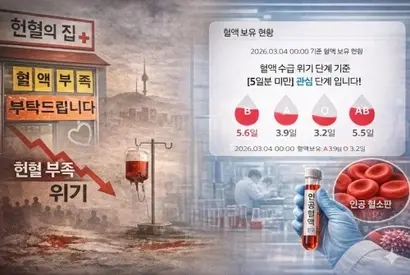
According to the Korean Red Cross's blood donation app, Red Connect, the blood reserve level as of midnight on the 4th stood at 4.3 days, triggering a 'caution' alert for blood supply. An adequate blood reserve level is considered to be at least 5 days. Blood types O and A, which are in high demand, are particularly low at 3.2 days and 3.9 days, respectively. In the event of large-scale surgeries or a surge in emergency patients, there is a risk of a critical shortage that could jeopardize lives.
The long-term outlook for blood supply is also challenging. The population capable of donating blood has plummeted due to the persistent trend of low birth rates. Conversely, the elderly population aged 65 and over—who are restricted from donating blood—has exceeded 20%, and they consume more than 40% of the total blood used in medical settings.
With this structural blood donation cliff difficult to overcome, the government and the pharmaceutical/biotech industry are turning their eyes toward cell-based artificial blood technology, which involves manufacturing blood in laboratories.
Artificial blood refers to technology that does not rely on blood donations, but instead involves manufacturing blood components like red blood cells and platelets in laboratories or factories using stem cells, or developing blood substitutes aimed at oxygen-carrying functions.
The Ministry of Health and Welfare recently initiated the creation of a domestic ecosystem by announcing a new project for the '2026 First Phase Cell-based Artificial Blood (Red Blood Cell/Platelet) Manufacturing and Verification Platform Technology Development.' The development tasks included in this announcement range from investigating global regulatory trends to establishing non-clinical and clinical trial guidelines and providing consulting support for clinical entry. It also includes proposals for improving outdated systems where the legal status of artificial blood—such as the current Blood Management Act and the Advanced Regenerative Bio Act—is difficult to define. This seems to reflect complaints from the industry, which has the technology but faces hurdles in commercialization due to regulations.
The core of artificial blood development is to use induced pluripotent stem cells (iPSC), which can differentiate into all body tissues and organs, or to proliferate blood cells in large quantities to create red blood cells and platelets that function identically to real blood. Currently, domestic companies such as Art Blood, Daewoong Pharmaceutical069620, Ducell Bio, and Pharmicell005690 have entered the race to develop artificial blood.
Art Blood possesses technology for mass-producing red blood cells using hematopoietic stem cells. Having successfully produced red blood cells in a 50-liter bioreactor, it is considered technologically ahead of competitors in the UK and Japan. In 2024, it became the world's first to produce dog blood, prior to human trials. Last year, Art Blood began construction on a GMP factory dedicated to artificial blood in Ansan, Gyeonggi Province. The goal is to build a production capacity on a scale of tens of thousands of liters, and the company plans to apply for Phase 1 clinical trials of red blood cell products for transfusion to the US FDA in 2027.
In May 2023, Daewoong Pharmaceutical signed an MOU with iPSC development specialist E-cell and is focusing on developing artificial red blood cells. They are combining E-cell's stem cell differentiation technology with Daewoong Pharmaceutical's expertise in large-scale biopharmaceutical production and quality control.
Ducell Bio is challenging itself to develop artificial platelets using iPSC. In 2023, it acquired a domestic patent for technology that selects cells with high platelet production yields and also completed a Patent Cooperation Treaty (PCT) application. In January, it mass-produced artificial platelets in a 50-liter large-scale bioreactor.
Last August, Pharmicell succeeded in developing 'Hempharmine-16,' an artificial blood product created by chemically synthesizing hemoglobin and albumin—oxygen-carrying proteins—directly with pharmaceutical ingredients. The company emphasizes the advantage of eliminating the need for cell culture, which reduces production costs and allows for administration without regard to blood type. While much verification is still needed, the company has begun establishing a process for commercial mass production.
The government aims to have patients use artificial platelets and red blood cells in clinical settings by the mid-2030s. The plan is to support the construction of a manufacturing process platform by 2032 to secure mass production technology, targeting commercialization by around 2037. Platelets are the blood component with the most unstable supply due to low rejection rates during transfusion and a very short shelf life of about 5 days. Red blood cells, as they transport oxygen via hemoglobin, are the most frequently and essentially administered blood component to patients suffering from massive blood loss or severe anemia, making them the highest in consumption. White blood cells, however, are considered a long-term task due to their complexity as the core of the immune system.
Even when artificial blood is released, it is unlikely to completely replace human blood donation. The biggest obstacle is cost. Unlike blood obtained through voluntary donations, manufacturing artificial blood through cell culture inevitably incurs massive costs.
Mass production technology is also still unstable. To produce the enormous volume of blood needed for transfusions, high-efficiency cell differentiation and proliferation technologies are required.
In particular, blood plasma—a liquid component containing a complex mix of numerous proteins, hormones, and immune substances—is currently considered an area that cannot be fully replaced with current technology. An industry official stated, "It is difficult to 100% artificially replicate the countless nutrients, immune factors, and chemical substances present in human blood," adding, "Artificial blood will act as a supplement to blood donation."