

[비즈한국] Geopolitical risks from the Middle East are directly targeting the financial markets following the death of Iranian Supreme Leader Ayatollah Ali Khamenei in the joint U.S.-Israeli airstrike, Operation ‘Epic Fury,’ on the 28th of last month. A key indicator to gauge the ripple effects of this situation is the traffic through the Strait of Hormuz, the lifeline for crude oil transport. The number of oil tankers, which stood at 65 the day before the war began, plummeted to just 6 within a day, reflecting market panic in real time. This strait, through which about 21% of global crude oil and LNG trade passes, is considered a critical ‘maritime bottleneck’ for major importers, including South Korea, as 83% of that volume is destined for Asia.
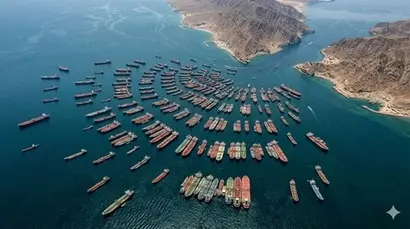
According to the U.S. Energy Information Administration (EIA), as of 2024, 84% of crude oil and condensate and 83% of LNG transported through this route were destined for Asian countries, including China, India, Japan, and South Korea. International oil prices had already risen by more than 20% this year to over $70 per barrel amid rising tensions, but volatility is increasing, with prices nearing the $77 mark immediately after the market opened.
According to private analysis from firms like Capital Economics, if oil prices break through $100, it would create inflationary pressure, raising global inflation by 0.6 to 0.7 percentage points. This could provide justification for the Federal Reserve to delay its interest rate cuts.
However, experts consider the probability of an extreme scenario to be low. This is because the establishment of a three-person interim council—comprised of President Masoud Pezeshkian, Judiciary Chief Gholam-Hossein Mohseni-Ejei, and Assembly of Experts member Ayatollah Alireza Arafi, as per Article 111 of the Iranian Constitution—is leading to command confusion, and the neutrality declared by the pro-Iranian Hezbollah is weakening the momentum for a full-scale, long-term war. In particular, as the Supreme National Security Council (SNSC) of Iran recognizes the strait as the country's core financial lifeline, it is highly likely they will hesitate to take the self-destructive step of a total blockade. Because of this, and considering the power vacuum within Iran, the view that the issue will end as an ultra-short-term crisis of about a week, or a short-term one of one to three months, is gaining traction. Even if oil prices rise by 15-20% in the short term, the uncertainty is likely to subside within three months due to a limited conflict and the resumption of production increases by OPEC+.
In the foreign exchange market, cracks are appearing in the ‘dollar strength’ formula that repeated during past geopolitical crises. Experts have noted a ‘Dollar-Frown’ phenomenon, where the market questions the absolute stability of the dollar, given that this situation was instigated by the U.S. The fact that the yen and the Swiss franc responded first as safe-haven assets rather than the dollar is highly significant. While the won-dollar exchange rate may overshoot to 1,480 won in the short term due to worsening South Korean trade terms from high oil prices and concerns over foreign capital outflow, there is an expectation that it will stabilize at around 1,430 won on average in the second quarter once risks subside.
The domestic stock market may experience a price correction of about 10% from its highs in the short term, and foreign demand is expected to face a net selling pressure of approximately 500 billion won per day, considering its weight relative to market capitalization.
However, the prevailing view is that this correction will be a temporary shock rather than a structural decline. This is because the fundamental growth driver of the domestic stock market, the semiconductor-led profit growth trend, remains solid, and there are positive factors supporting a valuation increase, such as the passage of the third commercial law amendment focused on treasury stock cancellation. Furthermore, there is a strong sentiment among individuals and ETFs to utilize geopolitical risks as a short-term buying opportunity.
Ultimately, the peak of geopolitical uncertainty is expected to be the result of Iran's next leadership election, scheduled within the next 1-2 days. Tensions could rise if individuals like Khamenei’s second son, Mojtaba Khamenei, or Parliament Speaker Mohammad Bagher Ghalibaf, who is supported by hardline conservatives, are elected. Nevertheless, the fact that the top 8 OPEC+ countries have begun reviewing a resumption of production increases of up to 411,000 barrels per day starting in April is the key to calming oil price volatility.
Investors should stay calm and monitor the actual recovery of traffic in the Strait of Hormuz and the supply responses from oil-producing countries, rather than being buried in sensational news. It is also worth remembering that while the market always imagines the worst, history has rarely been as bad as those imaginings.