

[비즈한국] In 1789, British naval officer John Hunter witnessed a platypus in Australia for the first time. It was a bizarre creature with the body of a beaver and the bill of a duck. However, for a while, other biologists could not believe Hunter’s claim. They even thought it was a fake created by stitching together parts of different animals.
But the platypus is real. Its appearance is as mysterious as if it were bridging a missing link in evolution. Recently, however, astronomers have discovered so-called 'platypus galaxies' at the edge of the universe through observations by the James Webb Space Telescope! These are strange galaxies that do not belong to any of the galaxy types known to date.
The features of a platypus do not seem strange when viewed individually. Webbed feet, a bill, fur—all are ordinary. The problem is that these traits coexist in one animal. The controversial platypus galaxies are no different. The individual characteristics displayed by these galaxies are common things frequently seen in other celestial bodies. But it is unprecedented for these features to appear simultaneously in a single celestial object.
The characteristics of this celestial body can be summarized as follows. First, it is small and its light is so concentrated that it looks more like a point source than a galaxy. Second, the galaxy's redshift is so large that we know it is located at the very edge of the distant universe. Third, emission lines are observed in the galaxy's spectrum, but the spread (width) of these emission lines is extremely narrow.
In fact, seeing the first and second features together is no longer a rarity. In astronomy, they are called quasars. Although they appear very small like stars, the fact that their redshift is as large as 3.6 to 5.4 completely rules out the possibility of them being nearby stars. Instead, they are more like quasars shining brightly from a very great distance. This object existed when the universe was only 1.2 to 1.8 billion years old. It is an early universe object that existed in a very young period, only one-tenth of the current age of the universe.
The reason quasars are observed despite being at a great distance is that they emit powerful energy. Astronomers estimate that most quasars harbor violent black holes at their centers. As supermassive black holes at the centers of early universe galaxies swallow large amounts of gas all at once, they grow rapidly, spewing out massive amounts of energy. However, it is ambiguous to simply define the observed platypus galaxies as quasars harboring active galactic nuclei.
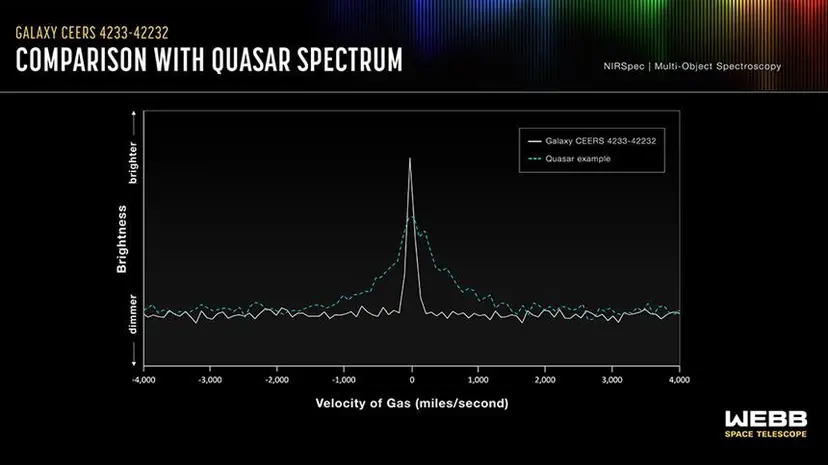
This is precisely because of the third characteristic. If they harbor supermassive black holes at their centers that are growing by rapidly swallowing gas, the gas at the center of the galaxy would be orbiting at extremely high speeds. Such rapid movement of gas causes a massive Doppler effect. The Doppler effect refers to the change in the wavelength of light observed as an object emitting light moves. Typically, celestial bodies harboring such rapidly orbiting gas exhibit both large redshifts and blueshifts, and the spectrum appears evenly spread toward both shorter and longer wavelengths. Therefore, the emission lines of the spectrum also appear widened on both sides.
However, the emission lines of the platypus galaxies are very narrow and sharp. This is a perplexing feature not seen in typical quasars. Compared to ordinary quasars, the emission lines of platypus galaxies are much narrower and dimmer. It is difficult to consider them mere quasars.
There are other possibilities. Active galaxies with violent black holes at their centers can have varying emission line widths depending on the angle from which we view them. If we see the rapidly orbiting gas from the front, the emission lines appear wide and spread out on both sides; however, if the center is obscured by thick dust and we only see the slower-moving material on the outskirts, there is a possibility that the emission lines would be observed to be much narrower.
But here arises an even bigger problem. Active galactic nuclei of the type just mentioned have never been observed in the form of point sources. They are mostly observed in elongated shapes. This is because they become active galaxies with narrow emission lines when the galaxy is viewed from the side rather than from above. Therefore, the nine suspicious celestial bodies discovered this time are classified neither as quasars nor as active galaxies viewed from the side. They are nothing of the sort. They are something strange that we have never seen or experienced before.
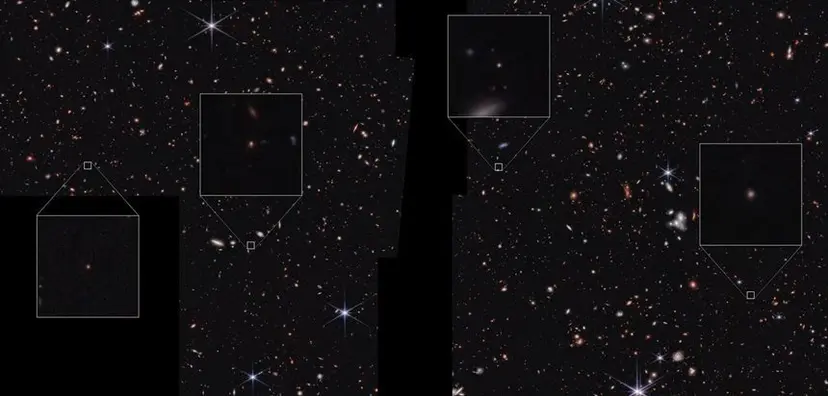
There is a more surprising final possibility to explain their identity. The reason they look almost like point sources in James Webb photos could be because they are just too, too far away. A galaxy's spectrum is a blend of the light from the stars residing within it. Eight out of the nine galaxies discovered this time exhibit a spectral shape similar to that seen in typical galaxies. Based on this, when recalculating, this possibility remains.
In fact, they could be galaxies composed only of very young stars. They might even exist at a time when the universe was only 100 million years old. There is a possibility that about 300 million relatively low-mass stars have gathered, making their mass as small as the Small Magellanic Cloud near our Milky Way. And stars are steadily being born at a rate of about twice the mass of the Sun every year. The stars born during this period have much lower metal content, at most half the level observed in our galaxy.
If this final possibility is true, the platypus galaxies can be seen as very young galaxies that have just begun to grow, essentially the moment of a galaxy's seed germinating. This is quite interesting when compared to the simulation cosmology that explains the evolution of today's universe. Cosmological simulations usually reproduce cosmic evolution in a way where small galaxies rapidly repeat collisions and mergers from the beginning of time to increase their size. This process is called the hierarchical merging of galaxies. It is estimated that almost all large galaxies in the universe today were formed this way.
However, unexpectedly, the extremely early universe just after the Big Bang may have been peaceful. Initial galaxies might not have repeated chaotic mergers, but rather spent time growing slowly and independently as seeds germinated. It is unknown if there is a link to the identity of the small red dots discovered in succession by James Webb. At the very least, it only confirms once again that the early universe is much more bizarre than we thought.
Reference
https://science.nasa.gov/missions/webb/scientists-identify-astronomys-platypus-with-nasas-webb-telescope/
Who is author Woong-Bae Ji? He loves cats and the universe. After watching 'Galaxy Express 999' as a child, he developed a dream to share the beauty of the universe. He is currently an assistant professor in the Faculty of Liberal Arts at Sejong University, participating in various science communication activities such as lectures and writing. He has authored books such as 'A Piece of the Universe Every Day,' 'Scientists of the Starry Universe,' 'Can't Go But Can Know,' and 'Strange Questions That Come to Mind When Looking at the Universe,' and has translated 'The Hitchhiker's Guide to the Real Universe,' 'How I Killed Pluto,' 'Quantum Life,' and 'Cosmigraphic.'