

[비즈한국] When shared e-scooters first appeared in Korea in September 2018, they were anticipated as an innovation in 'last-mile' mobility. However, as of February 2026, shared e-scooters in urban centers have devolved from innovation into a 'nuisance.' On the afternoon of February 25, the reality was starkly evident in front of Exit 5 of Gongdeok Station on Seoul Subway Line 5.
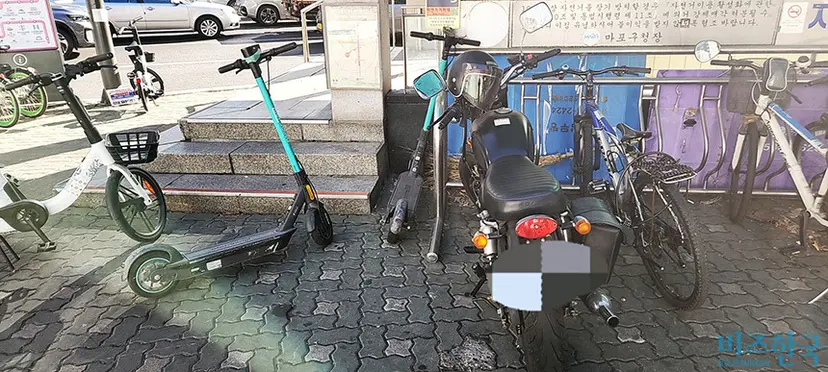
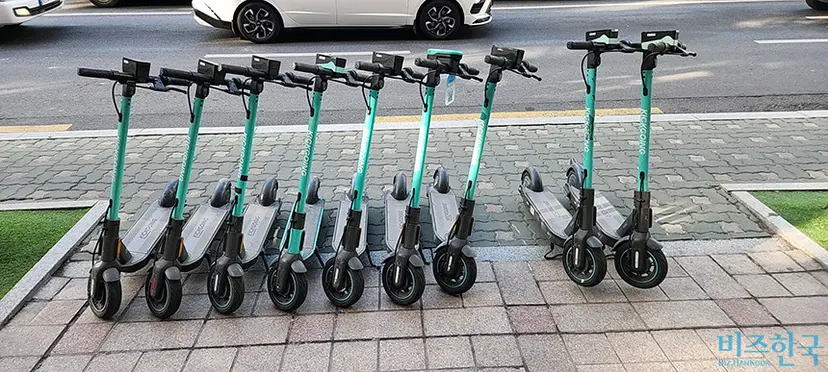
The rack intended for citizens' bicycles had already lost its original function, turning into an unrecognizable display area tangled with e-scooters, shared bicycles, and motorcycles. The nine e-scooters crammed between trees appeared orderly at a glance, but in reality, they were nothing more than a massive wall obstructing pedestrian traffic.
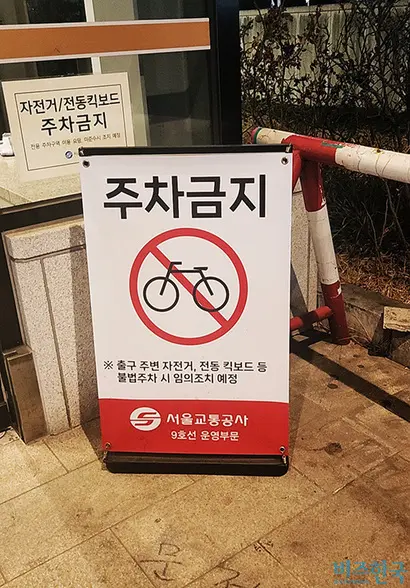
Current Seoul municipal ordinances designate areas such as the front of subway exits, on top of braille blocks, near crosswalks, roadways, bike lanes, and within 5 meters of bus stops as 'immediate towing zones.' Because companies must bear towing and storage fees for parking in these spots, they tend to manage returns in these areas strictly.
The problem lies in the 'blind spots' that are not subject to immediate towing but still significantly hinder pedestrian traffic. Sidewalks in busy areas, narrow alleys, stairwell entrances, and shop entrances are often not included in the immediate towing zones. While the app warns that an additional fee may be charged for returning a scooter in the middle of a sidewalk, that is the extent of it. Companies employ technology to prevent returns in areas where they would incur towing fees, while choosing 'technical neglect' regarding indiscriminate parking on standard sidewalks where there is no risk of towing.
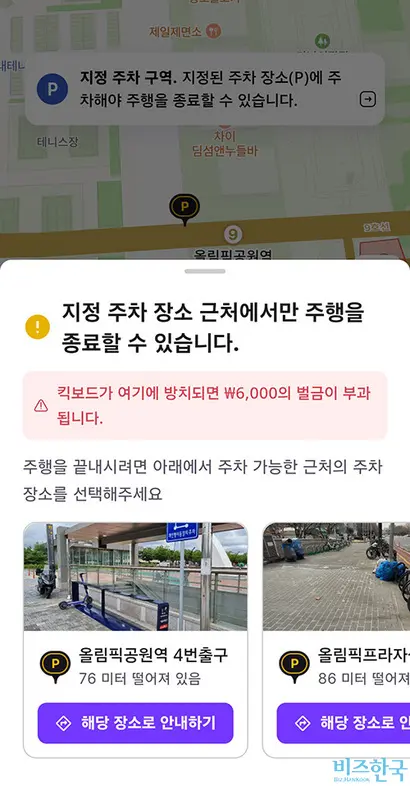
The industry has long touted that it would end unauthorized abandonment through advanced technologies such as Visual Positioning Service (VPS) or AI camera parking determination. However, the reality of the technology, as verified by this reporter on the ground, was a flimsy net designed to evade corporate responsibility. In the case of Company A, which emphasizes VPS technology, the app would display a warning window about potential additional fees or towing if a device were parked in a no-parking zone.
However, that was where the system’s restraint ended. The return button would activate the moment the user stepped even slightly outside the five immediate towing zones designated by the Seoul Metropolitan Government. Even if a scooter was left horizontally blocking a path, it could still be returned. While companies warned users of additional fees or towing costs reaching up to 40,000 won, they were effectively condoning improper returns.
The same was true for Company B, which uses AI cameras to determine parking locations. They showed sophistication by refusing returns in strictly regulated areas like on braille blocks or at subway entrances. However, the company's intended loophole was revealed in an unexpected place: the pedestrian stairs near Seongnaecheon in Songpa-gu, a short distance from the subway station.
Even after blocking the entrance to the stairs, hindering pedestrian passage, and taking a parking photo, the app approved the return with a 'free pass' without any restraint. This is evidence that the advanced technology promoted by the companies functions only to avoid towing by local governments and is utterly powerless in protecting the right to walk.
An official from the Seoul Metropolitan Government’s Transportation Office stated, "Since businesses can operate by simply reporting to the tax office (without separate permits), it is realistically difficult to manage all companies." They expressed frustration, adding, "Even when companies register, there is no notification sent to the relevant departments." While they issue official requests for correction and take towing measures when illegal parking occurs, there is no means to impose substantive penalties on companies as these are administrative measures based on ordinances.
The operation of shared e-scooter parking zones is also little more than a desperate measure devised by local governments to ensure public safety for the 'public interest of resolving unauthorized abandonment.' Even as local governments strive to protect public interest and safety through ordinances, the institutional limitations are clearly exposed as the related bills have been adrift in the National Assembly for six years, leaving authorities to repeat warnings through limited regulatory means.
Ultimately, the responsibility points to the National Assembly, the legislative body. Since 2020, 12 bills related to personal mobility devices have been proposed, yet they have been adrift for six years without crossing the threshold of the National Assembly. The core of the currently pending bills is to prohibit and sanction the unauthorized abandonment of shared e-scooter and bicycle rental businesses. Additionally, the bills include changing the current reporting system to a registration system to facilitate easier management.
Only when the law is passed can local governments impose substantive sanctions, such as business revocation or suspension, on companies that neglect their management duties. While the National Assembly remains idle and companies hide behind flimsy technology to reap profits, citizens continue to live with these unwelcome guests occupying their sidewalks every single day.