

[비즈한국] The U.S. government and Anthropic appear set to clash once again over the military use of the AI model 'Claude.' This follows the revelation that the U.S. military utilized Anthropic's AI model 'Claude' in a recent airstrike operation in Iran.
U.S. President Donald Trump ordered the exclusion of Anthropic from all government projects just one day before the airstrike on Iran. Because the U.S. military had already deeply integrated Claude into its classified systems, the operation occurred before the model could be replaced. This incident is regarded as a symbolic clash between the ethical guidelines championed by a private company and the military utilization policies of a government that prioritizes national security.
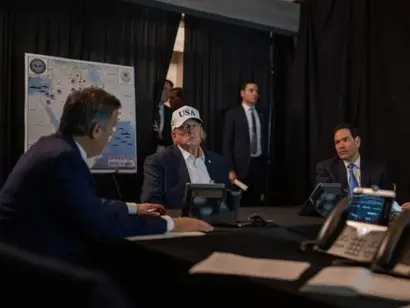
U.S. Treasury Secretary Scott Bessent announced on March 2 that, following President Trump's directive, the use of Anthropic's AI tools would be suspended across the entire administration. This measure is the result of a conflict over the scope of technology usage between the U.S. Department of War and Anthropic, which has now spread to the entire government.
Anthropic signed a $200 million contract with the U.S. Department of War (the Pentagon) last July and has been collaborating with them, providing AI related to defense issues. However, the conflict began last January when it was revealed that Anthropic’s AI model, Claude, was used in the operation to capture Venezuelan President Nicolás Maduro. Anthropic determined that the use of AI in this operation violated its ethical guidelines and moved to put the brakes on the Pentagon’s indiscriminate use of its technology.
While collaborating with the U.S. Department of War, Anthropic insisted that its AI would not be used for: △large-scale surveillance of U.S. citizens, or △fully autonomous weapons without human intervention. In an interview with CBS, Anthropic CEO Dario Amodei argued that mass surveillance of citizens, even if technically legal, is an abuse of government power that exceeds the intent of the law and infringes upon the fundamental rights of citizens not to be monitored.
Furthermore, he opposed the use of AI in developing weapons that independently identify and fire at targets without the approval or intervention of a human operator. CEO Amodei pointed out that current AI systems are unpredictable enough to misidentify friendly forces or civilians, and that delegating military decisions entirely to machines rather than humans raises serious issues of accountability and control.
The Pentagon took a hardline stance against Anthropic's restrictive cooperation policy. U.S. Secretary of War Pete Hegseth issued an ultimatum with a three-day deadline, stating, "We must be able to use AI without restriction for all legitimate purposes." When Anthropic did not comply, the Pentagon officially designated Anthropic as a 'supply chain risk company.'
A supply chain risk designation is a powerful sanction previously applied to companies associated with hostile nations, such as Russia's Kaspersky Lab or China's Huawei. Applying this to Anthropic, a domestic company, has strong punitive undertones, essentially aimed at paralyzing the company's operations.
President Trump criticized Anthropic as a "selfish, 'woke' leftist company," claiming they were endangering U.S. national security. Ultimately, on February 27, President Trump placed Anthropic on the administration's blacklist and ordered its exclusion from all government business. In response, Anthropic announced it would take legal action, arguing that the administration's move was an excessive interference in a private company's decision-making.
While Anthropic’s standing has weakened due to the conflict with the administration, competitors are quickly moving to fill the void. OpenAI CEO Sam Altman and xAI CEO Elon Musk have complied with the U.S. administration's requirements and secured new defense contracts. Notably, OpenAI has faced criticism for a dual stance: aligning with Anthropic's ethical principles in public while signing contracts with the Pentagon.
Conversely, in the private market, the government's pressure has paradoxically boosted Anthropic's brand awareness. As the number of users who sympathize with Anthropic’s convictions increases, the Claude app has reached #1 in App Store downloads, showing that demand in the private sector remains solid.
This situation is expected to serve as an important precedent for determining the limits of ethical control for AI companies versus the extent to which the state’s military use of AI should be permitted. Currently, due to the lack of clear laws regarding the scope of AI's military application, the structure is prone to conflict between the administration's arbitrary directives and a company's subjective ethical standards.
As shown in the Anthropic case, with AI now established as a key asset on the battlefield, finding a balance between ethical guidelines and national security is set to become a core agenda in the global AI supremacy race. Attention is now focused on how the U.S. administration's actions will influence the policy-making of other AI companies, and what results Anthropic will achieve through its legal response.