

[비즈한국] With the National Assembly's passage of the 'Special Act on the Establishment of the Jeonnam-Gwangju Integrated Special City,' which merges South Jeolla Province and Gwangju Metropolitan City, the launch of the nation's first integrated regional administrative municipality has been confirmed. Set to launch as a single metropolitan government this July, the Jeonnam-Gwangju Integrated Special City will be reorganized into a super-regional entity with a population of 3.2 million and a Gross Regional Domestic Product (GRDP) of 150 trillion won. Attention is now focused on whether it will establish itself as a growth hub for the southern region, bolstered by national fiscal support and special regulatory exemptions.
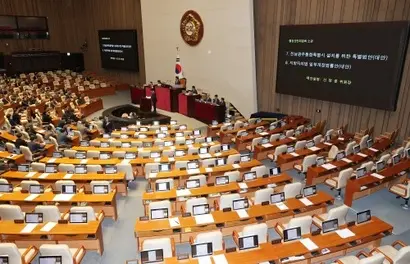
On the evening of March 1 at approximately 9:00 PM, the Special Act for the establishment of the Jeonnam-Gwangju Integrated Special City passed at the National Assembly's plenary session. The bill was approved with 159 votes in favor, 2 against, and 14 abstentions out of 175 members present. Additionally, an amendment to the Local Autonomy Act, which includes the legal basis for administrative integration and regulations such as having four vice-mayors, also passed the plenary session with 165 votes in favor, 2 against, and 6 abstentions out of 173 members present. Members of the People Power Party did not participate in the vote in protest against the ruling party's handling of the bill.
According to the bill, South Jeolla Province and Gwangju Metropolitan City will be abolished on July 1, and the Jeonnam-Gwangju Integrated Special City will be launched as a single metropolitan autonomous government. The integrated special city will be granted status equivalent to that of Seoul, along with special exceptions for national fiscal support and educational autonomy. Following the integration, Jeonnam and Gwangju will emerge as a 'super local government' with a population of 3.2 million and a GRDP of 150 trillion won.
With the passage of the bill, future schedules are expected to gain rapid momentum. First, a Support Committee for the Jeonnam-Gwangju Integrated Special City will be established under the Prime Minister to oversee the establishment of basic plans, the transfer of authority, and the creation of detailed enforcement decrees. Jeonnam and Gwangju will also activate a task force for administrative integration to jointly prepare detailed action plans for integrating organizations, finance, and administrative duties.
The first Mayor and Superintendent of Education for the Jeonnam-Gwangju Integrated Special City will be elected during the 9th National Simultaneous Local Elections on June 3. After the official launch on July 1, the integrated local government will acquire its legal status and begin providing administrative services. The newly elected Mayor and Superintendent of Education will also take office on the same day. The integrated special city will initially operate all three government buildings: the Jeonnam Eastern Office (Suncheon), the Muan Office (Jeonnam Provincial Office), and the Gwangju Office (Gwangju City Hall).
Voices in Jeonnam and Gwangju welcomed the passage of the special act. Above all, they expressed high expectations for the economic benefits that the integration will bring. Gwangju Mayor Kang Gi-jung stated after a joint memorial service at the May 18th National Cemetery in Buk-gu, Gwangju, on the 2nd, "Gwangju and Jeonnam will end the capital-centric system and emerge as the center for the 'five-pole, three-special' balanced development." He added, "We will complete an exemplary integration law to create a decentralized local government at the level of a federal system," showing his determination to complete the integration.
Mayor Kang continued, "I want to call this special act a 'Youth Jobs Special Act' that will revive Gwangju and Jeonnam. It is a law that creates a city where young people stay and want to visit by providing incentives to companies and attracting public institutions to drive 20 trillion won in fiscal investment," he said. "We will add economic prosperity to the pride of having defended democracy and end the pain of young people leaving their hometowns to find work."
The Gwangju Chamber of Commerce and Industry also issued a statement, saying, "We expect this to act as a substantial catalyst for expanding business recruitment and investment." They added, "If integrated administration leads to attracting large-scale national projects and expanding regional infrastructure, it will become an opportunity to create a virtuous cycle where local talent can pursue their dreams in their hometown, while businesses and jobs grow together."
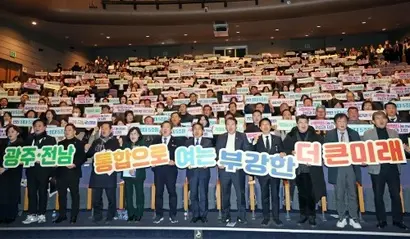
The reason for such high expectations regarding economic effects is that the bill includes provisions for regulatory liberalization and special exceptions for industrial development. The purpose of the bill, as stated, includes 'establishing a hub for global future high-tech industries such as AI, energy, and semiconductors, achieving smart innovation in agriculture and fisheries, building a key growth axis in the southern region to overcome the capital-centric system, and realizing substantial decentralization and fiscal independence.'
Specifically, it will create hubs for future industries, such as AI, semiconductor, and high-tech strategic industry clusters, as well as specialized complexes for advanced medicine and aerospace. Through support for industrial structural transformation, it will also work to upgrade national key industries like petrochemicals, steel, and shipbuilding. To build national hubs for culture and tourism, it will promote national support for cultural and tourism infrastructure, the creation of historical and cultural cities, AI-culture content convergence industrial complexes, global content tourism complexes, and the construction of a national cultural information center. In the energy sector, the bill includes provisions for creating energy future cities, special exceptions for electrical business licensing, and the designation of preliminary zones for offshore wind power.
In addition, Jeonnam and Gwangju are requesting the relocation of major public institutions. The special act specifies a 'special provision regarding the relocation of public institutions,' stating that "when the government relocates public institutions from the metropolitan area to local areas, the Integrated Special City must be given priority consideration as a relocation destination." Consequently, it is reported that the two local governments have petitioned the government for the relocation of 40 key institutions, including the Korea Agency for Infrastructure Technology Advancement, the National Agricultural Cooperative Federation, the National Federation of Fisheries Cooperatives, the Korea Airports Corporation, the Korea Racing Authority, the Korea District Heating Corporation, and the Korea Environment Corporation.
Meanwhile, as the launch of the Jeonnam-Gwangju Integrated Special City becomes visible, moves by other local governments are also drawing attention. The 'Administrative Council of Special Autonomous Cities and Provinces of Korea,' consisting of four cities and provinces—Gangwon, Jeju, Jeonbuk, and Sejong—stated in a declaration last January, "Special autonomous cities and provinces should not be disadvantaged due to the incentives for administrative integration announced by the government," and expressed concern, saying, "Seeing the rapid progress of the Special Act on Metropolitan Administrative Integration in the National Assembly and political circles, we are taking the alienation of special autonomous cities and provinces very seriously."