

[비즈한국] The Homeplus rehabilitation process stands at a crossroads of either 'extension' or 'termination' around March 4, 2026. As the deadline for the approval of the rehabilitation plan approaches, the court has effectively entered a phase of questioning stakeholders again regarding whether to continue the proceedings and how to secure funding. What the market is focusing on is not the speed of business normalization, but the fact that the question of whether they can prove their "will to endure" with "money to endure" has moved to the forefront.
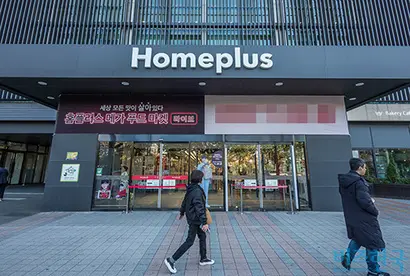
At this juncture, the card played by the majority shareholder, MBK Partners, is the pre-execution of 100 billion won in DIP (Debtor-in-Possession) financing, which is emergency operating capital provided to companies in rehabilitation. However, there is a condition attached. It is reported that they also conveyed their willingness to cooperate with the "manager replacement" demanded by labor unions and others. This has lent weight to the interpretation that the financing issue has moved beyond simple financial negotiations into a governance issue of "who holds the key to the rehabilitation."
From the perspective of stakeholders, 'manager replacement' affects the credibility of the rehabilitation plan
At the heart of the structural innovation-type rehabilitation scenario put forward by Homeplus was the procurement of 300 billion won in DIP financing. However, skepticism has grown in the market regarding whether the planned funding would materialize, as observers noted that the attitude of major stakeholders such as the Korea Development Bank and Meritz was passive. Eventually, the prospect that "if the DIP is blocked, extension will also be difficult" spread, and it appears the court is also in the mood to re-verify the effectiveness of the rehabilitation plan based on the "realism of funding."
In this context, MBK's proposal for the pre-execution of 100 billion won becomes not just a liquidity injection, but a device to change the axis of negotiation. What the court wants is not just a promise to "put money in," but a "structure that makes the money come in," and it can be interpreted that the first step of that structure is the "manager." Since the manager is in the practical chain of command for company operations in a rehabilitation process, for stakeholders, the replacement of the manager is directly linked to the "credibility" of the rehabilitation plan. By linking the capital injection with a willingness to cooperate in replacing the manager, MBK paradoxically confirms that the core issue of the rehabilitation is not operations, but governance.
The problem is that it does not end with 100 billion won. The question remains as to who will fill the remaining 200 billion won of the 300 billion won DIP plan and under what conditions. Some reports even mention that MBK and Meritz have each proposed an additional 100 billion won in DIP financing following the manager replacement and extension of the rehabilitation process. In this case, too, the "seniority conditions, interest rates, collateral, and triggers (additional execution conditions)" become as much of an issue as the "scale" of the funds. This is because the direction of the rehabilitation changes depending on whether the nature of the money is operating capital, essentially bridge financing, or a structure premised on future M&A.
Express sale and 'extension vs. termination' scenarios… Where will the funding for partner companies go?
The sale of Homeplus Express is another turning point in the rehabilitation phase. The company has presented the Express sale, liquidation of underperforming stores, and workforce efficiency measures as a structural innovation package alongside DIP procurement. However, interpretations of whether the sale is for "cashing out" or "avoiding responsibility" differ among stakeholders. If the sale proceeds are used as the core of the rehabilitation resources, the puzzle of "money to endure" could be solved, but if conditions regarding the acquirer, price, and employment succession are formed unfavorably, the social cost of the rehabilitation could increase dramatically.
Around March 4, the scenario will largely diverge into two paths. If it proceeds to an extension, the court is highly likely to demand a governance prescription of a "new management system" along with a "funding plan," which would create a structure where DIP execution and asset sales are linked under that system. In this case, pressure on partner company receivables, rent, and short-term liquidity could be managed at a level that "prevents further arrears," but the actual recovery amount will inevitably be determined by the content and speed of the rehabilitation plan.
Conversely, if it leans toward termination, the rehabilitation could rapidly move toward a liquidation or bankruptcy phase. In that case, the race for recovery regarding partner company receivables, short-term debt such as commercial paper, rent, and various unpaid debts will accelerate, and there is a high possibility that individual creditor actions such as provisional seizures and enforcement will begin in earnest. Whether it is 'extension' or 'termination,' it is clear that the essence of the Homeplus situation is converging not just on the structural slump of the retail industry, but on "who is putting in money and designing the rehabilitation under what responsibility and control."
Ultimately, March 4th is not just a schedule for Homeplus. In a rehabilitation process where private equity (major shareholders), creditors, and labor unions are clashing, it is highly likely to be the date that gauges what the court sees as the "conditions for survival," and whether the trend of demanding governance reform before funding becomes a benchmark for other large-scale restructuring efforts.