

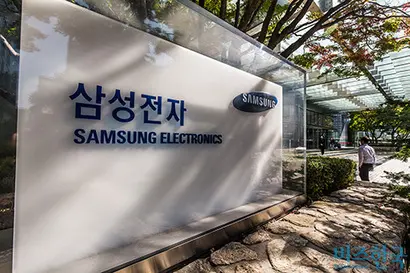
[비즈한국] Samsung Electronics005930 has announced it will go beyond the level of “further automating factories” and leap into the stage of “autonomy,” where manufacturing sites make decisions and execute them on their own. On March 1, Samsung Electronics stated that it would transform its domestic and international production plants into ‘AI Driven Factories’ by 2030. The vision is to implement digital twin-based simulations across all manufacturing processes, from raw material arrival to production and shipping, and to deploy AI agents in the areas of quality, production, and logistics to strengthen data-driven analysis and pre-verification. It also stated that it would expand AI applications in the environment and safety sectors to establish a system that detects risk factors in advance and prevents accidents.
On the surface, it sounds like “putting AI into a factory,” but the implication for industrial sites is much weightier. In manufacturing, AI directly impacts the cost structure. The moment yields increase, defects decrease, inventory thins out, and downtime is reduced, the “floor” of production costs changes. At the same time, reducing the probability of safety accidents lowers serious disaster risks, and reduced quality volatility leads to lower delivery and claim costs. Furthermore, if global production bases and suppliers begin to stand on the same data and standards, the supply chain standard itself will be reshuffled.
Lee Young-soo, Executive Vice President and Head of the Samsung Electronics Production Technology Research Institute, emphasized, “The future of manufacturing innovation lies in building an autonomous manufacturing site where AI understands the field and executes optimal decisions on its own.” Samsung Electronics also announced it would unveil its industrial AI application strategy and manufacturing innovation vision based on digital twins at MWC 2026, held in Barcelona, Spain.
AI That Changes Costs: KPIs Are Defined by ‘Autonomy,’ Not ‘Automation’
The points where money leaks in production sites are generally fixed. Representative examples include line downtime, sections where yields fluctuate, rework and waste caused by quality variations, capital tied up in excess inventory, and penalties for delivery delays. Samsung Electronics’ plan to implement digital twins and AI agents for quality, production, and logistics across all processes is close to a declaration that it will shift these cost items from ‘reactive response’ to ‘pre-verification.’
The key is priority. The market will accept this announcement as an ‘investment narrative’ rather than mere ‘publicity’ only when it discloses which factories will be applied first and in which processes it intends to achieve results first. While the effects of digital twins can appear faster in bases with large production volumes and stringent quality requirements, the difficulty of data standardization and on-site application is higher. Conversely, processes that are relatively easy to standardize can produce quick results, but the impact of “changing the manufacturing landscape” might be limited. Ultimately, KPIs (Key Performance Index) must be proven through manufacturing metrics like defect rates, yields, OEE (Overall Equipment Effectiveness), downtime, days of inventory, and on-time delivery rates, rather than dashboards like “AI adoption rate.”
Another question is robots. Samsung Electronics even mentioned ‘humanoid manufacturing robots’ as part of its final picture of autonomy. However, robots aren't just about bringing in a piece of equipment. Process designs change, safety standards are revised, and maintenance systems and parts supply chains are altered. At this point, the distinction between what Samsung Electronics keeps for in-house development and what it leaves open for robot and SI (system integration) partners will create a map of the ecosystem. This is why the question, “How far will Samsung dominate the standard for factory automation?” follows immediately.
When ‘AI Governance’ Enters the Factory, Responsibility Changes
AI autonomy at manufacturing sites brings the issue of ‘responsibility’ along with efficiency. It must be recorded who made a decision and based on what criteria, and how responsibility will be shared when that decision leads to quality or safety accidents. The reason Samsung Electronics announced it would also disclose an ‘AI governance strengthening strategy for increased autonomy’ at MWC 2026 is because, as industrial AI grows, this issue is no longer a secondary concern.
For example, the plan to use AI in the environment and safety sectors to detect risk factors and prevent accidents shifts the auditing and supervision system while improving on-site safety. Reducing accidents doesn’t end as a positive outcome; it requires regulations and records to explain “why the AI's judgment was correct” and “what correction loop was followed when it was wrong.” Since safety in manufacturing is also a matter of regulatory compliance, governance is highly likely to extend beyond internal controls to supplier and contracting structures. Ultimately, Samsung Electronics’ AI autonomous factory strategy hinges on how it spreads data, standards, and audit systems across the entire supply chain, beyond internal innovation at its production hubs.
Therefore, the significance of this announcement is not merely that “Samsung is putting AI into factories.” The moment manufacturing competitiveness is converted into cost, AI becomes an operating system that simultaneously controls costs, safety, delivery, and quality. An ‘AI Autonomous Factory’ is a declaration of who builds that operating system, what rules it runs on, and to what extent it will remain under a company’s control. 2030 is merely a target date. What the market truly wants to see is the sequence of execution: where, in what manner, and how quickly they will turn that goal into reality starting from 2026.