

[비즈한국] "Our goal is to discover at least one drug candidate, enter at least one clinical trial, and execute at least one technology transfer every year."
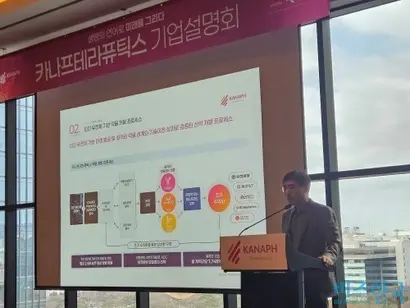
Lee Byung-chul, CEO of Canaph Therapeutics, an innovative human genome-based drug developer, presented this vision at an IPO (Initial Public Offering) press conference held at the Conrad Hotel in Yeouido, Seoul, on the 27th. Established in February 2019, Canaph Therapeutics is set to be listed on the KOSDAQ market on the 16th of next month, seven years after its founding.
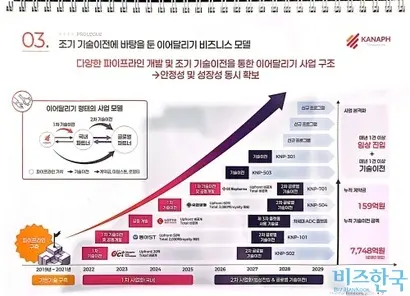
Canaph Therapeutics has built exceptionally strong partnerships for a biotech company. GC Biopharma006280 is the second-largest shareholder, holding a 13.06% stake before the IPO. The company signed a joint voting rights agreement with CEO Lee Byung-chul and voluntarily agreed to a three-year lock-up period for half of its holdings, effectively blocking potential overhang risks after listing. Last December, GC Biopharma signed a technology transfer and joint development agreement for 'KNP-701,' a dual-antibody based ADC (Antibody-Drug Conjugate) candidate that targets both EGFR (Epidermal Growth Factor Receptor) and c-Met (Hepatocyte Growth Factor Receptor).
The Dong-A Socio Group has positioned itself as a partner through both individual investment by the owner and affiliate-level cooperation in new drug development. Kang Jung-seok, Chairman of Dong-A Socio Holdings, is the third-largest shareholder with an 8.5% stake. Dong-A ST170900, a drug developer, signed a technology transfer agreement for 'KNP-101,' a dual-antibody (Anti-FAP/IL-12mu) based immuno-oncology drug candidate, in December 2022 for a total of 203 billion KRW, and is currently co-developing it.
Furthermore, Canaph Therapeutics transferred 'KNP-502,' a synthetic drug candidate that simultaneously inhibits receptors EP2 and EP4—which induce drug resistance after cancer treatment—to Oscotec039200 in March 2022. In March 2024, it transferred 'KNP-504,' a candidate targeting the protein SOS1 involved in cancer survival signaling for KRAS-mutant cancers, to Yuhan Corporation000100. The company also signed a next-generation ADC platform co-development agreement with Lotte Biologics in July 2025. The cumulative technology transfer value for Canaph Therapeutics totals 774.8 billion KRW. In September 2020, the company also signed a CDO (Contract Development Organization) agreement with Samsung Biologics207940 for the development of cell lines, processes, non-clinical trials, and clinical sample production for the retinal disease drug candidate 'KNP-301'.
CEO Lee Byung-chul expressed confidence in having a sustainable drug development system. He noted that by analyzing vast human genome data through a proprietary disease signature discovery system, the company identifies promising targets highly correlated with diseases and applies optimal modalities to build a competitive pipeline. Genome data is used essentially for biomarker discovery, which helps select patient groups expected to have high treatment response rates. By precisely classifying patients based on genetic variation characteristics, the company aims to dramatically increase the clinical success rate of new drugs.
Canaph Therapeutics possesses research capabilities in modalities such as dual antibodies, small molecule compounds, and ADCs. CEO Lee’s global pharmaceutical and biotech industry experience is also a significant asset. "When I worked at Genentech, a global drug developer, I had experience bringing an ADC candidate into Phase 1 clinical trials," Lee explained. "At the Japanese pharmaceutical firm Santen, I identified unmet needs in macular degeneration, which we are now developing as part of our pipeline."
Canaph Therapeutics expects to raise 32 billion KRW through its KOSDAQ listing. Excluding operational funds (5.2 billion KRW) and fees, 57.3% of the remaining 26 billion KRW—more than half—will be concentrated on the development of KNP-101 and KNP-701. The company plans to invest 5.7 billion KRW in KNP-101 and 9.2 billion KRW in KNP-701.
However, some in the industry have expressed concerns that the offering price might be overvalued. While the potential of Canaph Therapeutics is acknowledged, the public offering price was determined by using domestic pharmaceutical companies with solid financial structures as comparison companies. Canaph Therapeutics selected four companies—Chong Kun Dang, Hanmi Pharmaceutical, Boryung, and Onconic Therapeutics—as final comparable companies and set the target offering price between 16,000 KRW and 20,000 KRW.
In response, CFO Park Chang-won stated, "Most competing drug developers are currently in the red but maintain high PERs (Price-to-Earnings Ratios); if we compared ourselves to them, our corporate valuation would actually be higher," adding his determination to address the controversy directly: "(By using companies like Chong Kun Dang as comparables), we believe we have calculated our corporate value conservatively."