

[비즈한국] The probability of a startup reaching the 'unicorn' ranks with a valuation of $1 billion (approx. 1.4 trillion KRW) is far less than 1%. Moreover, it is industry conventional wisdom that it takes an average of 7 to 10 years to pass through this eye of a needle. In Germany, in particular, the investment climate is conservative, making the process even longer. In such a market, there is a defense startup that reached unicorn status in less than two years since its founding. It is the Berlin-based startup 'Stark Defence'.
Valuation Doubled in Six Months
On the 13th (local time), the prominent German economic magazine 'Manager Magazin' reported, citing internal sources, that Stark was valued at over 1 billion euros (approx. 1.1 billion dollars) in a recent investment round. It is effectively a case where its 'valuation' more than doubled in just six months after drawing attention for surpassing $500 million in valuation last August. Notably, the venture capital firm of Peter Thiel, a PayPal co-founder and a major figure in defense tech investment, participated in the round, adding symbolic weight. With this, Stark is rapidly establishing itself as a key pillar of German defense tech alongside Helsing, the leader in German defense AI.
That is not all. On the 25th, the German Bundestag Budget Committee approved a total of 536 million euros (approx. 790 billion KRW) in offensive drone contracts for Helsing and Stark Defence. The maximum procurement limit for both companies was set at 1 billion euros each, and the German government plans to deploy these drones to troops stationed in Lithuania by 2027. This contract marks the starting point of a multi-year drone procurement program worth several billion euros, and it is the first contract under which Germany has officially introduced offensive drones into the military.
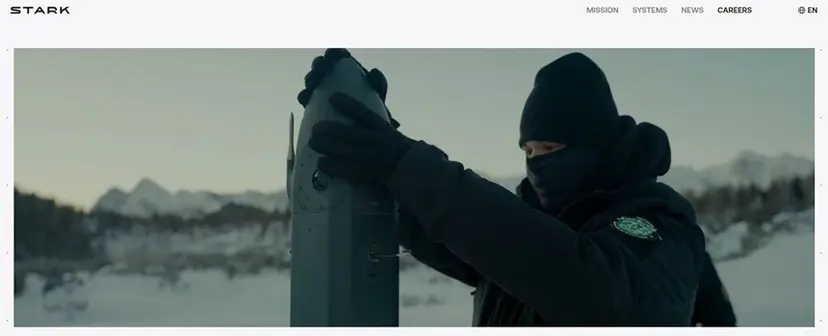
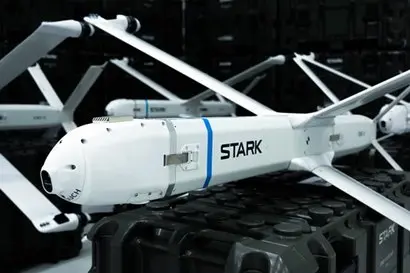
Stark's flagship product is 'Virtus', a vertical take-off and landing (VTOL) offensive drone that performs target detection, reconnaissance, and strikes simultaneously. Virtus is not a simple suicide drone. It is closer to a 'Software-defined Weapon' that learns from battlefield feedback in real-time to update its algorithms in just a matter of days. Furthermore, Stark is expanding its portfolio to include 'Minerva', a C2 software that integrates the operation of multiple unmanned aerial vehicles, and 'Vanta', a maritime unmanned system, building a multi-domain unmanned power system that covers both air and sea.
Stark was founded in Berlin in early 2024 by Florian Seibel. Seibel is an aerospace engineer who served in the German Armed Forces for 16 years and later founded and led the reconnaissance and surveillance drone startup Quantum Systems. He left Quantum, where the development of offensive weapons was restricted due to ethical policies, to start a new company to challenge himself with what he truly wanted to build. The trust he built with key investors like Peter Thiel at Quantum became a crucial foothold for Stark to attract funding immediately after its inception.
Closing the Repentance Book, Opening the Strategy Book: Germany
The biggest backdrop to Stark's growth lies in the changing nature of warfare. The Russia-Ukraine war proved that low-cost unmanned vehicles can change the landscape of the battlefield. Unmanned systems that can be mass-deployed much faster and cheaper than multi-trillion KRW tanks have emerged as a key variable in modern warfare.
The rapid shift in Germany's post-war identity also played a role. Just a few years ago, starting a business in the defense sector was close to a social taboo in Germany. The strong anti-militarism tradition formed after World War II and the historical debt of being a war-criminal nation created a social consensus that Germany should remain a 'civilian power' rather than a 'military power'. As a result, the cultivation of the defense industry remained in a politically and culturally sensitive area.
However, on February 27, 2022, three days after the outbreak of the Russia-Ukraine war, Germany declared 'Zeitenwende' (an epochal shift) and announced the creation of a 100 billion euro special fund for national defense. The realization that borders cannot be protected by moral superiority alone drove Germany. Consequently, venture capital, which had previously been reluctant to invest in defense due to ESG standards, began actively injecting funds into defense tech under the banner of 'defending democracy'. The concept of 'Tech Sovereignty'—defending Europe's security with European code without relying on the US or China—has essentially been translated into the language of capital.
This trend is not unique to Germany. In Silicon Valley, companies like Anduril and Shield AI have already been recognized with multi-billion dollar valuations, opening the era of 'software-defined defense'. In the US, the line between civil and military technology blurred long ago, and venture capital has accepted defense as a strategic investment area. Conversely, Germany has only just reached that turning point after the Zeitenwende.
If Helsing and Quantum opened the path, Stark is running the fastest on it. As long as the German defense industry has embraced the speed of startups, Stark is just the beginning, not the end.
The author, Lee Jung-woo, has worked for 17 years as a journalist covering major industries such as automobiles, secondary batteries, and heavy industry, as well as defense, diplomacy, environment, education, and health/welfare. He has specifically reported on the field changes in industrial structure centered on mobility, energy transition, and sustainability. He currently resides in Berlin, Germany, and serves as a partner at the startup accelerator '123 Factory'.