

[비즈한국] Bizhankook’s investigation has confirmed that the operator of the Hangang Bus failed to repay 60.5 billion won in loans to Seoul Housing & Communities Corporation (SH) on time, resulting in a default. Recently, SH signed an amended agreement to extend the maturity of 87.6 billion won in loans, including the overdue amounts, until 2045, and demoted its repayment priority behind commercial bank loans (Related article: [Exclusive] SH Concedes 'Repayment Priority' on 87.6 Billion Won Hangang Bus Loan). Critics point out that the financial burden has increased as the recovery of public funds has not only been delayed but has also been pushed down in the repayment hierarchy.
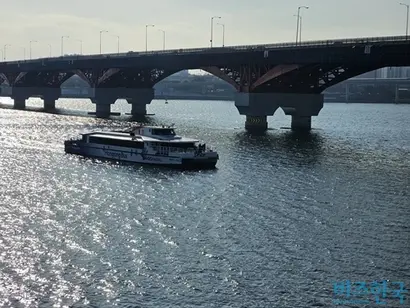
Combining data from Bizhankook's investigation and materials from the office of Representative Chae Hyun-il of the National Assembly's Public Administration and Security Committee, the Hangang Bus failed to repay 60.5 billion won (two loans) borrowed from SH by their maturity dates last year. This constitutes a default, or an overdue status. The loans that Hangang Bus failed to repay on time were a 49.5 billion won short-term loan (1-year maturity) executed in November 2024 and an 11 billion won short-term loan (6-month maturity) executed in April of last year, with maturity dates in November and October of last year, respectively.
The overdue loan status of Hangang Bus was resolved during a recent process of amending the loan agreements. On the 20th of last month, SH and Hangang Bus signed an amended loan agreement that extended the maturity of 87.6 billion won (three loans), including the 60.5 billion won (two loans) that were overdue, to 2045 (20 years from the start of operations), which is the end of the Hangang Bus project period. The agreement also stipulated that these loans would be subordinate to commercial bank loans.
Fortunately, it appears that late fees resulting from the default were paid before the agreement was amended. Previously, when the SH Board of Directors approved the loan amendment proposal last December, it was decided that “for the short-term loan (49.5 billion won) and additional short-term loan (11 billion won), as the maturity dates arrived before the board resolution, default damages corresponding to the number of overdue days (6% annual interest rate) should be claimed from the day after maturity until the date the amended agreement is signed, and the amendment should be signed after payment is completed.”
An SH official stated, “We received the full amount of late fees before the loan amendment on the 20th of last month, so there are currently no overdue payment records,” adding, “We cannot disclose past details.”
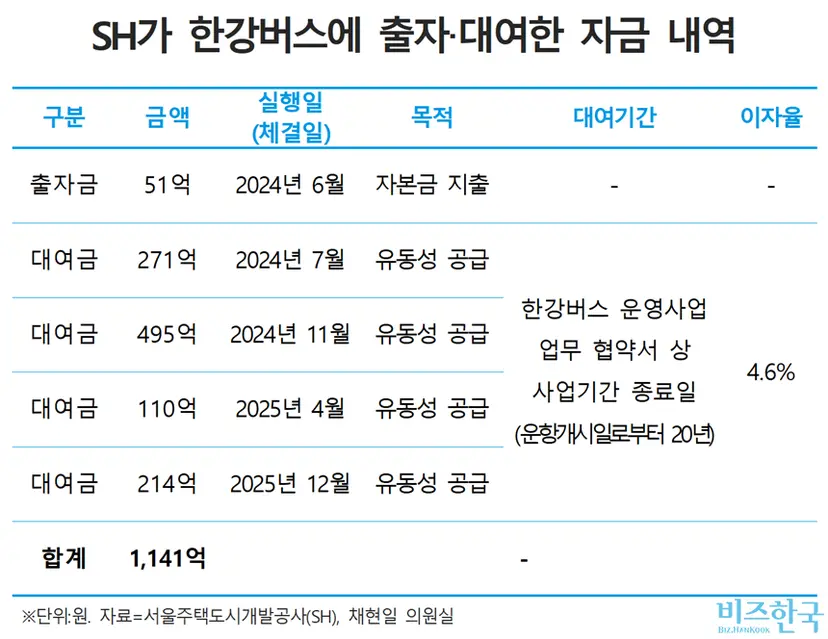
SH provided an additional 21.4 billion won in loans last December, while Hangang Bus was in a state of default. The loan period extends until 2045, the end of the Hangang Bus project. SH explained that it determined the funding shortfall occurred due to increases in project and operating costs resulting from changes in the external environment, and that it injected the funds to ensure smooth project implementation and secure financial stability as the majority shareholder.
However, it remains uncertain whether the loans will be recovered. This is because the recovery structure for Hangang Bus loans has worsened due to last month’s agreement amendment. Through the amendment, SH extended the maturity of 87.6 billion won in loans (three cases), including the 60.5 billion won (two cases) that were in default, by up to 20 years to 2045. The repayment priority for these loans, which had previously been ahead of the 50 billion won in commercial bank loans, was changed to subordinate status. This was done to meet the conditions for Hangang Bus's commercial bank loans.
The total funds injected by SH into Hangang Bus to date amount to 114.1 billion won. After investing 5.1 billion won as founding capital in June 2024, SH provided loans of 27.1 billion won in July 2024, 49.5 billion won in November 2024, 11 billion won in April last year, and 21.4 billion won in December last year. Excluding the initial equity capital, the total amount of loans alone reaches 109 billion won. All these were for the purpose of supplying liquidity to Hangang Bus.
Ha Seung-soo, representative of 'Tax Thief Catchers,' pointed out, “Even if SH is the majority shareholder of the company, there is a premise that loans to a separate legal entity will be recovered at maturity. Failure to recover loans on time means that the risk of loss for the corporation has increased significantly. If a company has 49% private ownership, funding should also be provided through methods like paid-in capital increases to share the risk with the private sector. Lending additional funds to a company that failed to fulfill its obligations and subordinating those loans amounts to bearing the burden of loss, which could potentially constitute breach of trust.”