

[비즈한국] In an era where even philosophy is consumed in 'shorts' and AI (artificial intelligence) substitutes even for our thinking, what does it mean to do philosophy?
Philosophy is often dismissed as 'chasing clouds,' far removed from reality. Some view it as a hobby for the wealthy or an escape for those maladjusted to reality. However, true philosophy is about thinking to solve the problems and absurdities we face in life. Therefore, for a woman in Korea to 'do' philosophy, she has no choice but to be intense. This is because she must live a life that confronts questions every single day.
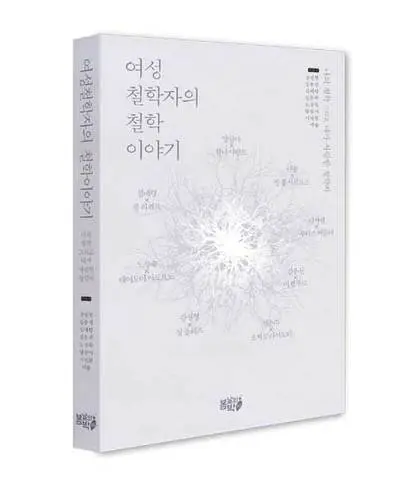
The recently published book, 'Stories of Philosophy by Female Philosophers,' contains the 'philosophizing' stories of eight active and notable emerging and mid-career female philosophers in Korea.

Kang Seon-hyeong, Kim Bun-seon, Kim Ae-ryeong, Kim Eun-joo, Noh Seong-sook, Yang Chang-a, Lee Seon-hyeon, and Lee Sol each study thinkers representing 20th-century modern philosophy, such as Gilles Deleuze, Michel Foucault, Paul Ricœur, Rosi Braidotti, Theodor Adorno, Hannah Arendt, Judith Butler, and Jean-Paul Sartre. How did they encounter philosophy, what led them to study these thinkers, and do we still need philosophy? 'Stories of Philosophy by Female Philosophers' re-examines the meaning of philosophy through their experiences.
The authors show that philosophy begins in concrete life situations and that a philosopher's life and theoretical thought cannot be separated. For instance, Yang Chang-a chose philosophy in her second year of high school. At a time when many were losing their lives due to the 'IMF crisis,' she decided, "Since I feel death is always near, I should do what I want." She also felt that there were "many riddles to solve." So, she entered the university's philosophy department.
She chose Hannah Arendt because the term 'the banality of evil' and Arendt's work stuck in her mind during college classes where she often dozed off, exhausted from part-time jobs. Arendt cultivated her ideas by actively reflecting on the things she experienced. Yang Chang-a, who felt stifled because she couldn't clarify the problems she needed to solve at the time, felt that Arendt was a 'contemporary.' Later, while joining sites of solidarity such as 'Gangjeong,' 'Yeongdo,' 'Miryang,' and 'Mandeok,' she experienced how things she had learned were either shattered or brought to life. Through those experiences, Yang gained a new understanding of Arendt.
In this way, these female philosophers speak of solidarity, community, and neighbors through philosophy—or perhaps they do philosophy through solidarity. This is different from the solitary contemplation often associated with philosophers. To them, philosophy is not lofty knowledge, but a path to solve real-world problems for themselves and others, and to live better lives.
Now, let's return to the initial question. Do we still need philosophy? Philosopher Kang Seon-hyeong answers as follows:
Philosophy is always interested in the process. If one says 'something' happened for 'this or that' reason, philosophy focuses on the 'this or that' rather than the 'something.' Therefore, philosophy is not about tautologically stating correct answers, but rather a constant invention of rational explanatory processes. It is precisely because of this that we can learn to question and learn the attitude of questioning along with philosophy.
For this reason, Kang says the joy of philosophy resembles the joy of life. "Even if our lives sometimes feel like a meaningless repetition of returning to the same place, just as that process is always a new process of learning, one can learn that joy through the process of philosophy—of wondering what one intended to answer and why one could not help but think that way.”
In an age where critical thinking is fading, what can 'philosophy' do for our lives, and how can we move forward through 'philosophizing'? 'Stories of Philosophy by Female Philosophers' draws the answer to this question from the lives of eight philosophers. The authors prove for themselves that philosophy is not advanced knowledge separate from life, but a continuous process of understanding the world and reflecting on oneself.