

[비즈한국] As electric vehicle (EV) adoption reaches a certain level, the industry's focus is shifting beyond mere quantity expansion toward a fundamental change in the role of EVs within the energy system. V2G (Vehicle-to-Grid) technology, which sends power stored in EV batteries back to the grid, redefines the electric vehicle as a 'battery on wheels' and a distributed energy resource. Major institutions like the International Energy Agency (IEA) view EVs as a core tool to enhance future power grid flexibility. They are being touted as an alternative to mitigate supply-demand imbalances and compensate for the volatility of renewable energy. With global automakers recently introducing related services and domestic local governments launching pilot projects, the review process for commercializing this technology is gaining momentum.
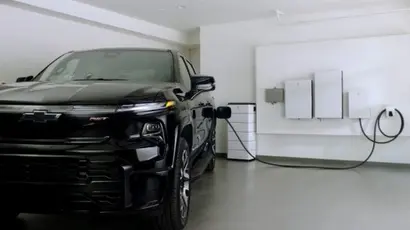
GM Energy Pushes for Home Lease Program
General Motors (GM) in the United States is accelerating the adoption of V2H (Vehicle-to-Home) technology—a type of V2G that utilizes EV power as an emergency home power supply—through its subsidiary, GM Energy. GM secured a hardware foundation in 2025 by selling 246,000 vehicles equipped with bidirectional charging capabilities in the U.S. market. Currently, building a V2H system requires over $8,000 just for hardware like bidirectional chargers and inverters, creating a significant initial cost burden when installation fees are included.
On the 19th, GM Energy announced it would pursue a lease program that allows customers to pay for energy management systems and home batteries in monthly installments, similar to a vehicle lease, to lower these cost barriers. The strategy aims to help consumers manage household energy costs using their EVs without thousands of dollars in upfront costs, while also securing emergency power during grid failures or natural disasters.
EVs Emerge as Distributed Energy Resources Supporting the Grid
V2G is a technology that uses dedicated bidirectional chargers to supply power from an EV battery to the electrical grid, effectively turning the vehicle into a type of Energy Storage System (ESS). Since the battery in an EV typically has a capacity of 60–80 kWh, comparable to a home ESS, its value as an aggregate energy asset grows as the number of vehicles increases. The core concept is to charge during off-peak hours when power demand and prices are low, and discharge during peak times to help stabilize the power grid.
In particular, for renewable energy sources like solar or wind power, where production is irregular depending on weather conditions, EVs can absorb excess power and supply it back when needed, simultaneously improving energy utilization and economic efficiency. This technical potential has already been verified abroad. In Japan, the Nissan Leaf has been used to verify emergency power supply capabilities during disasters, and in Germany, BMW is collaborating with utility companies to develop control systems that minimize the impact on battery life. The UK is also testing market mechanisms, achieving a reduction of up to 79% in peak-hour demand through smart charging controls.
Shin Oe-kyung, head of the Mobility Charging Industry Convergence Alliance at the Korea Automotive Technology Institute (KATECH), said, "If V2G can act as an incentive for EV users, the market for electric vehicles and chargers could expand further."
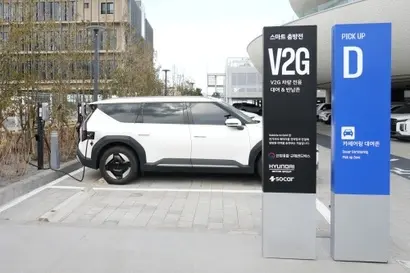
In South Korea, V2G pilot projects are actively underway, centered in Jeju Island, which boasts the highest share of renewable energy in the country. Because Jeju frequently faces power curtailment issues due to overproduction from wind and solar power, the island is focusing on utilizing EVs as energy resources to stabilize the power grid.
An official from the Jeju Provincial Government stated, "Jeju's share of renewable energy is 20%, double that of other local governments," adding, "Since being designated as a special zone for distributed energy, we are piloting V2G as a solution for mismatches in power supply and demand."
Soccar launched a pilot project in December last year by installing bidirectional chargers at the Jeju terminal to integrate V2G into its rental service. This is regarded as the first attempt in Korea to utilize rental cars as distributed energy resources rather than mere transport. Through a regulatory sandbox, they bypassed discharge restrictions at industrial charging facilities and allowed rental cars to participate in the power market, opening the door for new energy business models. Soccar plans to expand to 200 bidirectional chargers in the future to build an energy hub in the Jeju region.
Hyundai Motor Group has also signed an MOU with Jeju Island to create a 'Green Hydrogen and Distributed Energy Ecosystem' and has launched a V2G pilot service. The pilot operates with a total of 55 vehicles for Ioniq 9 and EV9 customers, providing benefits such as bidirectional charger installation and charging fee support to participants. Based on the data from this pilot, Hyundai Motor Group plans to verify the technology and business feasibility, then expand the service to other regions once relevant regulations are in place.
Challenges to Commercialization
Despite the technology's potential, there are many hurdles to overcome before commercialization. Key technical evaluation factors include whether batteries perform stably under repeated charge-discharge cycles and whether safety and control reliability are maintained during bidirectional power flow. In particular, data-driven, sophisticated management systems and warranty frameworks must be in place to dispel user concerns about battery degradation.
Institutionally, a legal basis must be established to recognize EVs as distributed energy resources, and a market structure for power trading must be designed. It is also essential to secure communication security with the power grid and design a reasonable settlement and compensation system that motivates users to provide their assets to the grid.
Last December, the Ministry of Climate, Energy, and Environment launched a public-private consultative body to establish a concrete roadmap for commercialization, covering technical standards, metering methods, and compensation systems. The body consists of an operating committee and working-level divisions. The operating committee, involving the ministry, power agencies, and representatives from industry and academia, discusses policy direction. The working-level divisions focus on technical areas—such as technology, standards, certification systems, grid interconnection, metering methods, and battery safety/longevity management criteria—as well as institutional and market areas, such as settlement/compensation methods, revisions to the Electric Utility Act, subsidy/incentive systems, and business structure design.
The next phase of the V2G business depends on how well it can be integrated into the national energy system based on technical reliability. The future value of EVs is expected to expand beyond mobility on the road to becoming a core hub for the energy transition.