

[비즈한국] BR Korea, an SPC Group affiliate fined by the Korea Fair Trade Commission (KFTC) for allegedly manipulating consent rates for promotional events, is facing collective backlash from its franchisees. Franchisees claim they can no longer bear the burden of excessive promotions and a profit structure that threatens the survival of their stores, demanding real measures for mutual growth. On the other hand, BR Korea maintains that increasing profit margins is not realistically feasible. This is why observers suggest the conflict between the two sides may be prolonged.
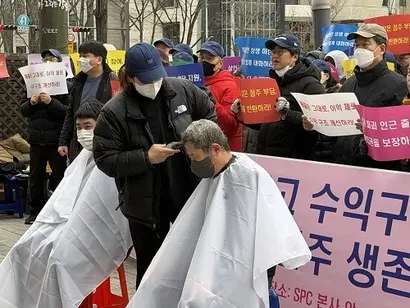
Over 100 Franchisees Gather at Headquarters for Head-Shaving Ceremony
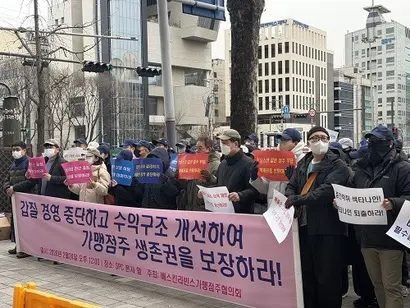
On the 24th, the Baskin Robbins Franchisee Association held a rally in front of the 'SPC 2023' building in Gangnam-gu, Seoul. The franchisees demanded that BR Korea, the headquarters of Baskin Robbins, improve the profit structure and stop unfair practices. About 100 franchisees participated in the rally, and the association issued a statement urging the headquarters to engage in responsible negotiations and prepare substantial countermeasures.
A head-shaving ceremony was also held on-site to highlight the desperate situation of the franchisees. Those who shaved their heads demanded effective support measures from the headquarters, stating that it is no longer possible to endure the worsening business environment, characterized by high inflation and rising labor costs. Among the participants watching the scene, voices of criticism directed at the headquarters erupted.
This rally marks the first instance of collective action by Baskin Robbins franchisees. An official from the association stated, "Since the association's launch in 2022, we have continuously discussed mutual growth plans with the franchisor, but we only received repetitive, formal responses with no real change. Franchisees reached a point where they could no longer endure, leading to the decision to rally. We plan to continue monthly rallies until the headquarters approaches negotiations with a responsible attitude."
As franchisees engaged in collective action, the headquarters appears to be taking steps to address the situation. BR Korea, which had not taken any follow-up measures after being sanctioned by the KFTC on February 1, reportedly presented a compensation plan to the franchisees just one day before the rally.
BR Korea was recently issued a corrective order and fined 318 million KRW by the KFTC for conducting promotional events for Baskin Robbins and Dunkin' stores without obtaining prior consent from franchisees. The Franchise Business Act stipulates that when conducting promotional events where franchisees bear all or part of the costs, consent must be obtained from at least 70% of all franchisees. However, during the investigation, it was revealed that BR Korea had treated non-consenting stores as if they had consented to meet the 70% threshold.
An official from the association pointed out, "The day before the rally, the headquarters offered a plan to compensate for losses incurred by non-consenting stores that had paid for promotional costs. Isn't this only coming out because the franchisees decided to rally?"
Regarding this measure, BR Korea stated, "The compensation plan is currently under discussion with the association, so it is difficult to explain." It further explained, "(The KFTC sanction) concerned an incident where an employee arbitrarily processed consent for one franchise store during the process of obtaining franchisee consent for a telecommunications company partnership promotion. After recognizing the issue, the company conducted an internal investigation, apologized to the franchisee, and took disciplinary action against the employee. To prevent recurrence, we have completely revamped the system so that third parties cannot arbitrarily process consent."
"Consumer Prices Sometimes Drop Below Supply Prices"
Franchisees are complaining about a structural problem where "nothing is left even after selling." The association claims that the cost-of-goods-sold ratio for franchisees exceeds 50%, which is excessively higher than other brands, and that it is difficult to make a normal profit due to frequent promotions. One franchisee lamented, "If you overlap the days when multiple promotions are running simultaneously and add them all up, the number of event days exceeds 700 per year. That is how excessively frequent the promotional events are."
They continued, "The headquarters says that participating in promotions is optional, but franchisees worried about a decline in sales effectively have no choice but to sign the consent form. Fundamental institutional improvements are needed for unreasonable promotional practices."
Currently, the headquarters operates an 'annual consent' procedure where they receive consent for the annual promotion plan at once. It is known that they specify the condition that even if the consent rate is below 70%, the event will proceed for stores that did consent. Franchisees criticize this method, arguing that while it offers a choice only in form, it is practically a structure that forces participation. Given the intense competition due to the saturation of franchise stores, if a neighboring store runs a major promotion such as a telecommunications partnership, a non-participating store must endure customer loss and a decline in sales.
It is also pointed out that ironic situations occur because the burden of high cost-of-goods-sold ratios is combined with frequent promotional events. One franchisee confessed, "Because we have events so often, the consumer price of ice cream that customers buy is sometimes lower than the supply price provided to the franchisee. In these cases, franchisees sometimes visit nearby competing stores to buy the ice cream themselves."
The issue of designating essential items also remains a factor of conflict. Baskin Robbins designates the 'pink spoons' used in stores as essential items and requires them to be purchased through the headquarters, but franchisees are demanding the designation be lifted due to the cost burden. The association stated, "The headquarter's supply price is 36 KRW per unit, but if bought online, it is around 16 KRW. We have requested it to be lifted, but since it was not accepted, we have reported it to the KFTC."
Recently, conflict over delivery fees has also emerged. Since February, the headquarters raised delivery app order prices by about 12% while simultaneously stopping delivery subsidies previously paid to franchisees. Franchisees complain that while prices went up, the sales effect is limited due to a decrease in orders, whereas the burden of delivery fees is being passed entirely onto the franchisees.
Amidst the ongoing conflict over profit structure and cost burdens, the headquarters maintains that a realistic response considering business conditions is necessary. BR Korea stated, "We are reflecting as much as possible of the franchisees' demands, but considering the current cost structure and the headquarters' situation, increasing profit margins is not realistically acceptable. We will continue discussions with franchisees in a direction that raises both store profitability and brand competitiveness within a sustainable structure for both the franchisee and the franchisor."