

[비즈한국] It has been confirmed through Biz Hankook's investigation that the Seoul Housing & Communities Corporation (SH) recently signed a contract to subordinate an 87.6 billion won loan it provided to the Hangang Bus operator, placing it behind commercial bank loans in repayment priority. SH also extended the loan's maturity to 2045, the end of the project period, and restructured the principal to be repaid in installments from 2038 to 2045. By enabling Hangang Bus to secure additional loans from commercial banks, critics argue this has increased the risk to public funds during an early stage where business viability has not yet been fully verified.
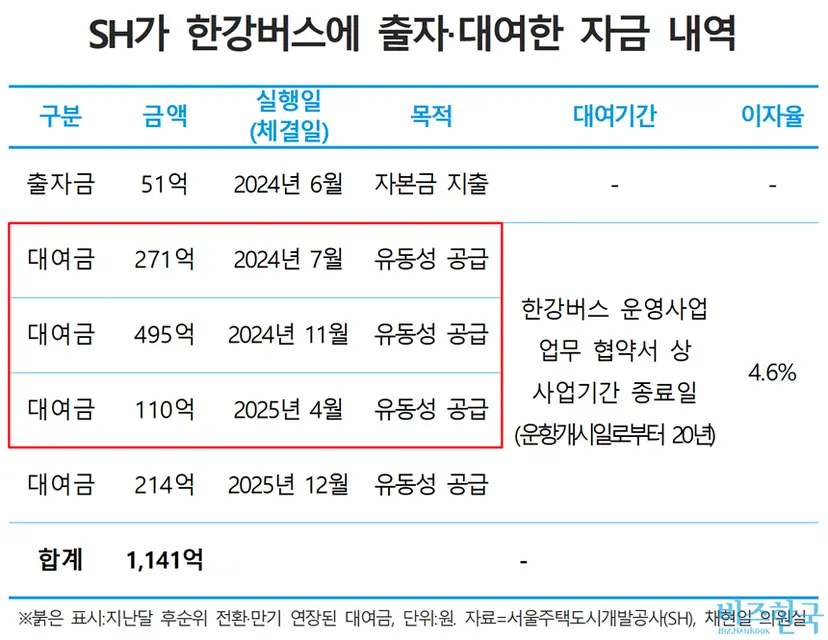
According to Biz Hankook's research and data from the office of Representative Chae Hyun-il of the National Assembly's Public Administration and Security Committee, SH and Hangang Bus signed a contract on the 20th of last month to amend the loan agreement. The core of the contract is the subordination of 87.6 billion won in existing loans (three separate loans) provided by SH to Hangang Bus, and the extension of the maturity date to 2045 (20 years from the start of operations), which marks the end of the Hangang Bus project term. Interest on the loans (4.6%) is to be paid quarterly, while the principal is to be repaid in installments of 10.95 billion won annually over eight years starting in 2038, following a grace period.
The amendment to the Hangang Bus loan agreement was driven by conditions set by commercial banks. Last June, Hangang Bus borrowed 50 billion won from private financial institutions. At the time, the lender group stipulated that the existing 87.6 billion won SH loan must be subordinated to the bank loans as a condition for the financing. Consequently, SH agreed to amend the Hangang Bus loan agreement after the initial loan contract was signed. However, this agreement was not fulfilled until this most recent revision. The lender group pressured SH, stating that the failure to fulfill the agreement constituted an event of default and threatened to classify the loan as a non-performing asset. Following this, the loan agreement was amended.
To date, SH has injected a total of 114.1 billion won into Hangang Bus. After an initial capital contribution of 5.1 billion won for the establishment of Hangang Bus in June 2024, it provided loans of 27.1 billion won in July 2024, 49.5 billion won in November 2024, 11 billion won in April last year, and 21.4 billion won in December last year. Excluding the capital contribution, the loan volume totals 109 billion won, all intended for Hangang Bus's liquidity support. The loans subject to this subordination and maturity extension include the 27.1 billion won from July 2024 (10-year maturity), 49.5 billion won from November 2024 (1-year maturity), and 11 billion won from April 2025 (6-month maturity), totaling 87.6 billion won across three transactions.
This amendment to the loan agreement has heightened concerns over the recovery of SH's funds. Out of the 109 billion won in Hangang Bus loans, 87.6 billion won, which previously held priority over bank loans, has now been subordinated. Maturity dates, which were originally 2025 and 2034, have been extended by up to 20 years to 2045. Furthermore, the profit structure of Hangang Bus, still in its early stages, has not yet been proven. In fact, the SH Board of Directors once deferred the amendment motion last November, stating, "The loan agreement amendment should be finalized only after sufficient operating data for Hangang Bus has been accumulated and the bank loan grace period (2 years) has ended.”
SH stated, "The subordination of existing corporate loans was a prerequisite for the commercial banks' loan agreement to ensure their credit security. Although we conveyed the Board of Directors' opinion to the financial institutions, they informed us that since the subordination of the existing loan was a mandatory condition for the loan agreement, failure to comply would result in an event of default. Considering the corporation's budget and asset size, we believe the impact of increased financial risk from this amendment will not be significant, and we plan to focus on improving the profit structure through normalization after the full resumption of Hangang Bus operations.”
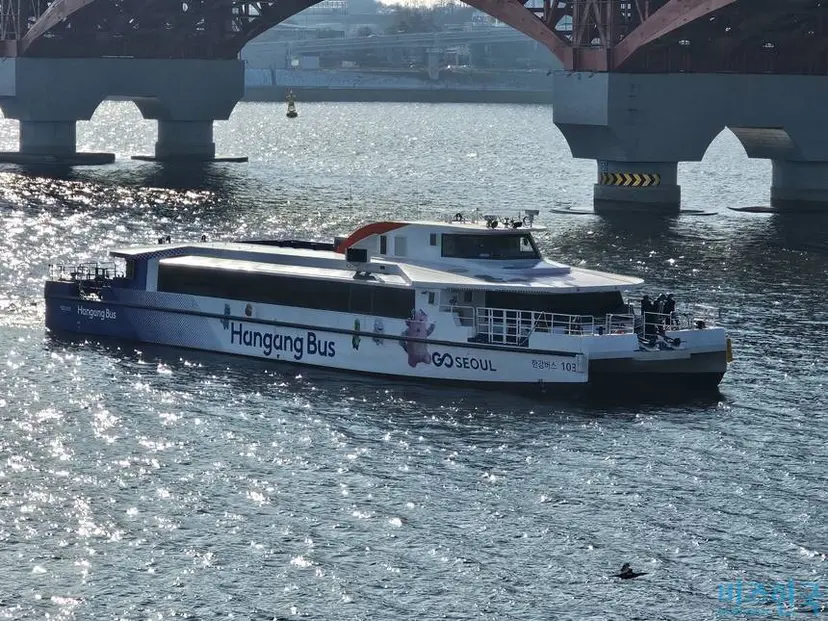
Hangang Bus is Seoul's first water-based public transportation system. Introduced last September, the Seoul Metropolitan Government launched the project to help mitigate severe road congestion and public transit crowding during rush hours. It operates as a passenger vessel system, traveling a total of 28.9 km across seven piers along the Han River, including Magok, Mangwon, Yeouido, Apgujeong, Oksu, Ttukseom, and Jamsil. The Hangang Bus operator is a joint venture between SH, under the Seoul Metropolitan Government, and E-Land Group's E-Cruise. The two companies hold 51% and 49% stakes respectively, effectively making the Seoul Metropolitan Government the majority shareholder.
Hangang Bus experienced partial service suspension last November due to an incident where a vessel stopped. At around 8:00 PM, the Hangang Bus vessel No. 102 became stuck in a shallow area near the Jamsil pier. The cause of the accident was attributed to navigating off-course and insufficient lighting on navigational buoys. Following the accident, Hangang Bus suspended operations between Apgujeong and Jamsil, limiting service to the Magok-Yeouido route. While the Seoul Metropolitan Government initially targeted a January resumption of full service, it postponed the schedule to March, citing the need for dredging to ensure water depth and additional safety inspections.
SH, the lender to Hangang Bus, is seeing a trend of deteriorating financial health. According to its financial statements, SH's debt-to-equity ratio rose from 178% in 2023 to 195% in 2024. The total debt of the corporation increased from 17.7069 trillion won to 20.0236 trillion won, an increase of 2.3167 trillion won. While a debt-to-equity ratio of 200% or less is generally considered stable for a standard company, exceeding this level is often viewed as a sign of a weak financial structure. Revenue in 2024 was approximately 1.2903 trillion won, down 9.1 billion won from the previous year, while operating profit reached 132.7 billion won, an increase of 77.6 billion won.
Representative Chae Hyun-il pointed out, "There are deep concerns about whether Hangang Bus, which only generates deficits, will ever be able to repay the 87.6 billion won to SH. It is time to stop Mayor Oh Se-hoon's reckless gamble on the Hangang Bus project.”