

[비즈한국] The domestic petrochemical industry has officially set sail on a full-scale structural overhaul to overcome the surging waves of global oversupply and deteriorating profitability. On the 23rd, the Ministry of Trade, Industry and Energy finalized approval for the business reorganization plan jointly submitted by HD Hyundai Oilbank, HD Hyundai Chemical, and Lotte Chemical011170. This marks the first approval under the 'Petrochemical Industry Restructuring Roadmap' announced by the government last August. Attention is focused on whether this will serve as the starting signal for the struggling Korean chemical industry to pivot from a structure centered on commodity products to one focused on high-value and eco-friendly goods.
50:50 Ownership Stake… 1.1 Million Ton Naphtha Cracker Operations Halted
The core of this reorganization lies in maximizing operational efficiency by integrating the assets of Lotte Chemical and HD Hyundai Chemical located in the Daesan Petrochemical Complex in Chungnam. According to the detailed plan, Lotte Chemical will physically spin off its Daesan business site and merge it with HD Hyundai Chemical. To ensure the financial stability of the new integrated entity, shareholder companies HD Hyundai Oilbank and Lotte Chemical headquarters will each inject 600 billion KRW, totaling 1.2 trillion KRW in a massive capital increase. Through these self-rescue efforts, the existing 6:4 equity structure between HD Hyundai Oilbank and Lotte Chemical will be adjusted to 5:5.
The most notable change in the business structure is the cleanup of excess supply facilities. The integrated entity has decided to completely suspend the operation of Lotte Chemical's NCC (Naphtha Cracking Center) facility, which produced 1.1 million tons of ethylene annually, over the next three years—the period of the reorganization. Furthermore, it will reduce operations for redundant or loss-making low-profit commodity downstream facilities. Instead, the strategy is to maximize production efficiency by raising the utilization rate of the remaining high-efficiency facilities from 80% to 100%, and to secure both raw material supply stability and cost competitiveness through vertical integration with refinery processes.
Government Offers 2.1 Trillion KRW Package Covering Finance, Taxes, and Costs
In response to these private-sector decisions, the government has prepared a large-scale 'tailored support package' worth over 2.1 trillion KRW, covering finance, taxation, cost improvement, and technology development. In the financial sector, the government will provide up to 2 trillion KRW to support companies struggling to secure investment funds due to worsening management conditions. Creditor financial institutions, including the Korea Development Bank, will provide 1 trillion KRW in new funds needed for facility integration and high-value conversion, while converting up to 1 trillion KRW of existing loans into perpetual bonds to manage debt ratios that might otherwise spike due to asset impairment charges from suspending facilities.
Tax benefits are also being provided. The burden of acquisition tax and registration license tax incurred during the structural change process, such as corporate divisions and mergers, will be reduced by 75-100%. Tax deferral benefits have been expanded to allow corporate tax incurred from asset sales to be paid in installments over five years after a five-year grace period. Additionally, the burden of taxes promoting investment and mutual cooperation has been eased to ensure companies can secure room for reinvestment.
To improve the cost structure, which dictates global competitiveness, a card to cut utility costs has also been played. By designating the Daesan Petrochemical Complex as a Distributed Energy Special Zone, the complex will benefit from electricity rates 4-5% lower than those of KEPCO. The government has also temporarily relaxed regulations prohibiting the overlapping of heat (steam) supply zones, opening the way for companies to freely select cheaper heat sources. Furthermore, zero tariffs will be applied to imported naphtha and crude oil through this year, and the scope of tariff quotas will be expanded. These measures are expected to reduce cost burdens in the petrochemical industry, which relies heavily on raw materials, by at least 69 billion to 115 billion KRW annually.
The ultimate goal of this reorganization goes beyond simple facility reduction; it aims to transform the portfolio toward 'high-value and eco-friendly' products. The integrated entity plans to move away from producing commodity products like ethylene and concentrate its capabilities on specialty products, such as high-elasticity lightweight materials for wires and cables and organic solvents for secondary battery electrolytes. It will also proactively respond to global environmental regulations by producing eco-friendly products using bio-naphtha and introducing low-carbon ethane raw materials. To support this, the government will launch large-scale R&D projects in the mid-to-long term, starting with 26 billion KRW in support for high-value technology development this year, including AI-based material design and greenhouse gas reduction process innovation.
Measures for regional economic contraction and employment anxiety resulting from the reorganization are also included. The government plans to relax the revenue decline requirements for employment retention subsidies to support the maintenance of idle personnel and to minimize negative impacts on local communities by extending support periods or expanding relevant budgets for regions declared as Employment Crisis or Industrial Crisis Response Zones, such as Seosan.
Minister of Industry Holds CEO Meeting: “Accelerating Follow-up Projects”
Starting with the approval of this Daesan Project No. 1, the Ministry of Industry plans to rapidly push for follow-up projects in major industrial complexes like Yeosu and Ulsan. To this end, the ministry announced it would solidify the institutional foundation by operating a public-private consultative body to collect corporate grievances in real-time and by swiftly enacting the enforcement decree of the 'Special Act on Strengthening Competitiveness and Support for the Petrochemical Industry,' which includes shortening the corporate merger review period and simplifying the succession of permits.
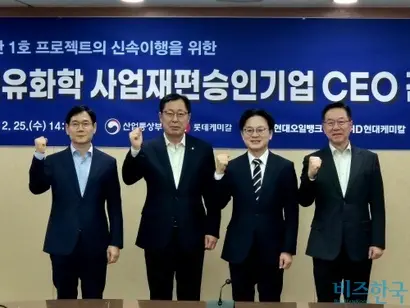
On the afternoon of February 25, the day the support package was announced, Minister of Industry Kim Jeong-gwan held a meeting with CEOs of the approved companies at the Korea Trade-Investment Promotion Agency (KOTRA) in Seocho-gu, Seoul. In his opening remarks, Minister Kim stated, "The Daesan Project No. 1 is the first achievement derived from close cooperation between the government and the industry," adding, "The government will act as a strong tailwind to ensure that the approved plans are implemented without a hitch in the field and lead to tangible results." He also urged the companies to put effort into mutual growth to ensure that partners and local communities grow together during the reorganization process.
In response, Cho Nam-soo, CEO of HD Hyundai Chemical, said, "I believe the government has done its best (regarding the support package). We will do our utmost to ensure this becomes an exemplary case that does not disappoint the government."