

[비즈한국] The market is focusing on the sanctions financial authorities will impose on the banking sector regarding the mis-selling of Equity-Linked Securities (ELS) based on the Hang Seng China Enterprises Index (H-Index). Financial authorities had pre-notified the banking sector of fines and penalties totaling 2 trillion won late last year, but recently reduced them by approximately 30% during a Sanctions Review Committee meeting. Nevertheless, with opposition growing in the banking sector that the scale of the fines remains excessive, eyes are on the final sanctions and their aftermath.
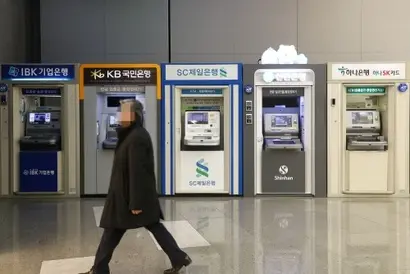
It is reported that financial authorities will finalize the sanctions for banks' H-Index ELS mis-selling at the 4th Securities and Futures Commission meeting to be held on the 25th. Once the sanctions are passed through the Securities and Futures Commission review, they will be confirmed upon resolution at the regular meeting of the Financial Services Commission. The banks that received pre-notifications for fines and penalties from financial authorities at the end of 2025 regarding H-Index ELS sales are as follows: KB Kookmin Bank (1 trillion won), Hana Bank (320 billion won), Shinhan Bank (280 billion won), NH Nonghyup Bank (190 billion won), and SC First Bank (150 billion won). While the total scale of the fines reached 2 trillion won, it is known to have been reduced by about 30% to 1.4 trillion won at the Financial Supervisory Service's Sanctions Review Committee held on the 12th.
The banking sector is hoping that the scale of fines will be lowered further, given that voluntary compensation has been carried out for a significant number of H-Index ELS victims. According to the office of Representative Lee Jung-moon of the Democratic Party of Korea, as of June 2025, the average consent rate for voluntary compensation for bank-sold H-Index ELS was 96%, with the total compensation exceeding 1.3 trillion won.
The Financial Workers' Union has actively opposed the authorities' sanctions. The union raised its voice, arguing that the method of calculating the fines is flawed and requires re-examination in terms of equity, rationality, and accountability. The union argued that while laws like the Serious Accidents Punishment Act or the Fair Trade Act set caps on fines, the Financial Consumer Protection Act allows for fines of up to 100% of the sales amount rather than the sales profit, effectively meaning there is no cap. Furthermore, it pointed out that while structural factors such as product design, institutional frameworks, and supervisory standards play a role in financial product transactions, the responsibility for losses has been shifted solely onto on-site employees and financial firms.
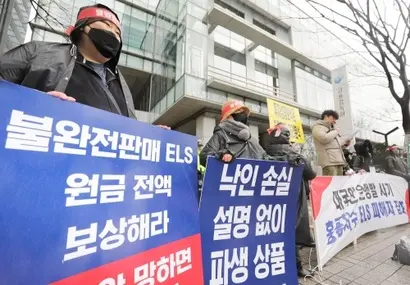
At a rally held in front of the Financial Services Commission on the 23rd, Kim Yong-hwan, head of the Shinhan Bank branch of the Financial Workers' Union, stated, "It is difficult to understand why additional sanctions are being discussed even though financial firms have fulfilled a significant portion of their responsibilities through voluntary compensation and settlements." He added, "The purpose of a fine is to recoup the economic gains obtained from violations. Imposing large-scale fines based on the total sales amount can be seen as punitive."
SC First Bank is particularly concerned about whether the fines will be reduced. SC First Bank is the only foreign-owned commercial bank in Korea engaged in retail banking, and the union claimed that it could withdraw from the domestic market depending on the scale of the sanctions. The Financial Workers' Union stated, "It could be directly linked to the survival and the continuation of domestic operations for some foreign banks," adding, "This is a matter that could affect the overall domestic business environment, financial market stability, and industrial competitiveness."
Moon Seong-chan, head of the SC First Bank branch of the union, said on the 23rd, "SC First Bank employees are trembling with anxiety regarding their employment and the continued existence of their workplace due to the H-Index ELS fines. The continuation of SC First Bank's domestic operations is decided by its parent company, Standard Chartered (SC) Group. Despite having a relatively smaller net profit compared to other banks, it is being threatened by fines that exceed its profit." He emphasized, "The impact of this will ultimately fall on the workers in the field. It could lead to damages such as wage cuts, restructuring, and workforce reductions due to worsening performance and regulatory environments."
SC First Bank has a relatively smaller profit scale compared to other banks, so the hit from the fines is greater. While major commercial banks report annual net profits in the range of 1 to 5 trillion won, SC First Bank's profit remains at the 300 billion won level. It is known that SC First Bank's fine after reduction is around 90 billion won. While the fine itself is smaller than those of other companies, it is not a small amount when compared to its net profit. SC First Bank's cumulative net profit for the third quarter of 2025 was 304 billion won, and the fine amounts to 29% of its net profit.
In 2024, SC First Bank's net profit fell 5.6% year-on-year to 331.1 billion won due to the fallout from voluntary compensation, as the estimated compensation for H-Index ELS (103 billion won) was recorded as a one-time cost. Even though operating expenses and provisions were reduced by 6.2% and 18.0% respectively compared to 2023, it could not prevent the decline in net profit. The decrease in loan and deposit volumes, which caused interest income to drop 4.7% year-on-year (from 1.2933 trillion won to 1.2321 trillion won), also had an impact.
SC First Bank recovered the net profit lost to H-Index ELS compensation in 2025, but it is set to decrease again due to the fines, as it reflected the financial authorities' pre-notification of sanctions at the end of 2025 into its settlement performance. An official from SC First Bank said, "We set the full amount of the fines as a provision in our 2025 settlement performance," adding, "As for voluntary compensation, it is currently about 98% complete."