

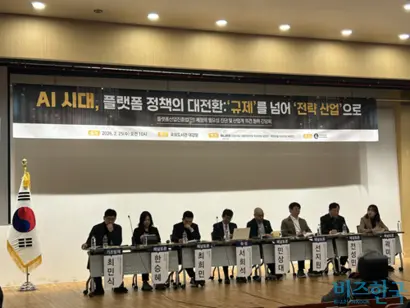
[비즈한국] “Without platforms, there is no data, no artificial intelligence (AI), and no sovereignty over future industries.” At a seminar on the ‘Platform Industry Promotion Act’ held at the National Assembly on the morning of the 25th, Professor Jeon Sung-min of Gachon University’s School of Business Management pointed out that overseas platforms like Google command more than half of domestic internet traffic, arguing that platforms should be elevated to national strategic assets rather than being treated merely as subjects for regulation.
Large-scale Investments Halved… “Alarm Bells for the Paradox of Regulation”
Professor Choi Min-sik of Kyung Hee University’s Graduate School of Legal Affairs, who delivered the keynote speech at the seminar, emphasized, “Most of the 19 platform-related bills proposed in the 22nd National Assembly are focused on regulation,” highlighting the urgency of enacting a Platform Industry Promotion Act that supports technological innovation and global expansion in the industry.
According to a Startup Alliance report, the share of large-scale investments of 10 billion won or more in platform startups fell by half, from 17% in 2021 to 8% in 2023. Professor Choi explained, “Major countries are making the protection of their own platform industries their top priority through policies and legal systems to preempt leadership in the digital economy.” In particular, as the world enters an era of ‘State Platform Capitalism,’ where platforms are managed and fostered as the core foundation for technological and industrial competitiveness, he diagnosed that enacting a basic law that balances regulation and promotion is urgent.
The seminar was hosted by ‘Unicorn Farm,’ a National Assembly startup research group, and organized by Startup Alliance. Industry, academia, and government officials gathered at the site to continue discussions on shifting the direction of domestic platform policy, which has been approached from a regulatory perspective, toward ‘promotion.’
The proposed ‘Platform Industry Promotion Act’ consists of 4 chapters and 19 articles. It features provisions for supporting the small and medium-sized platform ecosystem (Article 10), activating startups (Article 11), fostering specialized talent (Article 12), and supporting technological innovation (Article 13), while also including self-regulation (Article 18) and dispute resolution (Article 19) systems to protect users.
Platforms Are Industrial Infrastructure, ‘Differences in Perspective’ on Win-Win Solutions
In the panel discussion, specific suggestions were made regarding the effectiveness of the bill and the importance of self-regulation. Professor Seon Ji-won of Hanyang University Law School pointed out the side effects of government-led regulation. Professor Seon observed, “The current platform industry is not only technology-intensive but also an environment where self-regulation can be effectively implemented through dynamic user reactions.” She added, “The premise that the government leads self-regulation is inherently contradictory. As seen in the past case of the Game Industry Act, once the government intervenes, market-led self-regulation inevitably loses its momentum. We need trust in the active reactions of users and the choices of the market.”
Choi Hee-min, CEO of Lapo Labs, representing the industry, cited an example of data sovereignty. Lapo Labs, the operator of the fashion platform for women in their 40s and 50s ‘Queenit,’ is a startup that signed an acquisition contract for SK Store late last year and is currently undergoing related procedures, such as approval for a change in the major shareholder. CEO Choi explained, “Major overseas AI models are becoming standardized, reducing differentiators, and ultimately, ‘local data’ will be the deciding factor. Korea’s unique seasonal fashion data is a core competitive advantage that only domestic platforms can possess.” The explanation is that without platforms, it is difficult to find touchpoints with customers even with AI technology.
Regarding the settlement issue, she emphasized, “Platforms do not view the money to be paid to sellers as their own funds. Currently, self-regulation is working well, but even if regulations are introduced, the autonomy of operational methods, such as depositing funds in financial institutions, must be left to the platforms.”

On the other hand, small business owners requested sophisticated system design for mutual growth, such as managing settlement cycles. Min Sang-dae, head of the Digital Merchants Association representing the merchants, emphasized, “Over 95% of domestic small businesses are workplaces with fewer than 10 employees. When they reach sales of around 10 billion won, they show signs of shrinking again. Platforms are incubators for small business owners, but shortening the settlement cycle, even through regulation, is vital for the survival of micro-enterprises with fewer than 10 people.”
Han Seung-hye, a researcher at the Korea Internet Corporations Association, requested flexible legal design considering the welfare of the entire ecosystem, stating, “The ‘paradox of regulation,’ where startup investment shrinks, is appearing in Europe, which implemented strong big tech regulations.” Professor Jeon Sung-min analyzed, “As 9 out of 10 domestic startup business plans claim to be platforms, securing platform sovereignty is a survival strategy for the next generation.”
The government agrees on the necessity of a promotion act but is currently reviewing overlaps between statutes. Since existing laws, such as the Special Act on Information and Communication Technology Promotion and Convergence Activation (ICT Convergence Act), already cover a significant portion of support for platform companies, the government's policy is to carefully examine the relationship with existing laws.
While the ICT Convergence Act provides general support for technology, this proposed promotion bill is distinct in that it legalizes platform-specific ‘data virtuous cycles’ and ‘win-win cooperation with partner firms.’ The ‘On-Platform Act,’ centered on the Fair Trade Commission, is evaluated as being too focused on transaction fairness to encompass the big picture of industry cultivation.
Kwak Mi-kyung, head of the Digital Platform Team at the Ministry of Science and ICT, explained, “We believe that platforms should not only be viewed as subjects of regulation but that promotion perspectives should also be considered legally, and we are reviewing it as a policy research task. Since the On-Platform Act alone cannot cover the entire platform industry promotion, a promotion bill is also worth considering. However, whether a separate platform promotion bill is essential is a matter that needs further discussion.”
Lee Ki-dae, co-representative of Startup Alliance, emphasized, “Companies like Twelve Labs, which target the global market with a usage-based billing method, are also platform companies. A healthy platform ecosystem is necessary for the virtuous cycle of data and services, which can lead to a leap in Korea’s AI competitiveness.”
Kim Han-kyu, a member of the Democratic Party and co-representative of Unicorn Farm, expressed concern about the discussion landscape solely focused on platform regulation, which has been reignited by events such as the ‘Coupang situation.’ Rep. Kim stated, “If individual incidents dictate the policy direction of an entire industry, the limitations are clear. For solutions to be sustainable, strategic policy design that simultaneously considers the long-term development direction and growth structure of the platform industry must be accompanied.”