

[비즈한국] At the DSK26 exhibition held at BEXCO in Busan from the 25th to the 27th, LIG Nex1 unveiled the AI swarm drone developed in collaboration with the Agency for Defense Development (ADD). The AI-based loitering munition system incorporating this swarm drone is referred to as 'Air Sword', though the individual airframe itself is not called Air Sword. LIG Nex1079550 is participating in the system integration and AI development aspects of this project.
The AI swarm drone is the first military drone to feature applied Physical AI technology. By enabling dozens of AI drones to be launched from a single small truck and operate organically—much like a living organism—to search for and attack targets, this technology has the potential to become a 'game changer' that could alter the landscape of drone warfare.
The Air Sword drone is part of a project led by the Agency for Defense Development titled 'Research on AI-based Swarm Drone Control Technology,' which has been underway since November 2022. The objective of this project is to verify swarm drone technology that utilizes AI for military purposes. Currently, most small drones in operation are remotely piloted; if communication between the pilot and the drone is severed, the mission fails. To resolve this, countries are researching 'Physical AI' to allow drones to identify targets independently. However, drones have historically faced limitations in mission capability due to their smaller size compared to manned aircraft.
The solution to these fundamental issues is 'swarm AI technology.' By applying Physical AI, where each drone searches for targets independently, and then enabling multiple drones to exchange information as if they were a single entity, the overall mission performance is significantly enhanced compared to a single AI drone.
For example, when searching for enemies in a specific area, multiple drones can efficiently divide the search zone to drastically reduce search time. Even when under enemy attack, they can form optimal defensive formations to minimize damage. Furthermore, by enabling direct peer-to-peer communication between drones, they can maintain a stable network even if an enemy uses electronic jamming to disrupt the link to one of the drones.
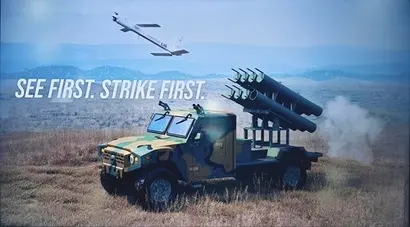
The Air Sword drone unveiled by LIG Nex1 is the prototype designed to demonstrate these capabilities. A small tactical vehicle can carry eight Air Sword drones; once launched, the drones form search formations and use autonomous flight technology to configure optimal patterns. During this process, the autonomous flight algorithms not only conduct target searches but also prevent collisions between friendly drones.
Once an Air Sword drone detects an enemy, it enters attack mode. The system automatically determines whether the detecting drone should strike immediately or wait for support from subsequent drones. Once a drone is assigned the attack mission, it carries out a suicide strike, while the remaining drones conduct a Battle Damage Assessment (BDA). If the attack fails, they prepare for a follow-up strike; if successful, they transition to searching for other targets.
This 'swarm attack' is not limited to just a few units. According to LIG Nex1 and ADD, the Air Sword drones are expected to be organized into groups (squadrons) identified as A, B, C, D, etc., with the ability to communicate between swarms to allocate missions among the various groups.
The swarm collaboration project is divided into three parts. LIG Nex1 is responsible for the first and second parts, while Hanwha Systems272210 is responsible for the third.
In terms of exterior design, the Air Sword resembles large loitering munitions like the American 'Switchblade 600.' It can fly for over an hour, strike targets 50 km away, and is equipped with HD-resolution electro-optical and infrared cameras, as well as a warhead capable of destroying armored vehicles. The mechanism of folding and unfolding wings is also similar to the Switchblade.
However, the true core of the Air Sword drone lies in its invisible software. Because the Physical AI allows the drones to communicate and carry out missions autonomously, it is expected to possess significantly superior mission performance compared to existing attack drones.
According to an official, all tasks for the Air Sword drone are scheduled for completion by this November, with its AI swarm capabilities being verified through approximately 30 flight tests.