

[비즈한국] It has been confirmed that the major pharmaceutical company Chong Kun Dang185750 recently purchased land adjacent to Bongeunsa Station in Samseong-dong, Gangnam-gu, Seoul, for 50 billion won. This small plot of land is located in the heart of the Gangnam business district and was once subject to plans for high-density development. With recent shifts in the pharmaceutical and biotech industry toward establishing bases in the Gangnam area, interest is growing regarding the rationale behind Chong Kun Dang's land acquisition. A Chong Kun Dang representative stated, "We are currently reviewing ways to utilize the site."
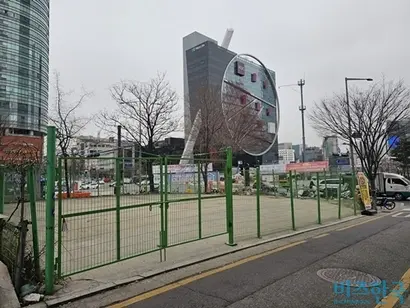
According to real estate industry sources and the property register, Chong Kun Dang purchased the land near Bongeunsa Station in Samseong-dong, Gangnam-gu, Seoul, on the 12th for 50 billion won. The transaction price per 3.3㎡ is approximately 500 million won, which is evaluated as one of the highest among land transactions in the area. The traded land is a 326㎡ (approx. 100 pyeong) plot adjacent to the Bongeunsa Station exit; it was previously used as a parking lot and has since remained vacant. Chong Kun Dang completed the transfer of ownership two months after signing the sales contract in December of last year. Given that no mortgage was established, it appears the purchase price was paid in cash.
The site acquired by Chong Kun Dang has potential for high-density development in the future. Although the land area itself is not large, industry experts suggest that high-rise construction is possible given the high floor area ratio permitted in the Gangnam business district. In fact, around 2012, there was an attempt to develop the site into a building with 4 basement levels and 14 above-ground floors (with a total floor area of 3,068㎡). While development permits were obtained, it is reported that the project did not proceed to actual construction. This area holds high development value as a business and MICE hub, located near COEX, the World Trade Center, and the planned Hyundai Motor Global Business Center.
Recently, there has been a trend of pharmaceutical and biotech companies relocating their bases to the Gangnam area in Seoul. Previously, ABL Bio298380 acquired a building in Samseong-dong, Gangnam-gu, Seoul, for approximately 65 billion won in 2023 and relocated its headquarters there from Pangyo Techno Valley last April. HLB Group028300 also purchased a building in Nonhyeon-dong, Gangnam-gu, Seoul, for approximately 91.5 billion won in 2024, moving its major subsidiaries into the space in December of last year. This trend is interpreted as a result of the perception that a Gangnam location is advantageous for securing high-end research personnel and improving accessibility for external collaborations and investors.
A representative for Chong Kun Dang only said, "How we will use the site is still under review and has not been finalized yet."
Chong Kun Dang's recent performance has been generally favorable. Last year's consolidated revenue was 1.6924 trillion won, an increase of 106 billion won (7%) compared to the previous year. Total assets grew by 339.4 billion won (23%) to 1.7982 trillion won. The debt ratio is around 79%, maintaining a stable financial state so far. Conversely, operating profit last year fell by 19% to 80.6 billion won, and net profit decreased by 30% to 77.8 billion won. The company explained that the profit decline was due to an increase in selling, general, and administrative expenses and R&D costs, as well as a base effect from the corporate tax refund received the previous year.