

[비즈한국] SETI began with the bold goal of finding signals that might be leaking from extraterrestrial civilizations outside of Earth. Unfortunately, it has come to an end without any significant breakthroughs. One of the most famous aspects of SETI was the SETI@home project, which sought to analyze vast amounts of radio signals by borrowing the idle time of computers around the world. Recently, the final analysis results of that massive, decades-long project were released! Surprisingly, several suspicious signals were discovered.
Astronomers collected many radio signals from across the universe using the now-collapsed Arecibo radio telescope. While most were caused by natural phenomena, there may have been artificial radio signals from the extraterrestrial civilizations we are searching for mixed in among them. For a long time, the work of automatically analyzing patterns and filtering out suspected artificial signals continued. However, the sheer volume of data was too massive, making it difficult to analyze efficiently with limited computational resources. Thus, astronomers launched the SETI@home project in 1999, utilizing the computers of many citizens around the world as a distributed resource.
At the time the researchers at the University of California, Berkeley were attempting to analyze SETI data, distributed computing technology was just being researched. So, the team launched the SETI@home project with the help of earthlings. Within just a few days, over 200,000 people from more than 100 countries who wanted to find extraterrestrials downloaded the program. Within a year, the number of alien hunters exceeded 2 million. During the idle time when people weren't using their computers and screensavers were active, individual computers searched for alien signals.
Over the past 20 years, more than 12 billion signal data points have been collected. From these, natural signals are filtered out first to find artificial ones. In particular, they focus on phenomena where strong radio signals suddenly leak out over a very short time. This is because such things cannot be easily explained by common natural phenomena. Of course, not all such signals are made by aliens. The vast majority are human signals. There are also signals mixed in from satellites or background city noise. Just as city lights drown out starlight, Earth's sky, which has undergone rapid urbanization, is a world full of loud noise even for radio telescopes. One must find the faint signals of aliens that have snuck in through such noise.
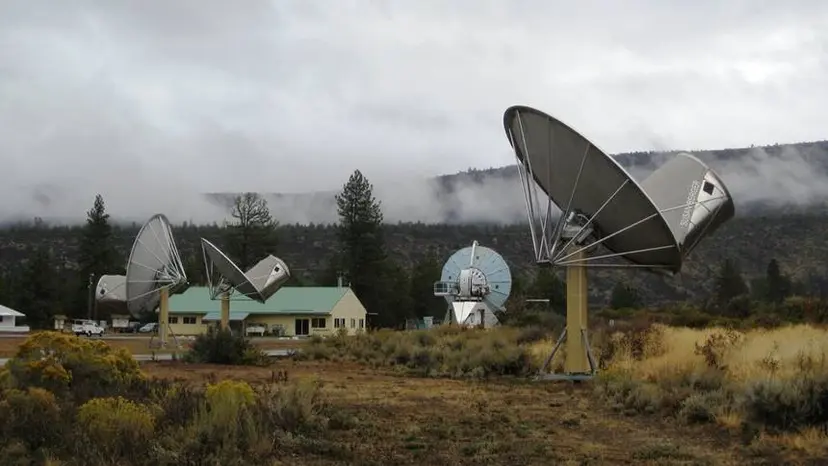
Recently, it has been discovered that strong radio flashes can also leak out momentarily from natural phenomena. These are celestial objects like supernova explosions or gamma-ray bursts occurring in the distance. Therefore, even if they aren't actual signals from extraterrestrial civilizations, they can create false-positive signals that look like suspicious ones. Of course, in these cases, traces are left behind that can be observed not only in radio waves but also in other electromagnetic wave ranges of adjacent wavelengths. Therefore, when a radio signal is captured, by checking if other light such as gamma rays or X-rays were detected from a similar direction, one can determine whether it is a natural signal accompanied by an explosion or a truly inexplicable artificial signal.
Before analyzing the signals, the research team first trained the system with 3,000 fake signals, known as "buddies." Based on this, they filtered out those strongly suspected of being fake signals before analyzing the remaining ones. A thorough and arduous analysis continued for 20 years. Out of 12 billion signals, 1 million were filtered out, and from those, 1,000 more suspicious ones were selected. Finally, 100 final candidates were chosen. These are the most promising signals.
First, these are signals captured in the correct frequency range that astronomers had hoped for. At the time the SETI project began, astronomer Frank Drake estimated that there was a high probability of extraterrestrial civilizations communicating via radio waves near the 21cm (1420MHz) neutral hydrogen line. Because hydrogen is the most common element in the universe, it is a marker that can be used universally everywhere. Therefore, a technological civilization would inevitably be aware of the existence of these radio waves. It is also easy to share frequency standards. If there are alien species that have succeeded in communication between different civilizations, it is highly likely that they would first utilize this universal radio wave. Furthermore, this radio wave is a light that can travel across the Earth's atmosphere without being blocked, and it is a light that is not easily absorbed or scattered by interstellar matter, making it advantageous for communicating across long distances.
Also, astronomers focused on pulsed signals that seem to fly with intent, rather than radio waves that explode just once. Meanwhile, if an extraterrestrial civilization exists, there is a high probability that it is on a planet orbiting a central star. If so, the planet's radio signal should show a regular Doppler effect. As the planet orbits its star, the radio signal observed from Earth would regularly experience redshift and blueshift. If such regular changes are also occurring, it can be suspected all the more to be a signal of an extraterrestrial civilization. There are as many as 100 promising signals that have survived these stringent conditions.
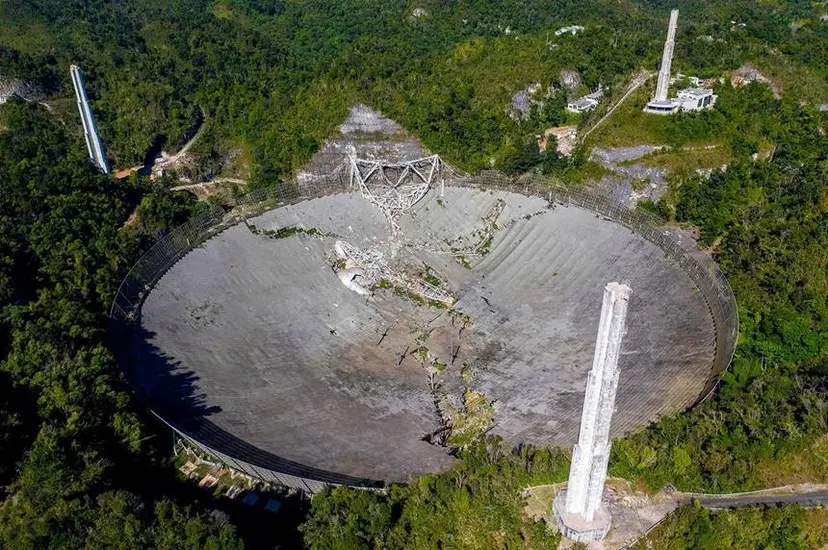
Now, these 100 signals must be analyzed more systematically. Unfortunately, the Arecibo telescope has collapsed and been decommissioned. Instead, other massive radio telescopes on Earth can take over the remaining roles. Astronomers are currently searching for other similar signals using FAST, a massive 500m-diameter radio telescope in China. FAST is eight times more powerful than the Arecibo telescope. Therefore, they will perform precision observations for 15 minutes each on the 100 final candidate signals filtered through this analysis, looking back in the direction they came from with FAST. They plan to finally filter out the signals that can only be considered artificial. The final results of the FAST observations are expected to be announced before long.
Of course, it is necessary to mentally prepare so as not to be too disappointed when the final results come out. There have already been many cases where people were excited for a moment and then disappointed. The famous Wow! signal incident also never had its identity precisely determined and remains a mystery. Over the past few years, various speculations have emerged—such as it being a comet passing through that part of the sky by chance, a signal from a satellite reflected in the Earth's atmosphere, or seeing radio waves from another star—but now that time has passed, it is almost impossible to verify its identity. The most important reason it is difficult to know the identity of the Wow! signal is that it has never been captured again since the first sighting.
That is exactly why a systematic, global, and large-scale search is urgent. It is not enough to just catch it by luck in one place; it must be caught simultaneously in at least two or three places to verify the signal and identify its nature. Now, the mission to search for signals from extraterrestrial intelligent civilizations has moved from SETI to Breakthrough Listen. Inheriting the unfulfilled dreams and spirit of SETI, they are listening to the signals of the universe on a larger scale to realize those dreams instead.
Many astronomers expect that with the soon-to-be-completed large-scale radio telescope array SKA, combined with artificial intelligence technology, the day will soon come when we can at least talk about whether or not this search for extraterrestrial intelligent civilizations is a worthwhile endeavor. Do extraterrestrial civilizations really exist? And will the day ever come when we can be truly certain about their existence? It might be a useless endeavor, but perhaps such "useless" work is exactly what makes it interesting.
When the SETI project was first launched, there were only six people on staff. Many of the data collected in the beginning were often discarded without even being properly analyzed. Perhaps signals from an extraterrestrial civilization were already coming in back then, but they might have been missed by a hair's breadth due to insufficient budget and resources. Searching for extraterrestrial civilizations and confirming their existence clearly requires a lot of time, effort, and energy. Is confirming their existence truly such a valuable and important task? If we don't find them, it will end up as a futile waste of effort, but if we eventually find them, it will be remembered as the most valuable challenge in history. Ultimately, that fate depends on the final success of this project.
Reference
https://www.science.org/content/article/scienceadviser-final-spark-seti-home
About the author, Ji Woong-bae? He loves cats and the universe. After watching 'Galaxy Express 999' as a child, he developed a dream of making the beauty of the universe known. He is currently an assistant professor in the Faculty of Liberal Arts at Sejong University, participating in various science communication activities such as lectures and writing. He has authored books including 'Every Day a Piece of the Universe', 'Scientists of the Starry Universe', 'Things You Can't Go To But Can Know', and 'Strange Questions That Come to Mind When Looking at the Universe', and has translated books such as 'The Hitchhiker's Guide to the Real Universe', 'How I Killed Pluto', 'Quantum Life', and 'Cosmigraphics'.