

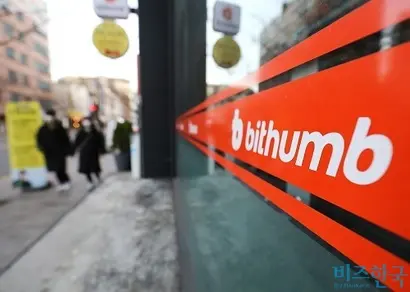
[비즈한국] From 170 million won to 95 million won. The price of Bitcoin, the 'leader' of virtual assets, has plummeted by over 40%. In the midst of this, the ugly truth of chronic 'internal control risks' has been exposed at virtual asset exchanges. An incident occurred at the major domestic exchange Bithumb where Bitcoin was erroneously distributed. In the market, there is talk of a potential 'stablecoin dominance' scenario, where stablecoins issued or managed by bank-level financial institutions could become the mainstream instead of highly volatile assets.
"Exchanges are not banks"
The crux of this Bithumb incident is that it demonstrated that the internal control standards of a virtual asset exchange can be shaken by system errors, employee negligence, or simple mistakes. This is hard to imagine at traditional commercial banks, which operate under strict regulations and oversight. While the government has previously mandated that virtual asset exchanges only allow the trading of 'actually owned coins,' critics argue that the fact that Bitcoin was actually transferred due to a simple employee error highlights the limitations of the current system.
As trust issues regarding virtual asset exchanges continue to be raised, there is a growing call for a U.S.-style approach that incorporates stablecoins into the institutional framework, mandating 'bank-level trust.' The U.S. 'Clarity for Stablecoins Act' includes provisions requiring stablecoin issuers to maintain capital adequacy and strict disclosure obligations equivalent to those of commercial banks. This aims to imbue stablecoins with responsibilities akin to those of 'currency,' rather than viewing them simply as 'coins.'
To this end, U.S. authorities plan to mandate that 100% of reserves be held in safe assets. They also intend to build a real-time monitoring system to ensure that issuers are actually depositing dollars or government bonds in banks proportional to the coins they issue.
The U.S. Government's Choice for 'U.S. Treasury' Demand
Behind the U.S. move to strengthen stablecoin regulation lies a strategic motive: to create demand for U.S. Treasuries through the digital asset market and solidify the dollar's hegemony. Currently, most dollar-pegged stablecoin issuers hold massive amounts of U.S. Treasuries as reserves to collateralize the value of their coins. In a situation where demand from traditional buyers of U.S. debt, such as China, has decreased, revitalizing the stablecoin market has the effect of securing 'new demand for Treasury bonds' for the U.S. government.
From the perspective of the U.S. government, as private issuers and exchanges attain bank-level credibility, the scale of stablecoins will grow, leading to increased U.S. Treasury purchases, which in turn allows the global digital financial ecosystem to remain centered on the dollar.
In Korea, the analysis suggests that if exchanges fail to meet bank-level security and internal control guidelines, stablecoin models issued or managed directly by banks will be discussed as a future alternative.
Bank of Korea: "Internal control requirements must be strengthened"
The Bank of Korea (BOK), which has generally been cautious about stablecoins, recently made a strong demand for 'strengthened control requirements' in connection with the Bithumb Bitcoin misallocation incident. In response to a written inquiry from Rep. Cha Gyu-keun of the Rebuilding Korea Party on the 18th, the BOK stated, "It is necessary to ensure the safety of the issuance and circulation of won-pegged stablecoins," and pointed to the Bithumb incident. It is rare for the BOK to issue a specific position on a virtual asset financial accident.
Currently, the Democratic Party of Korea and the government are in the final stages of coordinating the second phase of digital asset legislation. The BOK's firm stance is interpreted as an attempt to emphasize the importance of institutional design from the perspective of financial stability. Regarding this incident, the BOK pointed out, "While it primarily stemmed from human error, the core cause was the lack of internal control mechanisms to prevent such operational risks," adding that "similar incidents could occur even with the introduction of won-pegged stablecoins."
The BOK remains firm in its position that the authority to issue won-pegged stablecoins should not be indiscriminately granted to the non-banking sector. Because stablecoins act as a substitute for currency, the BOK is concerned that mismanagement could undermine currency trust and severely impact the effectiveness of monetary policy. The BOK has also proposed installing an organization similar to the U.S. 'Stablecoin Certification Review Committee (SCRC)' to independently review and certify new stablecoins.
Industry insiders note that the biggest driving force behind the stablecoin dominance narrative stems from 'exchange mistakes during a market downturn.' They argue that whenever an exchange fails to follow bank-level guidelines and shows holes in its internal controls, voices in the market call for "the first-tier financial sector (banks) to manage it directly instead."
A virtual asset industry official analyzed, "The virtual asset market has now moved beyond the stage of simple coin trading and is being tested on the stability of its financial infrastructure. Just as the U.S. government is forcing bank-level regulations on stablecoin issuers, the need for a stablecoin ecosystem in Korea will increase in the mid-to-long term, naturally leading to a structure centered on the first-tier financial sector." He added, "While we don't know how long the current downturn will last, if the next bull market arrives, it could be justified by the establishment of stablecoin-centric systems in major countries like the U.S."