

[비즈한국] Companies sometimes make decisions that are difficult to explain based solely on money. Understanding the laws and systems hidden within provides deeper insight into the inner workings. ‘Useful Business Tips (Al-Ssul-Bi-Beop)’ introduces clues to help understand business trends.
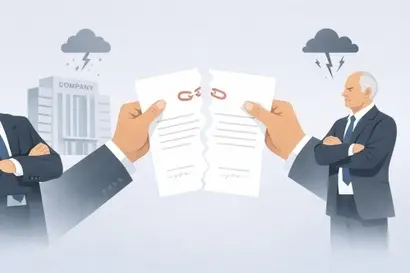
A company may hire an experienced expert from outside as an executive to ambitiously pursue a specific project. However, if performance falls far short of expectations and the company determines there is no practical benefit to maintaining the business, it unfortunately ends up restructuring related personnel and disposing of assets. In such cases, full-time employees are protected by the Labor Standards Act and cannot be dismissed easily simply due to management difficulties.
What about executives who are not regular employees? When the economy is bad, I often receive simultaneous consultation requests from companies asking how to lay off executives, and from executives emphasizing that the failure is not their fault and asking how to maintain the term and compensation conditions of their original executive contract. As each side has its own situation, it is a difficult problem to judge easily.
It is also quite absurd from the executive's perspective, as they generally expect the company to honor the executive contract, which is typically signed for a term of 2–3 years. However, if the company claims it will dismiss them without honoring even that due to worsening management conditions, it is emotionally difficult for the person affected to accept.
When reviewing this, the first thing to establish is that this discussion does not concern employees protected under the Labor Standards Act—that is, executives whose status as 'workers' is recognized. While titles such as 'Director' may be on their business cards, this is often just for external relations or appearances, and they are in reality often closer to employees subordinate to the company. In such cases, they are subject to the Labor Standards Act regardless of their formal title.
However, for executives who are not workers—meaning both the form and substance align with an executive role—the principles of mandate under the Commercial Act or the Civil Act apply, not the Labor Standards Act. Article 385, Paragraph 1 of the Commercial Act stipulates that 'the general meeting of shareholders may dismiss a director by resolution.' This means that a specific reason is not necessarily required for dismissal. However, it also provides that if a director is dismissed before the expiration of their term without justifiable cause, the director may claim damages from the company for the dismissal.
Article 689 of the Civil Act also stipulates that a mandate contract may be terminated by either party at any time, and if one party terminates the contract at a time unfavorable to the other party without unavoidable reasons, they must compensate for the damages. The former can be interpreted as applying to registered directors, and the latter to non-registered executives. Consequently, a company can dismiss an executive at any time through a resolution at a general meeting of shareholders. However, if there is no justifiable cause, it must bear liability for damages to the director.
The key here is whether a 'justifiable cause' exists, which is determined based on the time of dismissal, and the director claiming damages must prove the lack of such a cause. The damages resulting from dismissal refer to the loss sustained by being dismissed before the expiration of the term, meaning an amount equivalent to the remuneration that would have been received during the remaining tenure had they not been dismissed.
The crux of the matter lies in interpreting what constitutes 'justifiable cause.' The Supreme Court ruling (2004Da25611) summarized the criteria as follows:
1. A justifiable cause under Article 385, Paragraph 1 of the Commercial Act cannot be satisfied solely by the subjective loss of a trust relationship, such as discord between shareholders and the director.
2. A justifiable cause is recognized if the director has engaged in acts contrary to laws or the articles of incorporation, is mentally or physically unable to perform duties as a manager, or has fundamentally lost trust in their management capabilities due to failure in establishing or executing major business plans.
3. It is recognized as a justifiable cause for dismissal before the expiration of the term only when an objective situation occurs that hinders the director from performing duties as a manager.
Based on this judgment, the aforementioned ruling concluded that if a CEO failed to implement even a single part of the company's management plan for a year, displaying a lack of ability in attracting investment, management skills, and general qualifications, it not only made it difficult for the CEO to perform the duties entrusted by the company but also destroyed the human trust between the CEO and the company, leaving no choice but for the company to dismiss the CEO. Therefore, the dismissal was deemed to have a justifiable cause.

Ultimately, the existence of a justifiable cause depends on how one interprets the 'objective situation that hinders an executive from performing duties as a manager.' Courts generally issue rulings that respect the discretion and judgment of the company. For example, the Supreme Court ruling (2004Da47529) held that 'this includes not only cases where the cause for obstruction of duty arises within the director themselves, but also cases where objective management needs arise, such as the need for personnel reduction due to management difficulties like bankruptcy at the company level.' This implies that even if the director is not specifically at fault, a justifiable cause is recognized if there were objective difficulties due to market conditions.
Furthermore, the aforementioned ruling upheld the lower court's decision to dismiss the director's claim for damages by broadly recognizing the discretion of the company or shareholders as follows:
1. The legal relationship between a company and a director is not an employment contract but a contract similar to a mandate. Allowing the dismissal of a director by a special resolution of the general meeting of shareholders under Article 385, Paragraph 1 of the Commercial Act is intended to legally guarantee final corporate control to shareholders—the owners of the company—in a corporation where ownership and management are institutionally separated.
2. In such a situation where the company's fate is at stake, it does not seem unfair from the perspective of the purpose of the mandate or shareholder protection through company rehabilitation to consider that a resolution of dismissal, which signifies termination of the mandate contract based on high-level management judgment due to business necessity, can be made relatively more freely than in the case of subordinate employees, even if there is no specific illegal act contrary to the purpose of the mandate or damage inflicted upon the company.
Lower court rulings also generally recognize broad discretion for companies or shareholders. They have frequently recognized 'justifiable cause' in dismissals and dismissed executive claims for damages; major examples include:
1. Where a director in charge of sales, materials, and costs failed to collect receivables for goods from a client for 7 years, failed to submit quotes to some clients, and failed to perform cost analysis for some items.
2. Where a CEO inappropriately used golf courses for free during working hours and unfairly ordered staff to assign golf reservations at the request of personal acquaintances, ignoring member booking rules.
3. Where a director caused damage to the company by transferring the company's service mark to a third party without any consideration.
4. Where a CEO lost trust in their management capabilities by continuously complaining about salary despite knowing that management conditions had seriously deteriorated due to the COVID-19 pandemic, etc.
Of course, there are cases among lower court rulings that deny a justifiable cause and uphold an executive's claim for damages. These are cases where the company's claims were not objectively proven, appearing to be an unfair ousting.
1. Where a director was dismissed upon management deficits solely on the grounds of being 80 years old.
2. Where a director was dismissed for poor construction order performance, but the company had used the director's licenses to win several projects, the director had diligently performed other tasks for the company outside their unique duty of winning private construction orders, and the company had reappointed the director multiple times over 10 years.
Generally, executives have high levels of experience and recognition, and take great pride in their work. Therefore, they are often very offended and feel aggrieved by a company's demand to abandon their position due to sluggish business or worsening management. On the other hand, companies want to quickly resolve failing businesses and reduce staff. In an era of rapid market changes like today, they judge that waiting until the expiration of a 2–3 year contract is unthinkable.
As I interact with both executives and companies, I find myself receiving consultation requests from both sides with conflicting stances at the same time. It is regrettable that I encounter such cases more frequently than before as the market becomes difficult and the age of executives increases over time. If these issues cannot be resolved amicably and lead to legal battles, it is even more unfortunate for both parties.