

[비즈한국] Whenever real estate policies falter, the first card the government pulls out is taxes. There is an expectation that raising acquisition taxes, increasing capital gains taxes, and strengthening property taxes will dampen speculative demand and stabilize the market. It is also politically easy to explain. The justification of 'curbing speculation' is strong, and tax rate adjustments can be implemented relatively quickly through laws and enforcement decrees. As a result, tax-related measures appear more frequently and prominently than supply measures.
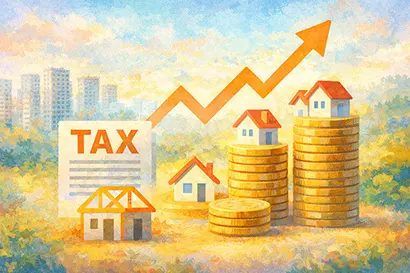
However, the experiences and research of countries around the world repeatedly demonstrate one fact. While taxes can be used to 'partially' suppress certain demand or delay transactions, they are not a panacea for fundamentally stabilizing a market where a structural supply shortage has accumulated. On the contrary, prioritizing taxes without increasing supply is highly likely to exacerbate side effects such as transaction freezes, rising rents, market distortions, and regional polarization.
Policy authorities must now admit that the essence of real estate market stabilization is not 'adjusting tax rates,' but 'advancing the timeline for supply.' Taxes are merely a supplementary tool.
The reason tax policies repeatedly fail is simple. Real estate prices are not determined solely by speculative sentiment. In particular, the housing market in large cities is simultaneously influenced by proximity to work, school districts, transportation, expectations for reconstruction, financial conditions, population movement, income, the structure of the rental market, and regulatory uncertainty. An approach that attempts to "stabilize prices" by merely raising taxes in such a complex market is inherently too simplistic in its design.
Moreover, the effects of taxation vary by tax item. Transaction taxes (acquisition tax, capital gains tax, etc.) tend to act in a way that reduces transactions themselves, while property taxes increase the cost of long-term ownership but can lead to rent pass-throughs or cash flow pressure. The problem is that many governments have ignored these differences and approached the issue with the simplistic framework that 'raising taxes will lower prices.'
The OECD, in its report on housing taxation, also points out that taxation at the transaction stage can increase economic distortions, clearly identifying that transaction taxes are costly in terms of efficiency. On the other hand, it discusses how recurring and predictable property-related taxation can be relatively less distortionary. The key is not 'whether to collect more taxes' but 'what kind of tax to design for what purpose.'
In other words, taxes must be a precise tool. However, in political reality, symbolism often takes precedence over precision. The result is usually the same: the market adapts, policy lags behind, and the damages are borne by actual end-users and tenants.
The effectiveness of demand-side policies depends on supply elasticity
The point that the IMF repeatedly emphasizes after analyzing case studies from various countries is clear. The effectiveness of demand-side policies (including taxes) is ultimately heavily dependent on housing supply elasticity. In markets where supply can increase quickly, demand management can work relatively well, but in markets where supply is blocked, the side effects of suppressing demand are easily transferred into transaction stagnation and rent increases.
This is an uncomfortable truth for policymakers. Taxes can be announced immediately, but supply takes time. It requires a long chain leading through permitting, groundbreaking, project financing (PF), presales, construction, and completion. However, if supply is postponed because it is difficult, the cost is even greater in the end. A few years later, a gap in move-in volume occurs, and the vicious cycle repeats, with the government tinkering with taxes and blaming the market again.
Unless the policy timeline is changed, the same failures will continue.
Lessons from Korea: Strengthening taxes shook transactions, the jeonse market, and regional concentration before prices
In Korea, empirical research supporting this issue is already available. A report by the Korea Research Institute for Human Settlements (KRIHS) analyzed the impact of real estate taxes on the market, suggesting that while increasing acquisition taxes led to a decrease in transaction volume, the price stabilization effect was not significant. The results also indicated the possibility of inducing jeonse (lump-sum deposit rental) price increases alongside downward pressure on sales prices, and the 'lock-in' effect and jeonse price inflation effect of capital gains taxes. In other words, strengthening taxes can, contrary to intention, increase the burden on the rental market.
This point is crucial. While many policies touted 'curbing speculation,' they may have actually functioned by locking up transactions and passing the burden onto tenants. If transaction taxes and capital gains taxes are excessive, those who want to sell cannot, and those who want to buy cannot, which slows down the market's price discovery function. Meanwhile, the jeonse and monthly rental markets become rigid as supply decreases. This is the mechanism repeatedly witnessed in the Korean market.
On top of this, structural changes recently pointed out by the Bank of Korea are overlapping. The Bank of Korea report diagnoses that the concentration of demand in preferred areas like Seoul, population movement between regions, and the strengthening of demand in preferred areas following regulation are among the backgrounds of market differentiation. At the same time, it points out that non-capital regions are seeing high levels of unsold units after completion and a decline in construction volume, leading to a cooling construction sector and increased financial risk. This means that an asymmetric structure—overheating pressure on one side and vulnerability in supply, construction, and finance on the other—is intensifying.
In such a market, tax prescriptions based on a national, monolithic logic are even more dangerous. What happens is that demand holds firm in core Seoul areas, while transactions dry up in non-capital regions. Consequently, taxes may work to deepen 'market polarization' rather than 'market stabilization.'
The price of delaying supply: The numbers eventually return as a backlash of supply shortages
As the tax debate heats up, more important figures are obscured: permits, groundbreakings, and completions. Even if you change taxes today, housing supply does not appear tomorrow. Permits and groundbreakings from several years ago create today's move-in volume.
Looking at the Ministry of Land, Infrastructure and Transport and related reports, housing permits, groundbreakings, and completion indicators in 2024 showed a generally sluggish trend, with the decrease in groundbreakings being particularly sharp. This inevitably leads to supply shortage pressure over time. In fact, in 2025, a flow appeared where the government announced both demand suppression and supply expansion plans against the backdrop of supply concerns and price pressure in the metropolitan area. It is as if even policymakers now acknowledge the reality that 'demand alone cannot be suppressed.'
The problem is always the order. Supply is slow, and taxes are fast. Therefore, the policy fits short-term political schedules but not the market's clock. As a result, the public experiences greater volatility.
If the goal of real estate policy is truly 'market stabilization,' the solution is clearer than one might think. It is not about eliminating taxes; it is about normalizing the role of taxes and making the role of supply paramount.
"Curbing house prices with taxes" is easy to say, but the public pays the price
Policies should be evaluated by results, not by justifications. Whenever the strengthening of taxes is announced, the market freezes, and a few months later, the burden of rents and concerns about supply rear their heads again. Then, another tax card comes out. If this vicious cycle is not ended, real estate policy becomes a policy that amplifies volatility rather than one that stabilizes it.
Both global examples and Korea's experience tell the same conclusion. Taxes may be effective in suppressing specific demand, but that effect is usually limited and temporary. When supply is blocked, the side effects of taxes appear more severely.
Ultimately, the core of market stabilization is the speed and predictability of supply. If the government truly wants to stabilize housing prices, it must discard the habit of using taxes as a tool for 'political declarations.' Necessary taxes should be designed precisely, predictably, and with minimal distortion, and the majority of policy capabilities should be invested in expanding supply and improving business speed.
The real estate market moves on supply curves, not tax tables. As long as this simple truth is ignored, no government will be able to stabilize house prices.
Kim Hak-ryeol, also known by his pen name Pasion, is the director of the Smart Tube Real Estate Research Institute and a former team leader at the Korea Gallup Real Estate Research Division. He operates and hosts the Naver blog 'Pasion's World Exploration' and the YouTube channel 'Stew TV.' He is the author of books including 'Rewriting the Korean Real Estate User Manual (2025),' 'The Power of Gyeonggi-do Real Estate (2024),' 'Absolute Principles of Seoul Real Estate (2023),' 'The Future of Incheon Real Estate (2022),' 'Kim Hak-ryeol's Absolute Principles of Real Estate Investment (2022),' 'Future Map of Korean Real Estate (2021),' and 'From Now On, Only Places That Will Rise Will Rise (2020).'