

[비즈한국] The market reacted immediately after a regulatory filing revealed that BlackRock, the world's largest asset manager, had acquired a stake of more than 5% in SK Hynix000660. On February 20, BlackRock disclosed through the Financial Supervisory Service's electronic filing system that it holds 36,407,157 shares of SK Hynix, representing a 5.0% stake. The base date was February 10, and the disclosure obligation was triggered as the stake exceeded the 5% threshold.
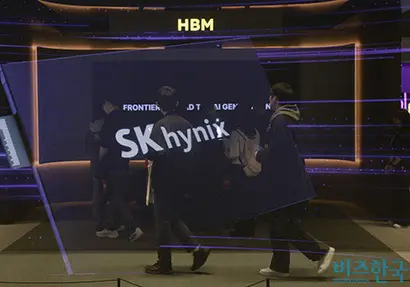
This disclosure is more than just news that a “big player has entered.” The fact that BlackRock holds a stake of over 5% in SK Hynix for the first time in about 7 years and 9 months, since May 2018, is symbolic. The market interprets this as a signal that expectations for the semiconductor industry cycle and expectations for structural reforms in the Korean capital market (policy) have begun to align in the same direction. In fact, on the day of the disclosure, SK Hynix's stock price hit a new intraday high, and reports followed that the KOSPI also reacted strongly due to the nature of the stock, which has a significant impact on the index.
BlackRock's investment is classified as a “simple investment” rather than “management participation.” It is reported that BlackRock increased its stake through open-market purchases and that its holdings consist of 14 entities, including specially related parties. However, it is difficult to dismiss the market's interpretation as an exaggeration. Global asset managers with a strong passive fund nature simultaneously look at whether “a national market has the conditions to reduce its discount” and “whether the country's flagship industry has entered an earnings cycle.” This is why the timing of BlackRock crossing the 5% threshold in SK Hynix ‘now’ is attracting attention.
The policy axis centers on the ‘Value-up’ program. The Korea Exchange (KRX) has been operating a system that allows companies to voluntarily disclose ‘Corporate Value Enhancement Plans,’ and reported that as of the end of January 2026, the number of cumulative disclosing companies has increased to 177 (131 KOSPI, 46 KOSDAQ). On January 22, 2026, the exchange revised its guidelines and commentary, lowering the threshold to allow disclosures based on qualitative goals, such as growth strategies and directionality, if presenting numerical targets is difficult. This suggests that the Value-up program is shifting from a “do-this, don't-do-that” regulation into a flow where it spreads as a “structure of being evaluated through communication with the market via disclosure.”
The point where Value-up influences foreign capital is ultimately ‘shareholder returns.’ Monthly status reports released by the exchange mention significant return movements, such as SK Hynix's decision to cancel a large amount of treasury shares (12.2 trillion won) and its cash dividend plan, as well as Samsung Electronics’005930 treasury share acquisitions and dividends. As domestic companies accumulate data on “what they return to the market when performance is good,” the logic for a re-rating (valuation upgrade) of the Korean market becomes much clearer to foreign investors. Particularly, as semiconductors are an industry where cash flow improves rapidly when the industry outlook is positive, the visualization of return policies is likely the ‘final puzzle piece’ of investment logic.
Added to this is the possibility of institutional change, specifically the “mandatory cancellation of treasury shares.” On February 20, the Legislation and Judiciary Committee's Subcommittee on Bill Review at the National Assembly passed the so-called 3rd Commercial Code Amendment, which centers on the principle that newly acquired treasury shares must be cancelled within one year, and existing treasury shares must be cancelled within one year and six months after the law takes effect. Although the final stage of legislation remains, the market reads this as a signal that “treasury shares are being reorganized from ‘storage sheds’ for defensive control into a tool for shareholder returns.” This flow is highly consistent with the Value-up program and is close to the “predictable rules” favored by global institutional investors.
The reform of KOSDAQ delisting moves within the same frame. The government announced that it would operate an intensive management period from February 2026 to June 2027, with the goal of prompt and strict exit for insolvent KOSDAQ companies, and would gradually strengthen delisting requirements such as raising market capitalization thresholds and clearing out ‘penny stocks’ (stocks under 1,000 won). The point is that “we will no longer let zombie companies that survive solely by being listed linger in the market.” While this is a shock in the short term, it can be interpreted as a structural reorganization aimed at restoring market confidence and reducing the discount in the long term. Foreign capital usually moves more significantly when the ‘market structure’ changes than when individual stocks do.
Ultimately, BlackRock's 5% disclosure is more of a signal that both axes have started to turn simultaneously—not just because “semiconductors are good” or “policy is good.” The Seoul Economic Daily reported that BlackRock's return to a 5% stake in SK Hynix is the first since 2018, citing analysis that semiconductor valuation (e.g., PER) burdens are relatively low, indicating that “industry outlook expectations” are growing. The Chosun Ilbo also reported on the trend of optimism regarding investment-friendly measures being reflected in the index, along with the fact that BlackRock has returned as a top-4 shareholder.
However, one should be cautious about accepting this signal as a ‘certainty.’ BlackRock disclosed this for simple investment purposes only, and the 5% report does not imply active management participation. While the policy direction is clear, market evaluation may vary depending on how consistently companies actually implement returns and governance improvements. Nevertheless, the reason this disclosure is becoming the subject of weekend commentary is clear: as a ‘yes’ has started to attach simultaneously to the key questions foreign capital asks when looking at the Korean stock market—“Is the discount structurally reducing?” and “Are earnings in the flagship industry increasing?”—BlackRock's return to 5% carries more weight than just a simple stake disclosure.