

[비즈한국] The U.S. Supreme Court has ruled that the Donald Trump administration's 'Reciprocal Tariffs' are illegal. The court determined that the President's imposition of tariffs based on the International Emergency Economic Powers Act (IEEPA) exceeded the scope of his legal authority. The White House immediately issued an executive order imposing a temporary 10% tariff on all global imports, citing Section 122 of the Trade Act. While this ruling puts the brakes on the Trump administration's broad tariff policy, concerns remain that uncertainties have only deepened.
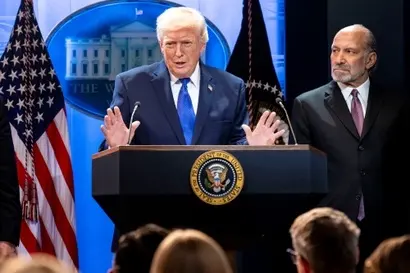
On February 20 (local time), the U.S. Supreme Court issued a 6-3 ruling declaring the reciprocal tariff policy illegal. The Supreme Court emphasized that under the Constitution, the authority to impose taxes, including tariffs, lies with the legislature, not the executive branch. This means that if the administration is to unilaterally implement measures with broad economic and political consequences, Congress must specifically delegate that authority.
Furthermore, the court pointed out that the President's 'import regulation' authority based on the IEEPA does not equate to the power to tax, and noted that there is no clear language in the IEEPA regarding the imposition of tariffs. While the IEEPA allows the President to regulate foreign transactions during an emergency, it does not explicitly mention imposing tariffs.
President Trump and the White House took immediate action following the ruling. The White House announced an executive order citing Section 122 of the Trade Act to impose a temporary 10% tariff on all global imports for a maximum of 150 days. Section 122 of the Trade Act is a provision that allows the President to adjust tariffs for a certain period in response to serious balance-of-payments deficits. Congressional approval is required to extend the tariff imposition beyond 150 days. As President Trump signed the order immediately after the ruling, Section 122 will take effect at 12:01 AM on the 24th (local time).
Through Presidential Proclamations, the White House explained that certain items, such as △specific critical minerals, △metals used in currency and gold bullion, △energy products, △pharmaceuticals, △natural resources and fertilizers that cannot be produced in the U.S., △parts for passenger cars, light trucks, medium-to-heavy vehicles, and buses, and △aerospace products, would be excluded from the additional tariffs.
Since April 2025, the Trump administration has defined trade deficits and trade disputes as a national emergency, using the IEEPA to impose broad tariffs on global trading partners. In response, small and medium-sized enterprises and 12 U.S. states filed lawsuits against the U.S. government. With the Supreme Court delivering an illegal ruling following the first and second trials, the 10-15% reciprocal tariffs that had been applied to major trading partners, including South Korea, have been invalidated.
Although the ruling declared reciprocal tariffs illegal, uncertainty remains. President Trump, expressing opposition to the court's decision, mentioned Section 232 of the Trade Expansion Act, Sections 122, 201, and 301 of the Trade Act, and Section 338 of the Tariff Act as alternative means of imposition. Section 232 of the Trade Expansion Act relates to national security, Section 201 of the Trade Act to safeguards, Section 301 to unfair trade practices, and Section 338 of the Tariff Act to retaliation against discrimination against U.S. goods.
The impact on domestic industry is also drawing attention. Industry insiders maintain a stance that as President Trump has mentioned additional measures, the situation remains uncertain and needs to be monitored. For key U.S. export items such as automobiles, semiconductors, and steel, item-specific tariffs are already applied under Section 232 of the Trade Expansion Act, making them unaffected by this invalidation of reciprocal tariffs. Instead, there is concern that the U.S. might use 'pinpoint tariffs' on specific items to fill the shortfall in tax revenue, leading the industry to closely watch the Trump administration's moves.
U.S. stock market indicators also fluctuated following the illegal ruling. Immediately after the news, tech, semiconductor, and consumer goods stocks led a rally, but the market took a cautious turn as the Trump administration responded with Section 122 of the Trade Act. As of the closing price on the 20th, the S&P 500 index rose 0.69%, the Nasdaq 0.90%, and the Dow Jones 0.47%.
The Blue House stated, "We will comprehensively review the details of the Supreme Court ruling and the U.S. government's position to consider a response plan that aligns with the national interest." The government plans to hold a joint meeting on the afternoon of the 21st, presided over by Policy Chief Kim Yong-beom and National Security Advisor Wi Sung-lac, to discuss measures to respond to the invalidation of the U.S. reciprocal tariffs.