

[비즈한국] South Korea's skies have opened the era of 1 million annual flights for the first time in history. As international flight operations have fully recovered from the long tunnel of the COVID-19 pandemic, our airspace is busier than ever. However, behind this glorious record, the long-standing controversy over the 'airspace transit fee,' which has been frozen for 20 years, is resurfacing. Critics point out that the fees paid by aircraft passing through Korean airspace are a 'bargain' that falls far short of international standards.
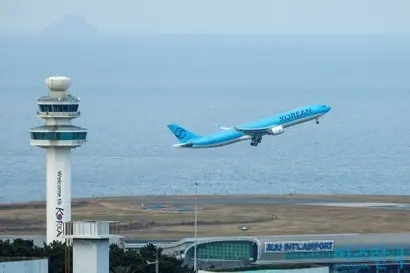
Transit Flights Surged 21%, But Fees Remain at 2007 Levels
According to an announcement by the Ministry of Land, Infrastructure and Transport on the 19th, total air traffic in South Korean airspace reached 1,013,830 flights in 2025. This is a 6.8% increase compared to the previous year and marks the first time the 1-million-flight milestone has been surpassed in a single year. An average of 2,778 aircraft flew through our skies daily, which is about 20% higher than the previous record high of 2019 (approximately 840,000 flights) before the pandemic.
Of particular note is the volume of 'airspace transit' traffic. International flights passing through Korean airspace surged by 21% in 2025 compared to the previous year. Consequently, total revenue from airspace transit fees is estimated to be around 97 billion KRW, hitting an all-time high. The Ministry of Land, Infrastructure and Transport interpreted this as evidence that the strategic importance of Korean airspace as a key aviation hub in Northeast Asia is strengthening.
However, the fees themselves remain at the level of 20 years ago. Currently, South Korea's airspace transit fee (air navigation facility usage fee) operates on a 'fixed-rate system,' where a set amount is charged based on the aircraft type (jet, prop, or piston). For the most common jet aircraft, the transit fee is 157,210 KRW. This rate has not been adjusted even once since 2007, regardless of inflation or increases in facility investment costs.
This fixed-rate system is out of step with the recommendations of the International Civil Aviation Organization (ICAO). The ICAO standard is a 'distance-weight proportional system,' which charges fees based on an aircraft's weight and flight distance. The principle is that as heavier aircraft fly longer distances, the burden on air traffic control increases, and they should pay accordingly.
Compared to neighboring countries, South Korea's fees are significantly lower. Japan, which follows ICAO standards, charges approximately 1 million to 1.2 million KRW when a large aircraft like a Boeing 747 passes through its airspace. This is about 7 to 8 times higher than Korea's rate. Major European countries maintain levels exceeding 2 million KRW. Even North Korea charges an airspace transit fee of about 800,000 KRW. This is the backdrop for why Korean airspace is perceived as a relatively cheap route among airlines.
National Audit Criticism and the Ministry's Cautious Stance

Calls for realistic adjustments to the airspace transit fee have also been raised in political circles. During the 2019 National Audit, then-lawmaker Yoon Ho-joong of the Democratic Party of Korea pointed out that between 2015 and 2019, Korean airlines paid 212.6 billion KRW in transit fees to Japan, while Japanese airlines paid only 8.2 billion KRW to Korea. At the audit, Yoon stated, "South Korea's airspace transit fee is among the lowest of all major countries in the world," adding, "The system must be reviewed and overhauled overall."
At the time, then-Minister of Land, Infrastructure and Transport Kim Hyun-mee responded, "There is an aspect where we could not respond aggressively because any increase in fees resulting from a system reform would impose direct and indirect burdens on airlines and passengers. We will prepare a reasonable plan by comprehensively reviewing international standards, the collection systems of major countries, and the opinions of stakeholders."
However, the airspace transit fee and the fixed-rate system have been maintained to this day. The Ministry remains cautious about reforming the system. The core of the Ministry's explanation is 'protecting national carriers' and the 'possibility of route detours.'
They explain that simulation results suggest that if a distance-weight system were introduced, the financial burden on our national carriers—which often use more of the domestic airspace than foreign airlines—would increase. Currently, over 90% of total airspace transit fee revenue comes from foreign carriers. However, if fees were charged proportional to distance, the logic is that Korean carriers, which often remain in the airspace for longer durations compared to foreign carriers that may make shorter transits, could end up at a disadvantage. The calculation is that while total revenue might increase, Korean airlines might bear a larger portion of that increased total.
The Ministry also raised concerns that because Korean airspace is geopolitically easy to bypass by shifting routes slightly into neighboring airspace or international waters, airlines might avoid Korean control zones if fees are raised. The argument is that if aircraft detour due to cost, total transit fee revenue could actually decrease.
Furthermore, airspace transit fees require coordination with the International Air Transport Association (IATA). IATA examines the total costs paid by an airline, including airport facility usage fees and transit fees, in comparison to the cost of services provided. The Ministry pointed out that raising transit fees could lead to pressure to lower airport facility usage fees, which constitute the revenue of the two airport authorities.
A Ministry official stated, "In Japan's case, transit fees are expensive, but that is due to enormous air traffic control costs, and they are actually operating at a deficit. In the case of North Korea, international aircraft rarely pass through its airspace due to cost and aviation safety concerns." The Ministry maintains that it must comprehensively consider the impact on the industry as a whole, including the burden on national carriers, when deciding whether to change the airspace transit fee system.