

[비즈한국] Since taking office last June, one of the key points President Lee Jae-myung has emphasized whenever discussing the economy is his commitment to rebounding the potential growth rate. However, contrary to the President's pledge to restore the potential growth rate to the 3% range, there is an assessment that it has even fallen below the 2% threshold. There are even forecasts that by around 2056, the potential growth rate will hover at nearly 0%, suggesting that the country's economic engine itself may lose all momentum.
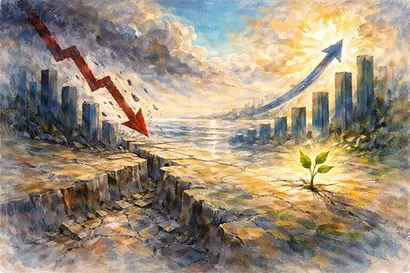
The risk of stalling just on the threshold of becoming a developed nation is increasing. In contrast, the world's largest economy, the United States, is expected not only to have overtaken South Korea in potential growth rate in 2023 but to continue widening the gap. Although President Lee has been encouraging domestic investors who are flocking to U.S. stocks to buy domestic ones, the long-term economic outlook makes this a difficult task. Experts point out that this widening gap in potential growth rates could also complicate efforts to resolve high exchange rate issues.
On January 30, international credit rating agency Fitch maintained South Korea's sovereign credit rating at 'AA-' with a 'stable' outlook. 'AA-' is the fourth-highest rating in Fitch's system, the same as that of countries like the UK, Belgium, and Taiwan. However, Fitch lowered its estimate for South Korea's potential growth rate from 2.1% to 1.9%. Given that the potential growth rate represents the maximum growth achievable by mobilizing all production factors without triggering inflation, this indicates that the growth engine of the Korean economy is cooling down. It also means that if the economy grows by more than 1.9% this year, it could stimulate inflationary pressure.
Fitch’s downgrade is particularly painful given that President Lee has consistently mentioned a target of 3% potential growth, both during his presidential campaign and since taking office. During a meeting with senior secretaries and aides on November 13 last year, President Lee stated, "With the potential growth rate falling by 1% under each administration, we are in a situation where it could soon turn negative," adding, "The greatest task facing the Republic of Korea is to rebound this falling potential growth rate." He further emphasized, "For this, bold structural reform is paramount. We must open a new path for growth and ensure a rebound in the potential growth rate through structural reforms in six core areas: regulations, finance, public sector, pensions, education, and labor."
However, the Organization for Economic Cooperation and Development (OECD) offers an even gloomier outlook than Fitch. According to the OECD Long-term Economic Outlook, South Korea's potential growth rate, which stood at 2.44% in 2022, already fell to the 1% range last year, recording 1.92%. It is projected to decline further to 1.57% by 2027. This downward trend is expected to continue, with the average potential growth rate falling to 1.49% between 2031 and 2035, and further to 1.16% between 2036 and 2040. This figure will fall below 1% during the 2041–2045 period, averaging 0.77%.
The downward trend persists, reaching 0.49% between 2046 and 2050, and 0.42% between 2051 and 2055. Even more critically, between 2056 and 2060, the potential growth rate is expected to plummet to an average of 0.01%, signifying a stage where economic growth effectively ceases. By 2061–2065, the potential growth rate is expected to reach an average of -0.21%, indicating that the economy will begin to shrink. The Korean economic engine is entering a phase where it is not just cooling, but freezing.
A greater concern is the growing disparity in fundamental economic strength—represented by the potential growth rate—compared to the United States. According to the OECD, the U.S. potential growth rate was 2.40% in 2022, which was 0.04 percentage points lower than South Korea's, but it overtook South Korea (2.41%) in 2023 with a rate of 2.44%. The gap is expected to widen further in subsequent years: 2.41% in 2024 (a 0.13 percentage point gap), 2.20% in 2025 (a 0.28 percentage point gap), 2.03% in 2026 (a 0.32 percentage point gap), and 1.95% in 2027 (a 0.38 percentage point gap).
This widening gap will intensify until the 2056–2060 period, when South Korea's potential growth rate drops toward 0% and the U.S. average stands at 1.27%, resulting in a gap of 1.26 percentage points. Unless the Korean economy achieves innovation, it will become increasingly difficult to keep pace with the U.S., which continues to renew its economic engine through cutting-edge industries such as Artificial Intelligence (AI). This undermines policies aimed at inducing 'Seohak ants' (Korean individual investors in overseas stocks) to return to the domestic market and could lead to permanent exchange rate volatility due to the outflow of investment capital.